You’ve seen the price tag.
$300 for a steak.
$100–$350 per pound.
A5 stamped like a luxury brand.
At first glance, Japanese Wagyu looks like the most expensive beef on Earth — and it is. But here’s the real question:
Why are chefs, scientists, farmers, and food lovers around the world willing to pay for it?
The answer isn’t hype. It’s genetics, 30 months of meticulous care, strict government grading, and actual scientific research. Japanese Wagyu isn’t just expensive beef.
It’s a controlled, traceable, cultural masterpiece you can eat.
1. The Genetics: Wagyu Is Not “Just Beef”


True Wagyu comes from only four Japanese breeds:
- Japanese Black (Kuroge Washu – 97% of production)
- Japanese Brown
- Japanese Shorthorn
- Japanese Polled
The highest quality A5 Wagyu almost always comes from Japanese Black cattle.
Since the Meiji era, Japan has strictly preserved bloodlines. Every calf is registered at birth using a unique 10-digit ID linked to its nose print — like a fingerprint. You can trace the animal back to its parents and grandparents.
Prestige brands like:
- Kobe Beef (Hyogo, Tajima lineage)
- Matsusaka Beef (Mie, often virgin female cattle)
- Omi Beef (Shiga, 400-year history)
Only a few thousand cattle qualify each year under additional regional rules.
This genetic control creates extreme rarity — and rarity builds value.
2. 30 Months of Precision Feeding
Most commercial cattle worldwide are grain-finished in about 120–150 days.
Japanese Wagyu?
28–30 months.
Small farms (often under 50 head of cattle) raise each animal carefully. Clean water, stress-free environments, controlled feeding programs.
After 11 months, Wagyu are fed high-energy grain-based diets. Total feed per animal: 4,000–5,000 kg over its lifetime.
Farmers even manage Vitamin A levels carefully to maximize intramuscular fat development.
The result?
- 30%+ intramuscular fat in the ribeye
- Fat melting point: 24–30°C (below body temperature)
That’s why A5 Wagyu literally melts in your mouth.
3. The A5 Grade: The Strictest Beef Standard in the World
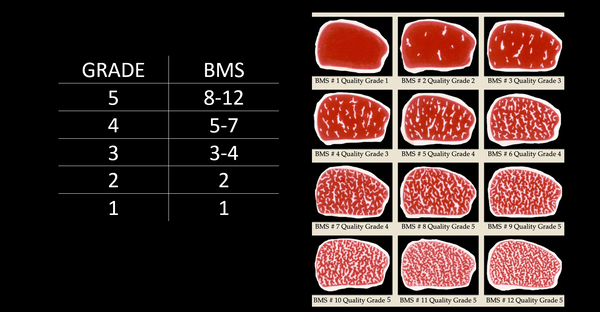


The Japanese Meat Grading Association (JMGA) uses a dual system:
Yield Grade: A–C (usable meat percentage)
Quality Grade: 1–5
A5 means:
- Yield Grade A
- Quality Grade 5
- BMS (Beef Marbling Score) 8–12
Only the top fraction of cattle achieve this.
Kobe beef adds even stricter rules:
- Tajima lineage only
- Hyogo prefecture raised
- Carcass weight under 470 kg
- BMS 6+ minimum
The pass rate is extremely low. That scarcity supports the price.
4. The Flavor: Scientifically Different


Wagyu doesn’t taste like regular steak.
It’s softer. Sweeter. More aromatic.
Scientific analysis shows Wagyu fat contains high levels of lactones, compounds that create peach- and coconut-like sweetness.
Compared to USDA Prime Angus, Wagyu has:
- Far higher marbling density
- More uniform intramuscular fat
- Lower fat melting temperature
That’s why chefs often cook it:
- Lightly grilled with just salt
- Thin-sliced for sukiyaki or shabu-shabu
- Quickly seared to avoid overcooking
Overcook it and you destroy what makes it special.
5. The Health Surprise: “Luxury” Fat That’s Actually Better
Here’s something many people don’t know.
Wagyu fat is 52.9% oleic acid (a monounsaturated fat — the same heart-friendly fat found in olive oil).
Research shows:
- Lower LDL (bad cholesterol)
- Higher HDL (good cholesterol)
- Improved lipid profile compared to conventional beef
Studies (including Sacks et al., Gotoh & Joo) support the idea that Wagyu’s fat composition is metabolically different from standard saturated fat-heavy beef.
Is it health food? No.
But compared to other heavily marbled meats, Wagyu is surprisingly heart-friendly when eaten in moderation.
A rare case where indulgence meets science.
6. Where the Money Actually Goes
Let’s break down cost structure.
- 30-month feeding cycle
- Imported grain (90%+ feed content)
- Small-scale farm labor
- Strict grading & certification
- Export tariffs (e.g., 26.4% into the U.S.)
- Cold-chain logistics
Production costs account for 90%+ of final retail price.
You’re not paying for marketing.
You’re paying for time, genetics, labor, and national standards.
7. Experience Value: It’s Not Meant to Be Everyday Food
A5 Wagyu is not designed to be a 16oz everyday steak.
In Japan, portions are smaller:
- 80–120g per person
- Shared among guests
- Cooked carefully
Because of its richness, even a small serving delivers maximum satisfaction.
It’s not about volume.
It’s about memory.
How to Make Sure It’s Authentic
When buying Wagyu:
- Look for certification paperwork
- Verify cattle ID through Japan’s official traceability database
- Check for official Japanese Wagyu logo
Price Guide (2025–2026):
- Japan: A5 ribeye approx. ¥25,900 per kg
- Overseas retail: $300–$400+ for 10oz A5 Kobe
If it’s cheap, it’s probably not Japanese Wagyu.
Final Verdict: Is It Worth It?
If you want:
- The world’s strictest genetic beef system
- 30 months of artisan farming
- Government-certified A5 grading
- Scientifically unique flavor & fat profile
- A cultural dining experience
Then yes.
Japanese Wagyu isn’t overpriced.
It’s underproduced.
And that’s exactly why it costs what it does.
One bite explains everything.