In late July 2026, the yen fell to its weakest level against the dollar since 1986.
Washington and Tokyo intervened together for the first time in over a decade — and the yen barely moved. For American travelers, that failed rescue is starting to look like a once-in-a-generation opening.
⭐ Bottom Line
As of mid-August 2026 the dollar buys around ¥159 — up from about ¥145 two years ago — after briefly touching a 40-year low near ¥163 in late July. A week in Tokyo that ran close to $2,000 in 2023 now costs roughly $1,750–1,800 for the same hotels and meals.
- Best for: Americans who assumed the “Japan is too popular now” headlines meant it also got expensive
- Exchange rate: ~¥159/$1 as of August 14, 2026 (Federal Reserve H.10 data), down slightly from the July low
- Lock it in: Rates move daily — book flights and prepay hotels now rather than waiting for a “better” week
Search “is Japan expensive in 2026” and the first page is dominated by headlines about record crowds, new tourist fees, and Kyoto’s higher lodging tax. All of that is true. None of it is the full picture. The single biggest number in any Japan trip budget — the exchange rate — has moved further in American travelers’ favor this year than in almost any year on record. In July 2026, the yen fell to its lowest level against the dollar since 1986, and a rare joint intervention by the US and Japanese governments barely slowed the slide.
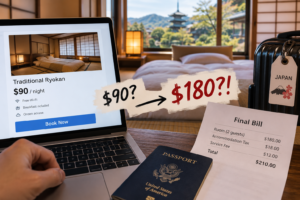
That means the dollars you convert into yen right now buy meaningfully more than they did in 2023, or even in early 2025 — even after the new fees making headlines are factored in. A mid-range Tokyo hotel that ran about $180 a night at 2023 exchange rates costs closer to $158 today for the same room, per current rate data. Multiply that across a week, two travelers, and every meal, and the gap stops being a rounding error and starts being real money.
What Actually Happened to the Yen in 2026
The short version: the yen has been weakening for years, but 2026 pushed it somewhere new. On June 30, the yen slid past ¥160 for the first time since 1986, according to Reuters. It kept falling through July, touching roughly ¥162–163 per dollar — a genuine 40-year low.
On July 31, the US and Japan carried out a rare coordinated intervention — the US buying yen directly for the first time in more than a decade, described by officials as a gesture of support rather than a routine market move. The yen recovered some ground, retracing roughly half its late-July losses. But as of August 14, it was still trading around ¥159 — down about 8% over the past 12 months, and nowhere near its pre-2024 range.
Most guides stop at “the yen is weak.” The next section is where that number turns into an actual trip budget.
What That Means in Dollars: Then vs. Now

Exchange rate moves are abstract until you put them next to a real receipt. Here’s what a typical Tokyo trip’s biggest line items cost at 2023 exchange rates versus where they land today.
| Category | 2023 Rate (~¥145/$1) | 2026 Rate (~¥159/$1) | Approx. Savings |
|---|---|---|---|
| Mid-range hotel, per night (¥25,000) | $172 | $157 | ~$15/night |
| Mid-range dinner, per person (¥4,000) | $28 | $25 | ~$3/meal |
| 7-day JR intercity travel (¥50,000) | $345 | $314 | ~$31 |
| Budget hostel, per night (¥6,000) | $41 | $38 | ~$3/night |
| 1-week trip, mid-range total (~¥400,000) | $2,760 | $2,516 | ~$244 |
The gap gets bigger, not smaller, the more you spend. A $80-a-night Tokyo hotel room delivers a standard of cleanliness and service that would run $150–200 in New York, London, or Paris — the weak yen doesn’t just make Japan cheap, it makes it cheap for a noticeably higher quality of stay than the same dollar buys at home.
Not every part of this trip got cheaper, though.
What’s NOT Getting Cheaper
Here’s the honest counterweight, because a “cheapest ever” headline that ignores the fine print isn’t useful to anyone booking a real trip.
Kyoto’s accommodation tax also increased this year, and from November 1, 2026, Japan is switching its tax-free shopping system from an at-checkout exemption to a refund-based model — you’ll pay the full tax at purchase and claim it back at the airport, rather than skipping it at the register. None of these individually erase the currency advantage. Combined, they’re worth noting so the “cheapest ever” framing doesn’t feel like a bait-and-switch once you’re actually budgeting.
None of this explains how long the currency window itself stays open, though — and that’s the part most trip-planning advice skips entirely.
How Long This Window Might Last
This is the part of the story that’s genuinely provisional, and worth saying plainly: nobody, including the analysts quoted in the financial press, is confident the yen stays this weak. A few things could change the math before your trip.
The Bank of Japan has signaled it’s open to raising interest rates faster than previously expected, which would typically strengthen the yen. Japan’s government has also shown it’s willing to intervene directly again, as it did in July and earlier in April–May. Neither move has reversed the broader trend so far — analysts describe intervention as something that can “buy time” rather than change direction — but a faster-than-expected rate hike from the BOJ is the one lever that has historically moved the currency more durably than intervention alone.
This is also, by nature, a dated story rather than an evergreen one. The access basics — flights, visas, how to get around — don’t change with the exchange rate. The dollar figures in this article will need updating as the rate moves; treat the trend (a genuinely historic window) as more durable than the exact numbers.
Where the Savings Show Up Most

The percentage gap is the same everywhere, but the dollar gap is biggest wherever you were already planning to spend more. Ski trips are the clearest example: lift tickets, gear rental, and ski-in lodging in Hokkaido are all yen-denominated, and Niseko’s international profile means prices skew higher than the Japan average — which means the weak-yen discount is worth more in absolute dollars there than on a budget Tokyo itinerary.

Picture the splurge you talked yourself out of last time — the ryokan with the private open-air bath, the omakase counter, the extra two nights — priced in today’s yen instead of 2023’s.
It’s not free, and it won’t feel that way at checkout. But for the first time in years, it’s genuinely closer than it looks.
The takeaway isn’t “book blindly because everything is cheap.” It’s that the exchange rate math genuinely changed in 2026, in a way that’s easy to miss under headlines about crowds and new fees — and it’s worth re-running your budget with today’s numbers before assuming last year’s price guide still applies.
✅ This Window Is Worth Acting On If You Are:
- Comparing Japan against a European or domestic US trip on price alone
- Planning a splurge (ryokan, omakase, ski trip) where the dollar gap is biggest
- Flexible enough to book flights and prepay hotels in the next few months
- Someone who assumed “overtourism” headlines meant “expensive” — they don’t automatically mean that
❌ Don’t Over-Index on the Exchange Rate If You:
- Are waiting for an even weaker yen — day-to-day moves aren’t predictable
- Haven’t budgeted for the tripled departure tax and Kyoto’s higher lodging tax
- Need a fixed, guaranteed budget — rates could tighten before departure
FAQ
- Is Japan actually cheaper in 2026 than a few years ago?
- For US travelers, yes, once you account for the exchange rate. The dollar buys roughly 10% more yen than it did in 2023, which offsets and usually outweighs recent price increases on hotels and new tourist fees.
- Why did the yen hit a 40-year low?
- A combination of wide US-Japan interest rate gaps, rising energy and import costs, and market bets against the yen pushed it below its previous 1986-era lows in June and July 2026, according to Reuters and CNBC reporting.
- Will the exchange rate stay this good?
- Nobody can say for certain. The Bank of Japan has signaled openness to faster rate hikes, which could strengthen the yen over time, but as of mid-August 2026 the rate remains historically weak.
- Does the weak yen offset the new tourist taxes and fees?
- Largely yes for most trip budgets. The tripled departure tax adds about $20 per adult, which is small next to the roughly $150–250 a typical week-long trip saves from the exchange rate alone.
- What’s the best way to take advantage of the exchange rate?
- Book flights and prepay refundable hotel rates now rather than waiting, use a no-foreign-transaction-fee card for purchases in Japan, and avoid dynamic currency conversion (always choose to pay in yen, not dollars, when given the option).
- Is this different from a normal seasonal cheap window?
- Yes. Seasonal price dips (like January) are about demand. This is a currency-driven shift that affects every yen-denominated purchase, all year, regardless of season.