
Does the Hidden Leaf Village Really Exist?
Naruto’s Konohagakure — the Hidden Leaf Village — was never directly modeled on a single real location. Masashi Kishimoto, the series’ creator, drew inspiration from multiple sources: the cedar forests of Shinto shrines, the tightly packed wooden architecture of old Japan, the cliff-faces where Hokage faces are carved. But across Japan, several places come remarkably close to the aesthetic and atmosphere of Konoha — and for fans of the series, finding them is the ultimate pilgrimage.
This guide focuses on two primary destinations: Iga in Mie Prefecture, the historical capital of real ninja culture, and Togakushi in Nagano Prefecture, whose ancient shrine forests and isolated mountain setting are the closest physical match to the world Kishimoto created. Both offer experiences that go well beyond merchandise and photo opportunities.
Togakushi Shrine, Nagano: The Forest That Looks Like Konoha
Why Togakushi Feels Like Hidden Leaf Village
The approach to Togakushi’s Okussha (inner shrine) follows a 2-kilometer avenue lined with roughly 250 Japanese cedar trees, some estimated to be over 400 years old. The trees form a tunnel overhead; filtered light drops in shafts through the canopy; the stone path runs straight and silent ahead. If you have watched Naruto, you will recognize something in this atmosphere immediately — it is the texture of the world Kishimoto built, the sense of a village hidden by and within ancient forest.
Togakushi sits at 1,200 meters elevation in the Nagano mountains, approximately 50 minutes from Nagano City by bus. The area was historically associated with ninja — specifically the Togakure-ryu school of ninjutsu, one of the oldest documented ninja traditions in Japan. The link to real shinobi culture is genuine, not a retrofit for tourists.
Togakushi Ninja Village Museum

The Togakushi Ninja Museum (Togakure-ryu Ninja Museum) sits near the shrine complex and offers a serious deep-dive into actual ninja history and technique. The museum contains original weapons, concealment tools, and written documents from the Togakure-ryu tradition. The attached Ninja House — a traditional building fitted with hidden rooms, trap doors, revolving walls, and concealed passages — is genuinely impressive rather than gimmicky. An outdoor ninja experience course lets visitors try shuriken throwing and other basic techniques.
Admission for museum plus ninja house plus experience course is approximately 1,500 yen for adults. The museum texts are in Japanese, but staff are accustomed to international visitors and can explain exhibits in basic English. Plan 2–3 hours for the full experience. The gift shop sells high-quality replicas of traditional ninja tools.
Getting to Togakushi
Take the Shinkansen to Nagano Station, then the Alpico bus bound for Togakushi (Bus Line 70 or 71). The bus takes about 50 minutes and stops near the shrine complex and museum. Buses run approximately every 90 minutes; check the schedule in advance as service is reduced in winter. Alternatively, a taxi from Nagano costs around 6,000–8,000 yen one way — worth considering for groups of three or more.
Iga, Mie Prefecture: Japan’s True Ninja Capital
The Historical Ninja Heartland
Iga Province — modern-day Iga City in Mie Prefecture — was, alongside Koga in Shiga Prefecture, the historical origin point of ninja as a distinct professional class. The terrain of Iga is ideal for the kind of guerrilla infiltration that made ninja indispensable: a mountain basin surrounded on all sides by forested ridges, with multiple escape routes through the hills. The area’s isolation made it possible for families to develop and protect secret techniques across generations. This is not mythology — it is documented military history from Japan’s Sengoku period (1467–1615).
Iga-ryu Ninja Museum
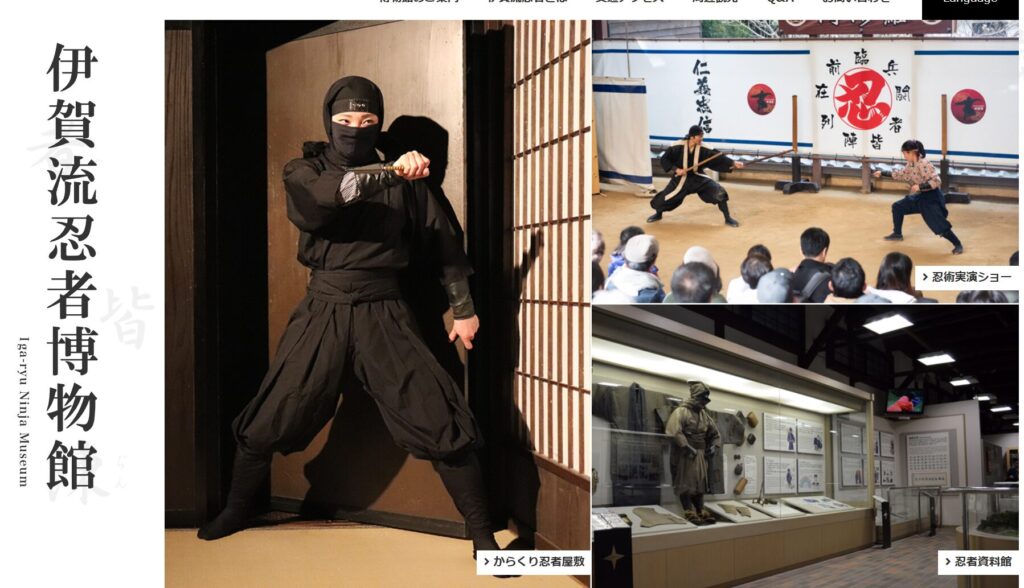
The Iga-ryu Ninja Museum, located adjacent to Iga Ueno Castle, is the most comprehensive ninja museum in Japan. The main exhibition hall contains an extraordinary collection of authentic ninja tools — shuriken in dozens of designs, rope ladders, water-crossing devices, disguise kits, and poison-making equipment — alongside detailed historical context explaining when and how they were used. A second building, the Ninja House, is a thatched farmhouse fitted with concealed weapons caches, hidden doors, and escape hatches typical of ninja safe houses from the Edo period.
The museum’s most popular feature is the live ninja performance: professional demonstrators show weapons techniques, acrobatics, and concealment methods in a small outdoor theater. Performances run four to five times daily. The combination ticket for museum, ninja house, and performance costs 1,000 yen for adults. Iga-ryu is the only museum in Japan where the tools on display were used by actual historical ninja — not reproductions made for tourism.
Iga Ueno Castle
Iga Ueno Castle’s main tower, perched on a high stone foundation above the city, is a striking sight — and the stone walls themselves, rising 30 meters from the surrounding moat, are among the highest castle stone foundations in Japan. The castle now houses exhibits on Iga’s feudal history and the role of ninja in regional politics. The view from the top floor extends across the Iga basin and the surrounding mountains — the geography that made this region such perfect ninja country is immediately clear from here.
Admission is 600 yen. The castle grounds (free) are a popular local park with excellent cherry blossoms in early April.
Getting to Iga
From Osaka (Kintetsu Uehommachi or Abenobashi station), take the Kintetsu Osaka Line to Iga-Kambe, then transfer to the Iga Railway to Ueno-shi Station (total journey approximately 90 minutes). From Nagoya, take the JR Kintetsu to Iga-Ueno Station (approximately 70 minutes). Iga is not on the JR main network — the private Iga Railway is the key connection.
Connecting the Naruto World to These Real Locations
What Kishimoto Actually Referenced
In interviews, Masashi Kishimoto has cited his love of traditional Japanese aesthetics as a primary influence on Naruto’s visual design. The Hidden Leaf Village’s wooden architecture draws on Japan’s pre-modern rural building styles; the Hokage rock faces reference Mount Rushmore filtered through Japanese monumental sculpture; the forest setting owes something to Shinto shrine environments across Japan. Togakushi in particular matches on multiple levels: ancient forest, mountain isolation, genuine ninja heritage, and a visual atmosphere that could step directly into the anime.
Building Your Naruto Pilgrimage Itinerary
A practical combined itinerary: fly into Osaka or Tokyo; spend Day 1–2 in Iga (Ninja Museum, castle, local ramen); travel to Nagano on Day 3 (Shinkansen to Nagano, afternoon arrival); spend Day 4 at Togakushi (full day, including shrine walk, museum, and ninja experience); return to Tokyo or continue to next destination on Day 5. Total train cost on JR Pass: approximately 15,000–18,000 yen for the Osaka–Nagano–Tokyo segment.
Both destinations are most atmospheric in autumn (late October to November, when foliage colors the forests) and in winter (snow on the Togakushi cedars creates an almost supernatural environment). Summer is hot and crowded at Iga; Togakushi remains cool even in August thanks to its elevation. Either destination alone is worth the trip — combined, they form one of the most distinctive and memorable travel experiences in Japan for any fan of the series.