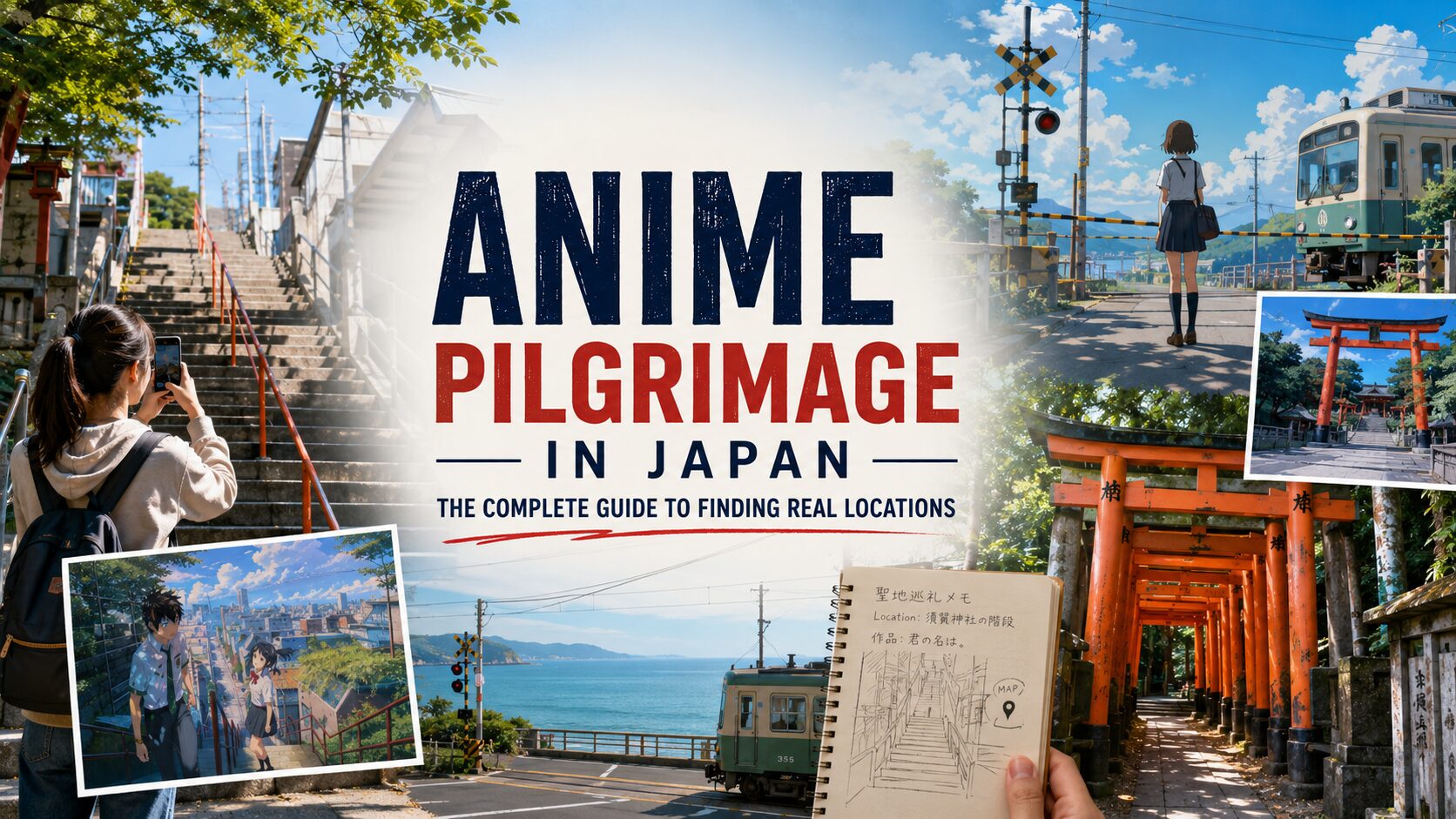
There’s a staircase in Shinjuku that looks like nothing from the street. Thousands of fans climb it every year anyway.
Finding it — and finding the dozens like it — isn’t luck. It’s a specific, learnable skill.
Here’s the direct answer: seichi junrei (聖地巡礼), literally “sacred site pilgrimage,” is real-location hunting for anime fans — comparing a remembered frame to an actual street, shrine, or station until they match. Japan’s Anime Tourism Association has published an official annual list of 88 locations since the practice went mainstream, and most of them cost nothing to visit and require no ticket or reservation at all. The list spans everything from world-famous urban landmarks to quiet rural towns that anime tourism single-handedly put back on the map.
The catch is that almost none of these places are marked. A production studio bases a background on a real street corner, and unless the location becomes famous enough for the town itself to lean into it, there’s no sign, no plaque, nothing pointing you there. What began as a niche fan activity in the 1990s — tracking down the Kamakura crossing from Slam Dunk — accelerated with digital cameras and social media in the 2000s, then went fully mainstream after Your Name’s 2016 release sent fans mapping its real-world settings within days of the film’s premiere — a pace that would have been unthinkable in the pre-smartphone era of the practice’s earliest days.
This guide covers how fans actually find these places, which ones are worth building a trip around, and the etiquette that keeps neighborhoods willing to let fans keep visiting.
How to Actually Identify a Real Location
The core technique is comparison, not luck: fans line up a remembered anime frame against Google Maps Street View, checking sight lines, building shapes, and signage until they find a match. This is a genuinely respected skill within the fan community — being first to pinpoint an obscure location carries real credibility, and dedicated location-hunting threads exist specifically to document and verify new finds before anyone travels to confirm them in person.
For well-known series, someone has usually already done this work. Fan communities on Reddit and Discord actively share confirmed location lists, and searching an anime’s title alongside “seichi junrei” or “pilgrimage” surfaces detailed walking routes on YouTube, station to station. Google Maps Street View itself doubles as a verification tool — pulling up a suspected location before you travel and comparing it directly against the anime frame confirms a match without needing to guess on the ground.
For lesser-known series, or scenes deliberately left ambiguous by the studio, the work falls to you — and that’s precisely the appeal for a segment of fans who treat the hunt itself as part of the pilgrimage.

The Locations Worth Building a Trip Around
The Suga Shrine staircase in Shinjuku’s Yotsuya neighborhood is arguably the single most recognizable pilgrimage site in Japan — the closing scene of Makoto Shinkai’s Your Name, a short walk from Yotsuya Station on the JR Chuo Line. Fans climb the steps and photograph the same view repeatedly, with the surrounding Yotsuya neighborhood holding several other recognizable scenes from the film for those willing to explore a block or two further.
The Kamakurakokomae railway crossing, made famous by Slam Dunk‘s opening sequence, remains one of the oldest and most visited pilgrimage sites, dating back to fans identifying it in the 1990s — making it, in a real sense, the origin point of the entire modern seichi junrei movement.
Washinomiya Shrine in Saitama, tied to Lucky Star, has fully embraced its fan following with anime-themed ema prayer plaques and festival tie-ins — a rare case of a location actively welcoming the attention rather than tolerating it. Toyosato in Shiga Prefecture followed a similar path after K-On! put the town on the map, and Chichibu has built stamp rallies and fan events around its connection to Anohana, reachable via the Seibu-Chichibu Line from Ikebukuro, with the Red Arrow express service cutting notably into the travel time.
Asakusa, home to Sensoji Temple, doubles as a real backdrop for Demon Slayer‘s Taisho-era Tokyo scenes, while Dogo Onsen Honkan in Ehime is widely cited as the primary real-world inspiration for the bathhouse in Spirited Away. Further afield, Hita City in Oita — hometown of Attack on Titan creator Hajime Isayama — has embraced its connection with a dedicated museum and life-sized bronze statues of the series’ main characters outside the train station.
The Etiquette That Keeps These Neighborhoods Open
This is the section most guides skip, and it matters more than any location list. The overwhelming majority of pilgrimage sites are real, lived-in residential neighborhoods, active train crossings, or functioning shrines — not attractions built for visitors. The towns that have leaned into fan tourism, like Washinomiya and Chichibu, are the exception, not the rule, and even they have limits on what they’ll tolerate, particularly around residents’ privacy and quiet hours in the evening.
What Nobody Tells You Before You Go
Most locations are completely unmarked, and finding them genuinely takes preparation — arriving without a saved reference image and hoping to recognize a spot on sight rarely works, even for dedicated fans. The other surprise is just how ordinary many locations look once you’re standing in them. The significance isn’t visual spectacle; it’s recognition, and that recognition only happens if you’ve done the homework beforehand.
Picture standing at the top of the Suga Shrine steps at the exact angle the light fell in the film, the ordinary Tokyo street around you suddenly overlaid with a scene you’ve watched a dozen times.
That specific feeling — fiction and reality briefly overlapping — is the entire reason seichi junrei has become its own subculture rather than a footnote.
Building a Multi-Series Route
Tokyo alone covers an enormous range without leaving the city: Shinjuku and Yotsuya for Your Name, Shibuya for Weathering With You, Akihabara for Steins;Gate, and Odaiba for Digimon‘s Fuji TV building and Rainbow Bridge. A single determined day could realistically hit three or four of these without much backtracking, since all sit on or near Tokyo’s central rail loop — the Yamanote Line alone connects most of them within a single ticket’s worth of travel.
Outside Tokyo, Kamakura (Slam Dunk), Saitama’s Washinomiya (Lucky Star), and Chichibu (Anohana) are all reachable as day trips from the city, each under two hours each way by train from central Tokyo. Building a route around two or three series in the same general direction — rather than criss-crossing the country chasing every location — keeps a pilgrimage trip realistic alongside a normal sightseeing itinerary.
| Series | Location | Access | Cost |
|---|---|---|---|
| Your Name | Suga Shrine, Shinjuku | Short walk from Yotsuya Station | Free |
| Slam Dunk | Kamakurakokomae crossing | Enoden Line from Kamakura | Free |
| Lucky Star | Washinomiya Shrine, Saitama | Tobu Isesaki Line to Washinomiya | Free |
| Spirited Away | Dogo Onsen Honkan, Ehime | Streetcar from Matsuyama | Bathhouse entry fee applies |
FAQ
- What does seichi junrei actually mean?
- Literally “sacred site pilgrimage” — the practice of visiting real-world locations that inspired or were faithfully recreated in anime and manga.
- Is there an official list of anime pilgrimage locations?
- Yes — Japan’s Anime Tourism Association publishes an annual list of 88 recognized locations.
- Do I need to pay to visit anime pilgrimage sites?
- Most are free public spaces like shrines, streets, and train crossings; a small number, like bathhouses or museums, charge standard entry fees.
- What’s the best app for finding anime locations?
- Butai Meguri is purpose-built for this, offering location maps and AR photo features for many confirmed sites, though combining it with fan-shared lists on Reddit or Discord fills in gaps for series it doesn’t yet cover.
- Are anime pilgrimage locations always in Tokyo?
- No — many of the most iconic sites are in smaller towns like Saitama’s Washinomiya, Shiga’s Toyosato, or Ehime’s Dogo Onsen, some distance from any major city, though Tokyo does host an unusually dense concentration of them.
- Is it rude to visit these locations as a tourist?
- Not if you follow basic etiquette — stick to public ground, don’t block traffic or trains, and treat residential streets with the same respect as any other neighborhood.
- How do I figure out if an anime location is real before I travel?
- Search the series title with “seichi junrei” to see if fans have already mapped it, then cross-check any candidate location against Google Maps Street View before committing to the trip.