Most “Tokyo vs Kyoto vs Osaka” guides assume you’re flying in from the US, landing in Tokyo by default.
For a lot of Australians, that assumption is already wrong before the trip even starts.
Here’s the detail most comparison guides skip entirely: as of 2026, Sydney is the only Australian city with a direct flight to Tokyo Haneda. Melbourne and Brisbane’s full-service flights land at Narita instead, while Jetstar runs services from Brisbane and Cairns straight into Kansai International Airport — Osaka’s airport, not Tokyo’s. That means a meaningful share of Australian travelers are already starting their trip in Osaka before they’ve made a single decision about it, simply because of which airline and route they booked months earlier without thinking about the downstream itinerary impact.
So the real question isn’t “which city is objectively best.” It’s which city fits your actual arrival point, your trip length, and what you’re actually going to Japan for. Every guide ranking these three cities is really answering a different, narrower question than the one most Australians are actually asking. Here’s the honest, factor-by-factor version.
Where Your Flight Actually Lands
Qantas and Jetstar both fly Sydney and Melbourne direct to Tokyo (Narita, and Haneda from Sydney specifically), while Jetstar’s Brisbane and Cairns routes go to Narita or, several times a week, direct to Kansai. Flight time from the east coast runs roughly 9–11 hours; Cairns is shorter at 7–8 hours given its more northern position, and Perth sits at around 9.5 hours on its own direct services.
Qantas’s full-service routes use Boeing 787 Dreamliners with proper Business and Premium Economy cabins, while Jetstar’s lower fares come with the usual low-cost trade-offs — worth factoring in if a 9-hour overnight flight is part of the calculation.

What Each City Is Actually For
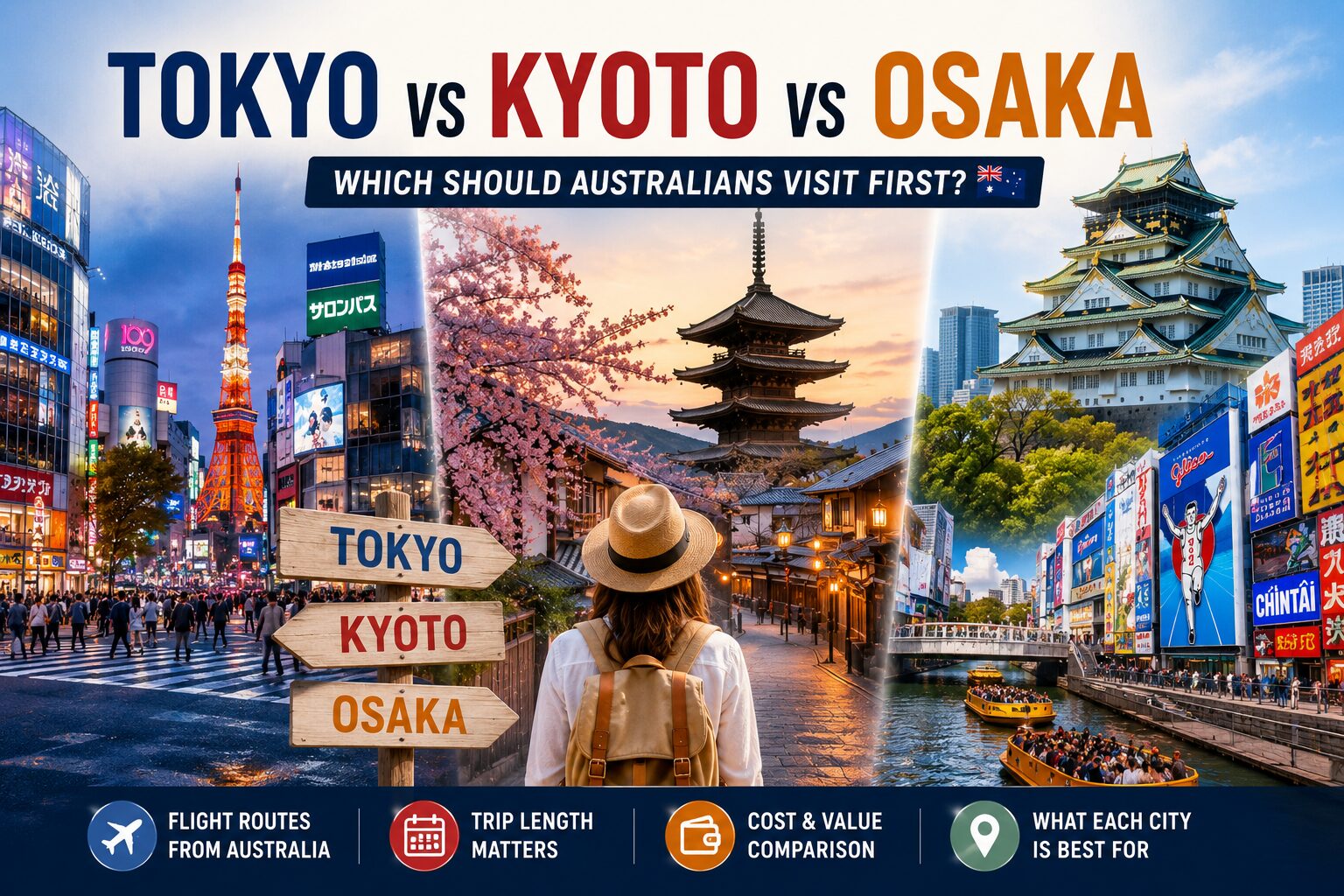
Tokyo is scale and modern energy — Shibuya crossing, Shinjuku’s neon sprawl, world-class shopping and dining spread across a city that never quite settles down. It’s genuinely overwhelming for a first day, in the best way, and it’s forgiving of jet lag since there’s always something open and something to do regardless of the hour.
Kyoto is Japan’s former imperial capital, largely spared bombing in WWII, which is why Fushimi Inari’s thousand torii gates, Kinkaku-ji, and Arashiyama’s bamboo grove still stand as they have for centuries. Unlike Tokyo’s sprawl, Kyoto is genuinely compact — most major sites are reachable by bus or bicycle, and the city rewards slowing down rather than rushing between checkpoints.
Osaka is unpretentious and food-obsessed — Dotonbori’s street food, Osaka Castle, and Universal Studios Japan give it a completely different energy from either of the other two. Where Tokyo and Kyoto both ask something of you — navigation in one case, reverence in the other — Osaka mostly just wants you to eat well and have a good time.
Cost: Where Your Aussie Dollar Goes Furthest
Tokyo consistently runs as Japan’s most expensive city for accommodation and dining, reflecting both its scale and its status as the country’s primary business hub. Osaka offers noticeably cheaper hotels and some of the best-value food in the country — the local food culture leans toward affordable street food and casual dining almost by identity, not just convenience. Kyoto’s hotels near major temples carry a premium, especially in cherry blossom and autumn foliage seasons, but its ryokan options often deliver more for the price than an equivalent Kyoto hotel room once a proper dinner is factored in.
Here’s how the numbers actually stack up side by side, once accommodation, food, and local transport are all folded in.
| City | Avg Daily Cost (mid-range) | Best For | Signature Experience |
|---|---|---|---|
| Tokyo | AU$180–280 | First-time visitors, shopping, nightlife | Shibuya Crossing, Shinjuku at night |
| Kyoto | AU$160–260 | Couples, history, temples | Fushimi Inari at dawn |
| Osaka | AU$140–220 | Families, food lovers, theme parks | Dotonbori street food crawl |
| All three combined | AU$170–250 avg | Most first-time visitors | Full Tokaido Shinkansen route |
Picture the same afternoon spent three different ways: neon and crowds in Shibuya, mist rising over a bamboo grove in Arashiyama, grilled skewers eaten standing up on a Dotonbori side street.
All three are real, all three are Japan — the only question is which one gets your limited days.
Getting Between Them: The Shinkansen Math
All three cities sit on the Tokaido Shinkansen line, which is exactly why most first-timers visit all three rather than choosing one. Tokyo to Kyoto runs a fixed 2 hours 20 minutes to 2.5 hours depending on the train type — the Nozomi is fastest but not covered by rail passes, while the Hikari takes slightly longer and is included. Kyoto to Osaka is a short 15–30 minutes depending on the train, short enough that many travelers base themselves in one and day-trip the other rather than packing and moving hotels twice.
Nara, a popular add-on for its free-roaming deer and Todai-ji Temple, sits about 30 minutes from Kyoto and slightly less from Osaka, making it an easy half-day addition from either base. Kobe, known internationally for its beef, is a similarly easy detour from Osaka for travelers with an extra afternoon to spare.

Families, Couples, and Solo Travelers
Osaka pulls ahead for families — Universal Studios Japan, ninja experience classes, and Kaiyukan Aquarium give kids plenty to do alongside the food scene, and the city’s overall pace is a little more forgiving of a group moving at a child’s speed. Kyoto suits couples and history-focused travelers who want the classic “this is Japan” imagery without competing priorities — it’s a city that rewards two people willing to wander without a rigid schedule. Tokyo works well for almost everyone as a first stop, simply because it’s the most forgiving city to land in jet-lagged and figure things out, with English signage and tourist infrastructure more thoroughly built out than almost anywhere else in the country.
Solo travelers tend to gravitate toward Tokyo or Osaka over Kyoto, both for the ease of meeting other travelers in hostels and bars, and because Kyoto’s temple-focused pace suits company more than Tokyo or Osaka’s built-in nightlife does.
FAQ
- Which city should Australians land in first?
- It depends on your flight — Sydney and Melbourne travelers typically land in Tokyo, while Jetstar passengers from Brisbane or Cairns may land directly in Osaka via Kansai Airport. Check your specific booking rather than assuming, since routes and airports do shift between schedule releases.
- Is it worth visiting all three cities on a first trip?
- For trips of 9 days or longer, yes — they’re close enough on the Shinkansen line that most first-timers visit all three without feeling rushed.
- Which city is cheapest for Australians?
- Osaka consistently offers the best value on hotels and food, with Kyoto close behind if you choose a ryokan over a hotel near the main temples. Tokyo can still be managed on a moderate budget, but it takes more deliberate choices around neighborhood and dining to get there.
- How long does the Shinkansen take between each city?
- Tokyo to Kyoto runs about 2 hours 20 minutes to 2.5 hours; Kyoto to Osaka is a short 15–30 minutes. Both are frequent enough that you rarely wait more than 10–15 minutes for the next departure.
- Which city is best for a family with kids?
- Osaka, largely thanks to Universal Studios Japan, along with kid-friendly options like ninja experience classes and the Kaiyukan Aquarium — all clustered closely enough to avoid long transfers with tired children.
- Can I fly into one city and out of another?
- Yes — flying into Tokyo and out of Osaka (or vice versa) is common and can save backtracking, especially useful given Kansai’s direct Jetstar connections to Brisbane and Cairns. Open-jaw tickets like this are usually priced similarly to a standard return fare.
- Is Kyoto or Osaka better for a day trip if I’m short on time?
- Kyoto delivers more distinctly “Japan” imagery for a single day, but Osaka’s Dotonbori and castle area pack more into a compact walkable zone if your day trip window is especially tight, since almost everything sits within a short walk of the main station.
- Do I need a JR Pass to travel between these three cities?
- Not necessarily — for a Tokyo–Kyoto–Osaka route specifically, point-to-point Shinkansen tickets often cost less than a JR Pass once you account for the pass’s exclusion of the fastest Nozomi services and the relatively short distances involved.