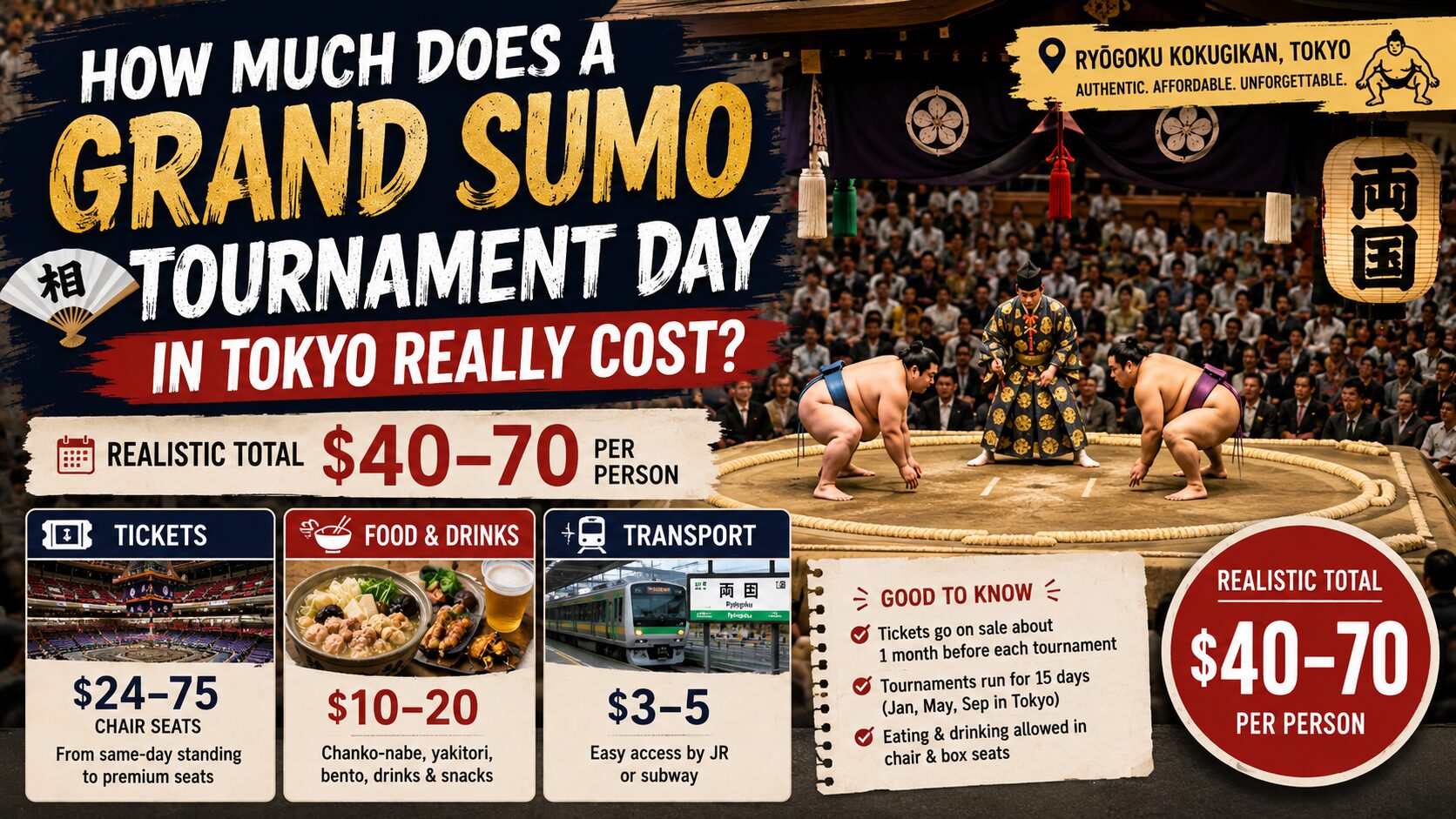
A same-day standing ticket to a Grand Sumo tournament costs about $15. A ringside seat costs nine times that.
Most first-time visitors pick blind between them, with no idea what the extra money actually buys.
⭐ Bottom Line
A realistic, comfortable first sumo tournament day at Tokyo’s Ryōgoku Kokugikan runs roughly $40–70 per person once tickets, food, and transport are all counted — well below what most travelers assume.
- Best for: travelers who want an authentic Tokyo day that isn’t already priced into every guidebook’s “expensive” bucket
- Typical spend: $24–75 for a seat, plus $10–20 for food at the venue
- Book ahead: tickets go on sale roughly one month before each tournament and can sell out same day for popular dates
Here’s the direct answer: according to the Japan Sumo Association’s official pricing, a day at Ryōgoku Kokugikan can run anywhere from about $15 for same-day unreserved standing to $135+ for a premium ringside tamari seat — and the honest answer for most travelers sits much closer to the low end than the high end. This is a category-by-category breakdown, not a single number, because the categories genuinely don’t scale the way people assume: food and transport barely move regardless of seat tier, while the seat itself swings the total by nearly $120 on its own.
The next Tokyo tournament, the Aki Basho, runs September 13–27, 2026, with tickets released August 8. Two more Tokyo tournaments follow in most years — January and May — each working on the same pricing structure below. All three run for 15 consecutive days, so there’s rarely a shortage of possible dates once you know your travel window.
Category 1: Tickets
Seating splits into three real tiers. Chair seats (Western-style, upper levels) run ¥3,500–11,000 ($24–75) depending on class (SS, A, B, C) and whether it’s a weekday or weekend — weekday pricing runs consistently a few hundred yen below weekend and holiday rates across every class. Box seats (masu-seki, floor cushions, traditionally for four people) run ¥34,000–42,000 per box ($230–285) — which works out to ¥8,500–10,500 ($58–71) per person in a full group of four. Sitting in a box means removing your shoes and sitting on a cushion for the day, a genuinely different physical experience from a Western-style chair. Tamari seats, arm’s-reach from the ring, are a flat ¥20,000 ($135) per person regardless of day, restricted to ages 16+, with no eating, drinking, or phone use permitted — close enough that sand from the ring can occasionally land on you during a bout — the tamari price stays flat regardless of weekday or weekend, unlike every other tier.
Category 2: Food at the Venue
Chanko-nabe, the hearty hot pot dish wrestlers themselves eat to bulk up, is sold in the venue for about ¥500 ($3.40) — one of the best-value, most on-theme meals in the city, and a rare chance to eat exactly what the athletes you’re watching eat daily. Yakitori grilled fresh in the arena’s basement kitchen adds a few more dollars per skewer, typically ¥200–400 each depending on the cut. Bento boxes, drinks, and seasonal souvenir snacks round out most people’s spending, and eating and drinking at your seat is explicitly allowed in both chair and box sections. A realistic food budget for a full day, arriving before the top-division matches and staying through, runs $10–20.
Category 3: Getting There
Ryōgoku Kokugikan sits a two-minute walk from Ryōgoku Station on the JR Sōbu Line — about 10 minutes from Tokyo Station, 25 minutes from Shinjuku. A standard subway or JR fare, typically ¥200–300 ($1.40–2) each way, is the entire transport cost for most visitors already staying centrally. The Ryōgoku neighborhood itself is worth arriving early for — the streets around the arena are lined with sumo stables (heya), some visible from the sidewalk, and life-size bronze statues and museum exhibits nearby round out a visit that costs nothing beyond the walk.

Where Travelers Overspend Without Noticing
Third-party guided tour packages bundling a chair seat with transport, snacks, and a booklet routinely run $100–190 for essentially the same B or A-class chair seat available directly for $35–75. The guide and extras have real value for a first-timer wanting context, but the seat itself isn’t why the price triples — it’s the guiding, the meeting-point convenience, and the included souvenir booklet doing most of that work.
Doors technically open in the morning for lower-division bouts, but most spectators arrive after 2:00 PM when the top-division matches begin — paying for a full-day ticket and only attending the afternoon isn’t wasted money, since the top-tier wrestling is genuinely the main event most people came for.
Where Splurging Is Genuinely Worth It
For a group of four sharing a box seat, the per-person math works out close to a mid-tier chair seat while delivering a completely different, more traditional floor-level experience — genuinely worth the modest premium for groups who can fill the box. It’s the one seating category where paying more and getting better value happen at the same time, purely because the pricing is structured per box rather than per seat.
Picture the exact moment two wrestlers charge at the opening clash, the crowd’s noise rising as one, salt still hanging in the air from the ritual toss moments earlier.
That moment costs the same whether you paid $24 or $135 — the ticket tier changes your seat, not the sport.
| Category | Low | Typical | High |
|---|---|---|---|
| Seat | $15 (standing) | $24–75 (chair) | $135 (tamari) |
| Food at venue | $3 (chanko-nabe only) | $10–20 | $30+ (multiple items, drinks) |
| Transport | $1.40 each way | $3–5 round trip | $10+ (taxi) |
| Full day, per person | ~$20 | $40–70 | $150+ |
The Running Total
For a realistic, comfortable first visit — a mid-tier chair seat, chanko-nabe plus a couple of snacks, and standard train transport — most travelers land at $40–70 per person for the entire day. What pushes that number higher is almost always the seat tier, not food or transport, both of which stay cheap regardless of which seat you choose. A couple splitting a box seat, adding a full lunch, and taking a taxi both ways could realistically double that figure — still far below what most travelers assume an entire day at a major Tokyo sporting event costs, and a genuine bargain against comparable major sporting events in most Western cities.
Who Should Splurge on Seating
✅ Pay up for a better seat if you are:
- Attending as a group of four able to split a box seat evenly
- Specifically chasing the closest possible view of the ring
- Making this the single anchor event of your Tokyo trip, worth a genuine splurge
❌ Stick with a standard chair seat if you are:
- Attending solo or as a pair, where box-seat economics don’t favor you
- New to sumo and unsure whether a full-day commitment suits your interest level
- Balancing this against other Tokyo splurges on the same trip
FAQ
- What’s the cheapest way to attend a sumo tournament?
- Same-day unreserved standing tickets, when available, run around $15 — the lowest-cost option, though availability isn’t guaranteed for popular dates.
- Are box seats worth it for a solo traveler?
- Not usually — the per-person value only improves with a full group of four sharing the box; solo travelers generally get better value from a chair seat.
- Is food at the venue expensive?
- No — chanko-nabe at roughly $3.40 is one of the best-value items in Tokyo, and a full day of eating at the venue rarely exceeds $20.
- When do sumo tournament tickets go on sale?
- Roughly one to two months before each 15-day tournament, through the Japan Sumo Association’s official ticket service.
- Do guided tour packages include better seats than buying direct?
- Not typically — the higher price reflects the guide, transport, and extras included, not access to better seating than what’s available directly.
- Can I get a refund if I can’t attend after buying a ticket?
- No — the Japan Sumo Association’s official terms state tickets cannot be changed or refunded once purchased, so confirm your date before buying.
- Do I need to bring cash to the venue?
- Card and cash are both accepted at most venue food stalls, though carrying some cash is sensible for smaller vendors or in case of card reader issues.
- How long does a full tournament day actually last?
- Doors open in the morning for lower-division matches, but the atmosphere builds steadily through the afternoon, with top-division bouts running roughly 2:00 PM to 6:00 PM.