Two travelers can fly into Japan on the same budget, for the same seven days, and have completely different trips — one waiting forty minutes for a photo at Fushimi Inari, the other walking straight up to the same gate.
The difference isn’t luck. It’s a handful of weeks most travelers never think to check.
⭐ Bottom Line
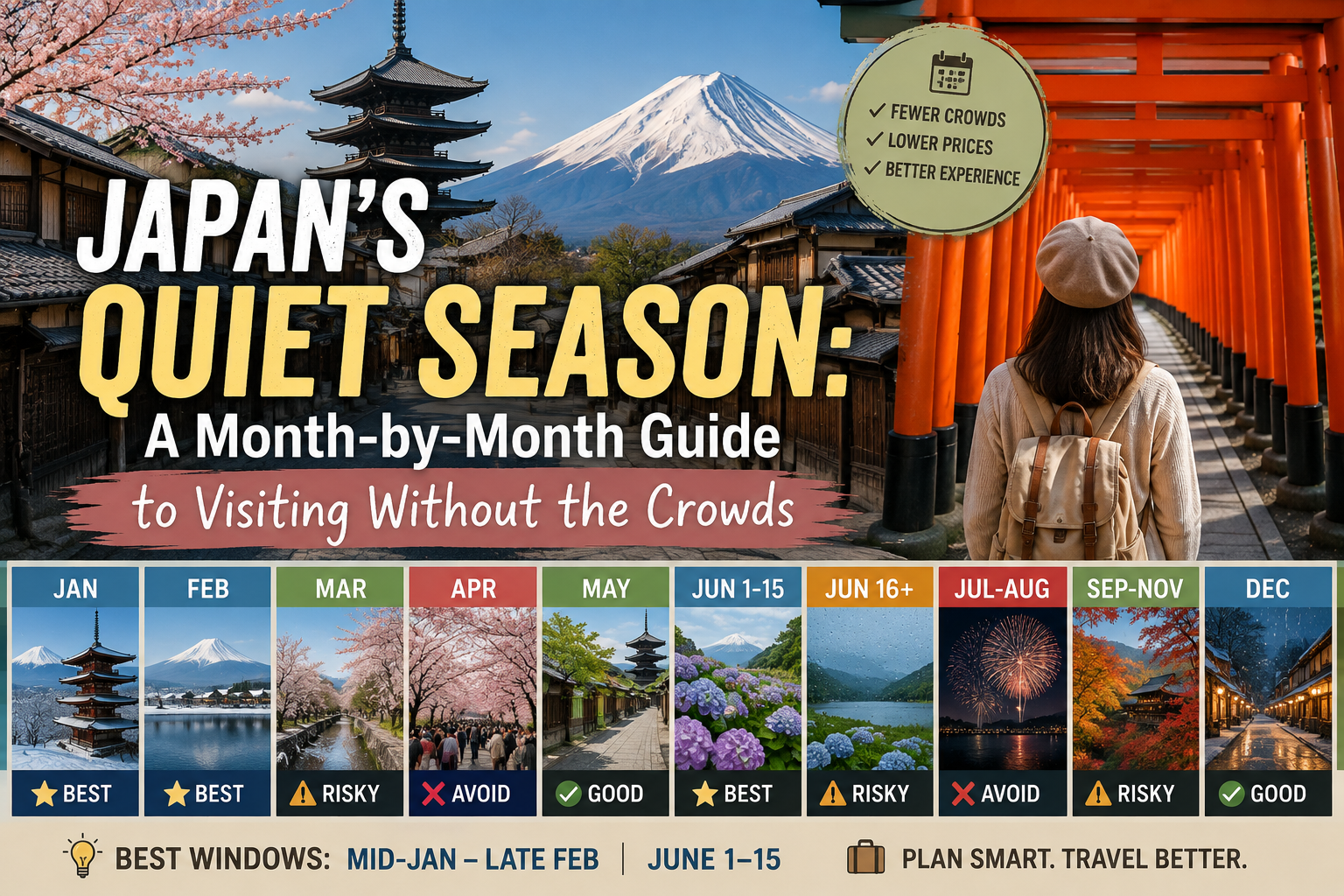
The two clearest quiet windows in Japan are mid-January through late February and the first two weeks of June — both offer meaningfully thinner crowds and lower prices than the shoulder-season months most travelers book instead.
- Best for: travelers with flexible dates who value breathing room over chasing cherry blossoms
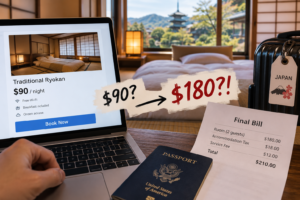
- Budget: hotel rates in these windows commonly run well below peak spring and autumn pricing
- Book ahead: even quiet-season trips need 2–3 months of lead time around Japan’s fixed holiday weeks
Japan’s peak season is common knowledge at this point: late March through May for cherry blossoms, September through November for foliage. What’s far less understood is that some of the months in between only look quiet on a calendar. A national dip in visitor numbers doesn’t automatically mean a specific week at a specific temple is empty — Japan’s own tourism data made that clear when foreign arrivals fell 5.5% year on year in April 2026, without April feeling noticeably calmer on the ground at any famous site.
So here’s the direct answer: the most reliably quiet stretches are mid-January to late February (once New Year’s week clears and excluding ski towns) and roughly June 1–15, just before the rainy season fully sets in and well before Obon. Both combine genuinely thinner tourist numbers with noticeably lower hotel and flight prices.
But “quiet” in Japan isn’t purely a function of how many foreign tourists show up. Domestic travel patterns — school trips especially — shape crowd levels just as much, and they’re the piece most outside guides skip entirely.
Why a “Slow Month” on Paper Isn’t Always a Quiet One

Japanese schools send students on multi-day trips called shugaku ryoko during a specific, predictable window: May, June, October, and November, most often to Kyoto, Nara, and Tokyo. These aren’t small groups — a single grade can bring roughly 200 students moving together. A month can post a genuine drop in foreign arrivals and still feel busy at exactly the landmarks travelers are trying to have to themselves, because a different, larger crowd fills the gap.
That’s also why national visitor statistics can mislead. Japan’s Tourism Agency reported foreign arrivals down 5.5% year on year in April 2026 — a real number, but not one that predicts crowd levels at any single site on any single date. The gap between “national numbers are down” and “this specific week will be quiet” is exactly where most trip-timing mistakes happen.
The Month-by-Month Crowd Calendar
This table is the actual answer key. Tiers reflect a combination of foreign tourist volume, domestic holiday and school-trip overlap, and typical hotel pricing.
| Month | Crowd tier | Why | Good for |
|---|---|---|---|
| January (after Jan 7) | BEST | New Year holiday clears, cold keeps casual tourism low | Lowest prices of the year, sunny clear days |
| February | BEST | Still cold, before spring anticipation builds | Ryokan and restaurant availability, budget travel |
| March | RISKY | Calm before ~March 20, then sakura anticipation builds fast | Early March for value; late March only if you want blossoms |
| April | AVOID | Cherry blossom peak most of the month; Golden Week starts Apr 29 | Only if blossoms are the priority over crowds |
| May (after May 6) | GOOD | Golden Week ends, before rainy season and Obon | Mild weather with real breathing room |
| June (1–15) | BEST | Before rainy season fully sets in; shugaku ryoko thins by mid-month | Best value-to-crowd ratio outside winter |
| July | RISKY | Rainy season lingers into humidity; summer break approaches | Festivals, if you don’t mind heat |
| August | AVOID | Obon (mid-month) plus peak heat and typhoon risk | Only if Obon festivals are the specific goal |
| September | GOOD | Quieter for international travel; typhoon risk into early month | Shoulder-season calm, watch the forecast |
| October | RISKY | Early month calmer; foliage anticipation builds later | First half for value, before the rush |
| November | AVOID | Peak foliage, especially the Kyoto rush mid-to-late month | Only if autumn colors are the priority |
| December (1–20) | GOOD | Tail of foliage, before New Year travel surge | A genuine, often-overlooked quiet pocket |
One more caveat worth stating plainly: this calendar reflects the main Honshu tourist corridor — Tokyo, Kyoto, Osaka. Okinawa runs on its own subtropical pattern, with a rainy season starting in May and real typhoon risk stretching from June into October. Hokkaido flips several of these tiers outright — August is one of its most pleasant, least oppressive months, while the winter window that empties out Kyoto is exactly when Niseko and Sapporo fill up with skiers. Treat the table above as a starting point for the well-trodden route, not a rule that holds everywhere in the country at once.
The Quiet Window Almost Nobody Times Right

Mid-January through late February is, by a real margin, Japan’s calmest stretch. Once New Year’s week clears, temperatures stay cold but skies are frequently clear and sunny, tourist volumes drop sharply, and hotel and flight prices hit their lowest point of the year. The exceptions worth flagging: ski towns like Niseko and Hakuba get genuinely busy with winter-sports crowds, and any Japanese holiday weekend within the window still draws a domestic bump.
Walking up to Kinkaku-ji’s golden pavilion with a dusting of snow on the roofline and no one blocking the classic sightline — that’s a scene peak-season visitors pay a 150%+ hotel premium and never actually get.
The honest trade-off: it’s genuinely cold, and a handful of outdoor attractions run reduced winter hours.
This window rewards travelers who don’t need blossoms or foliage to enjoy Japan — just space, clear photos, and a table at the ryokan you actually wanted.
Why Early June Deserves a Second Look
June gets dismissed by a lot of guides with a single line: “it’s rainy season, skip it.” That’s an oversimplification. The rainy season (tsuyu) typically strengthens through mid-June into July — meaning the first two weeks of June are often still relatively dry, and tourist numbers are already thinning as shugaku ryoko groups wind down and before Obon-driven domestic travel picks up.
There’s a real upside to the rain itself, too: hydrangeas bloom in temple gardens across the country during this window — Kamakura’s Meigetsu-in is one well-known example — turning the season’s biggest downside into one of its more photogenic reasons to go.
The Two Weeks You Should Book Six Months Ahead Regardless

Two windows sit at the opposite end of this entire guide: Golden Week (April 29 – May 6) and Obon (mid-August). Both cluster national holidays that send domestic travelers moving in huge numbers — hotel prices commonly double, and trains run genuinely full, not just busy. If either window is the only time you can travel, book transportation and accommodation as early as six months out, not the usual two to three.
If Your Dates Are Already Fixed
Most readers of a guide like this don’t actually have fully flexible dates — a fixed vacation window is the norm, not the exception. If your trip lands in a crowded month, the crowd itself is manageable with a few adjustments. Visiting famous sites at opening time on a weekday — a Tuesday at 7 AM beats a weekend at golden hour by a wide margin — cuts wait times dramatically even in peak weeks. Most major landmarks also have a quieter alternative just a few minutes away that carries a similar view without the line.
Timing the whole trip is the strongest lever. Timing each day within a fixed trip is the second-best one — and it’s available no matter which month you’re locked into.
✅ Go quiet-season if you are:
- Flexible on exact travel dates
- Fine with cool winter weather or a little summer rain
- More interested in breathing room than photographing blossoms or foliage
- Looking to stretch a travel budget further on hotels and dining
❌ Book peak season anyway if you are:
- Specifically chasing cherry blossoms or autumn foliage as the trip’s purpose
- Only available to travel during Golden Week or Obon, with no flexibility
- Attending a specific festival that only happens in a crowded month
- Traveling with a group that needs the widest possible tour and activity availability
Frequently Asked Questions
- What’s the single least crowded month to visit Japan?
- February, followed closely by the first three weeks of January after New Year’s. Both combine the year’s lowest tourist volumes with its lowest hotel and flight prices.
- Is June really a bad time because of rain?
- Not entirely. The first half of June is often still relatively dry and comes with real crowd and price advantages. The rainy season tends to intensify through the back half of the month into July.
- Will a “quiet” month still be crowded at famous temples?
- It can be, if it overlaps with Japanese school trip season (May, June, October, November) or a domestic holiday weekend. Checking both calendars, not just the foreign-tourist forecast, matters.
- Is cherry blossom season worth the crowds?
- That depends entirely on priorities. Expect accommodation premiums of 150–200% and booking windows of 6–9 months in the most popular cities if blossoms are the main goal.
- How far ahead should I book during quiet season versus peak season?
- Quiet-season trips are usually fine with 2–3 months of lead time. Golden Week and Obon are the exception — book those roughly six months out if at all possible.
- What if my vacation dates are already fixed during a crowded month?
- Visit major sites at opening time on a weekday, look for a lesser-known alternative near the famous landmark, and consider adding a region like Tohoku or Kyushu that sees far less traffic even during nationally busy weeks.