Every summer, climbers who spent months planning a Mount Fuji trip reach the trailhead and get turned back — not for bad weather, but for showing up at the wrong hour without a piece of paper most guidebooks don’t mention.
The gate itself decides who continues and who doesn’t.
⭐ Bottom Line
Every climber on all four Mt. Fuji trails now needs an advance online reservation and a ¥4,000 fee — and on the busiest trail, arriving after 2 PM without a mountain hut booking means the gate won’t open for you, no matter how far you’ve traveled.
- Best for: first-time climbers planning a summer 2026 or 2027 ascent
- Budget: ¥4,000 entry fee + ¥14,000–17,000/person for a hut night + ~¥3,900 round-trip shuttle
- Book ahead: Yoshida Trail reservations open around April–May; weekends and Obon week can sell out within minutes
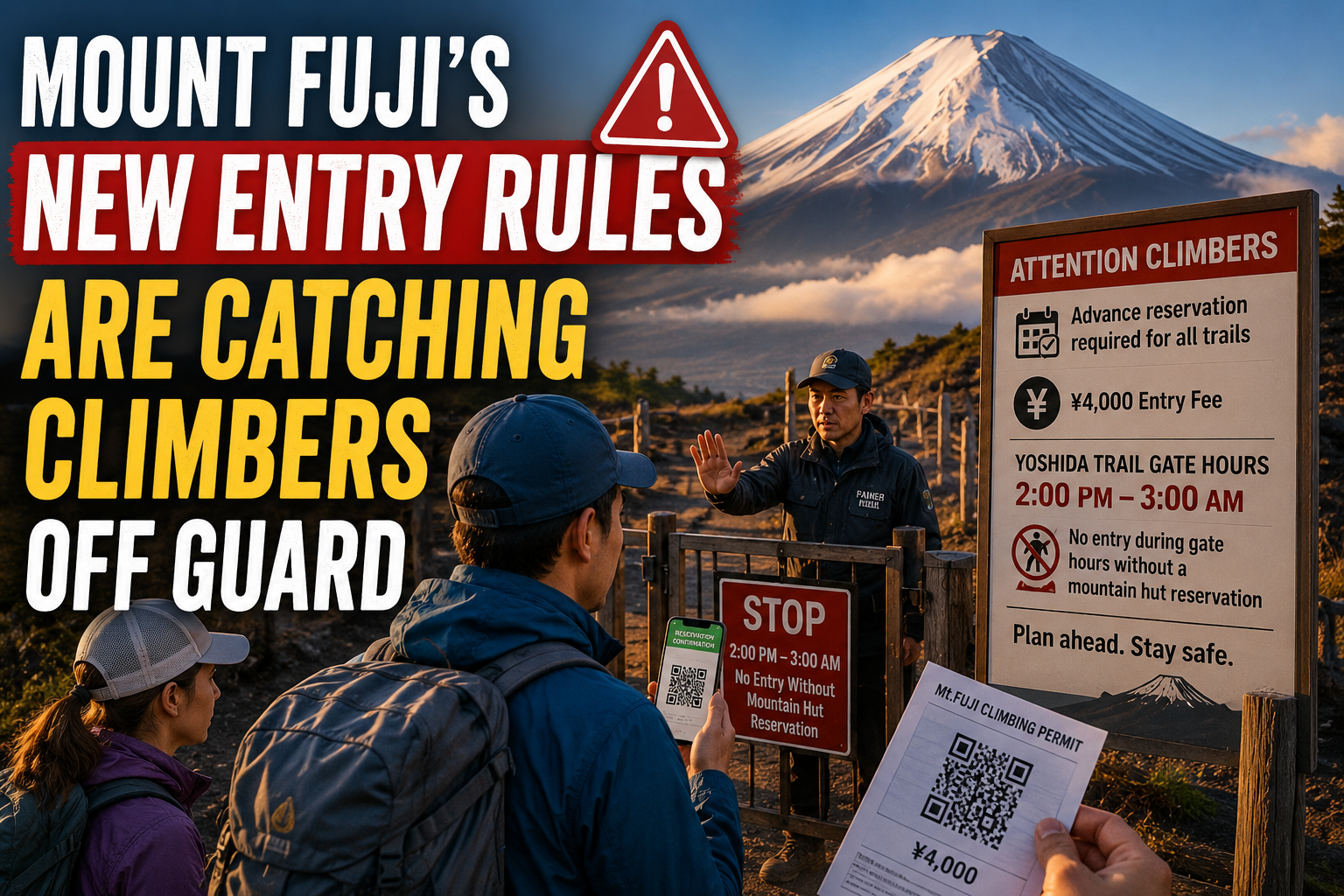
Here’s what’s true for the 2026 season, in plain terms: every climber on all four official trails — Yoshida, Subashiri, Gotemba, and Fujinomiya — must reserve and pay a ¥4,000 entry fee online before showing up, receiving a QR-code permit checked at the trailhead. On the Yoshida Trail specifically, the busiest and most popular route, a physical gate closes between 2:00 PM and 3:00 AM to stop dangerous overnight “bullet climbing.” Passing through during those hours requires proof of a confirmed mountain hut reservation — the entry fee alone doesn’t get you through.
So the direct answer to “do I need a reservation to climb Mount Fuji”: yes, on every trail, and on Yoshida specifically you effectively need two reservations — the ¥4,000 climbing permit through Yamanashi Prefecture’s official system (fujisan-climb.jp), and a mountain hut booking if any part of your climb happens after 2 PM.
None of this is brand new this week. It’s a rule set that firmed up between 2024 and 2025 — which is exactly why it keeps catching people off guard: the policy moved faster than most travelers’ awareness of it.
What’s Actually New for 2026, and What Just Feels New

Worth being precise here, because getting this wrong is its own kind of mistake: the ¥4,000 fee across all four trails started with the 2025 season — doubled from the old ¥2,000 charge that used to apply to the Yoshida Trail alone. What’s genuinely new for 2026 is narrower: the Subashiri Trail now opens on July 1 instead of its traditional July 10, aligning it with Yoshida’s opening date for the first time.
The 2026 season runs July 1 – September 10 on Yoshida and Subashiri, and July 10 – September 10 on Fujinomiya and Gotemba. Outside those dates, mountain huts close, shuttle buses stop, and the summit gets genuinely dangerous — this seasonal window itself is nothing new, but it’s worth stating plainly before anything else.
The Gate That Closes at 2 PM
On the Yoshida Trail, a physical gate at the fifth station enforces closed hours from 2:00 PM to 3:00 AM. The rule exists to discourage “bullet climbing” — pushing straight to the summit overnight without rest, which sharply raises the risk of hypothermia and altitude sickness. If you have a confirmed mountain hut reservation, staff will let you through even during closed hours, though you’re still strongly encouraged to go earlier for safety. If you don’t have one, the gate simply doesn’t open for you.
“Mt. Fuji optimization rangers” — mountain guides with the authority to intervene — patrol the trails specifically to enforce this and the equipment rules below. This isn’t a symbolic checkpoint; it’s an actively staffed one.
The Fee, the Reservation, and the Trail Most Guides Skip

Yoshida is the trail almost every first-timer defaults to, mostly because it has the most huts, the easiest transport from Tokyo, and the most English-language information. But it’s also the most crowded, and the only one with a hard daily cap and gate-hour enforcement. The other three trails, on the Shizuoka side, use a different registration system — the FUJI NAVI smartphone app — and don’t share Yoshida’s hard cap.
| Trail | 5th Station elevation | Typical ascent time | Reservation system | Best for |
|---|---|---|---|---|
| Yoshida | ~2,300 m | 5–7 hrs | fujisan-climb.jp, 4,000/day cap | First-timers wanting huts + easy Tokyo access |
| Subashiri | ~2,000 m | 5–8 hrs | FUJI NAVI app, no hard cap | Quieter forested lower slopes, fewer crowds |
| Fujinomiya | ~2,400 m | 4–7 hrs | FUJI NAVI app, no hard cap | Shortest climb; reachable via Tokaido Shinkansen |
| Gotemba | ~1,400 m | 7–10 hrs | FUJI NAVI app, no hard cap | Fit, experienced hikers wanting real solitude |
The trade-off is straightforward: Yoshida’s infrastructure makes it the practical choice for most visiting climbers, but its 4,000-per-day cap means popular dates can fill before you arrive. The three Shizuoka trails won’t turn you away for hitting a headcount, but they also have far fewer huts, so an overnight stay needs to be arranged well ahead regardless of which trail you pick.
The Cash-Only Mountain
Once you’re on the mountain, Japan’s cashless-payment culture disappears. Mountain huts don’t accept credit cards or IC cards for on-site purchases — water, snacks, phone charging, even toilet use. Bring roughly ¥3,000–5,000 in small bills and coins for the climb; there’s no ATM up there to fix a shortfall.
Standing above the cloud line as the sky turns from black to gold at the summit — goraiko, the sunrise climbers plan their whole ascent around — is the payoff every hut reservation and gate rule is really protecting.
It’s also a payoff that depends entirely on weather cooperating on your specific morning, which no reservation can guarantee.
This catches travelers used to Japan’s broader convenience-store cashless norm off guard more than almost any other Fuji rule — it’s easy to assume a country this card-friendly stays that way at 3,000 meters. It doesn’t.
What Rangers Actually Check at the Gate

Equipment checks are real, not a formality. Staff at the gate verify three things before letting climbers through: warm layers for near-freezing summit temperatures even in August, two-piece rain gear (a poncho doesn’t count), and proper trekking shoes. Sneakers, sandals, or fashion shoes can mean denied entry on the spot.
None of this is about bureaucracy for its own sake — altitude sickness, hypothermia, and exhaustion are the real risks the whole rule system, from gate hours to equipment checks, is built around.
If You Show Up Without a Plan
Here’s what actually happens if you arrive underprepared. On Yoshida, before 2 PM with no hut reservation: you can climb, but you’re expected back down before the gate closes, and the 4,000-climber cap may already be reached on a busy day. After 2 PM with no hut reservation: the gate does not open for you, regardless of how far you’ve traveled to get there. On the three Shizuoka trails, there’s no hard gate-hour cutoff, but skipping the FUJI NAVI registration and safety briefing means staff can still turn you away at their discretion.
The pattern underneath all of this is consistent: the rules assume you’ve made a decision — which trail, which day, overnight or same-day — before you arrive. Climbers who treat Fuji like a spontaneous stop on a Tokyo itinerary are the ones the gate system is, quite deliberately, designed to slow down.
✅ You’re ready if you:
- Can commit to a specific date and trail 1–2 months ahead
- Are booking a mountain hut if any part of your climb falls after 2 PM on Yoshida
- Have proper rain gear, warm layers, and real trekking shoes
- Are carrying cash for the mountain itself
❌ Reconsider this season if you:
- Want a same-day, unplanned add-on to a Tokyo trip
- Are traveling only during Obon week and haven’t booked yet
- Aren’t willing or able to carry proper cold-weather and rain gear
- Expect ATMs or card payment to be available on the mountain
Frequently Asked Questions
- Do I need a reservation to climb Mount Fuji in 2026?
- Yes, on all four trails. Yoshida climbers reserve and pay online through fujisan-climb.jp; the three Shizuoka-side trails (Subashiri, Gotemba, Fujinomiya) register through the FUJI NAVI app, which also includes a short safety briefing.
- How much does it cost to climb Mount Fuji?
- Budget roughly ¥4,000 for the entry fee, ¥14,000–17,000 per person for a mountain hut night with dinner and breakfast, and about ¥3,900 round-trip for the shuttle bus from Kawaguchiko or Mt. Fuji Station to the 5th Station.
- What happens if I arrive at the Yoshida gate after 2 PM without a hut reservation?
- The gate will not open for you. A confirmed mountain hut booking is the only way to pass through the Yoshida trailhead between 2:00 PM and 3:00 AM.
- Which trail should a first-time climber pick?
- Most first-timers choose Yoshida for its huts, infrastructure, and easy access from Tokyo, despite it being the most crowded and the only trail with a hard daily cap.
- Can I still show up and climb the same day without booking ahead?
- On Yoshida, only if the 4,000-climber daily cap hasn’t already been reached — which is unreliable on weekends and especially during Obon week in mid-August, when online slots can sell out within minutes.
- Do I need cash on the mountain?
- Yes. Mountain huts do not accept credit cards or IC cards for on-site purchases like water, snacks, or charging. Bring roughly ¥3,000–5,000 in small bills and coins.