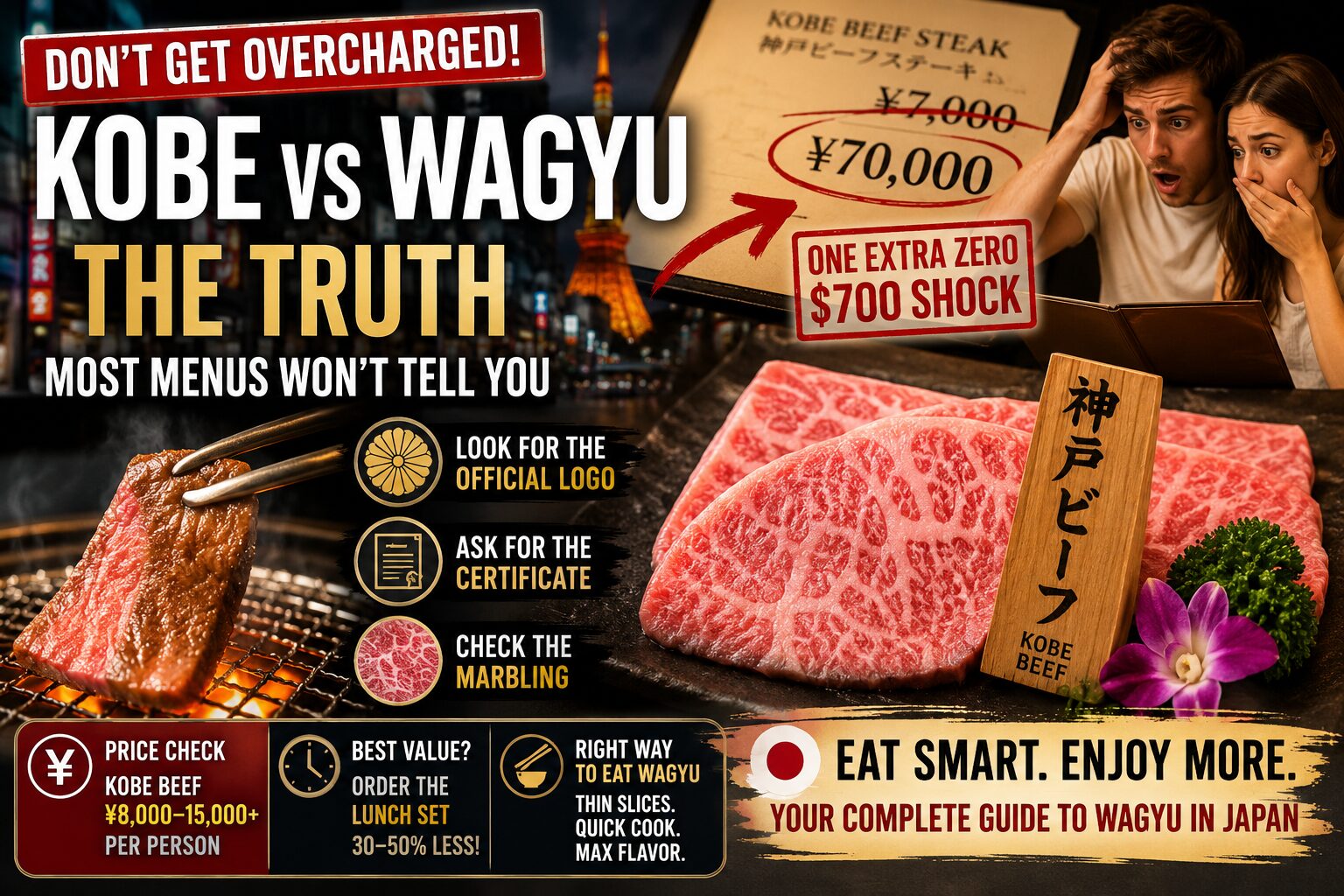
A couple in Tokyo misread one extra zero on a menu and paid $700 for a steak they thought cost $70.
They aren’t the only ones. The word ‘Kobe’ printed on a menu in Japan is doing more marketing than you’d think — and the reason has nothing to do with the beef itself.
Here’s a number that surprises most first-time visitors: Japan certifies only about 3,000 to 5,000 cattle a year as authentic Kobe beef. For comparison, the United States processes roughly 30 million cattle annually. That scarcity is the whole story — and it’s also exactly why so many restaurants in Tokyo, Osaka, and even Kobe itself are happy to let the word do work it hasn’t earned.
So which one should actually be on your plate? The answer depends on a distinction almost no menu explains: Kobe is not a quality grade. It’s a place.
Kobe vs Wagyu: What the Words Actually Mean
Wagyu (和牛, literally ‘Japanese cow’) is a category — four specific cattle breeds prized for intense marbling. Kobe beef is one narrow brand within that category: it must come from Tajima-strain Japanese Black cattle, born, raised, and slaughtered inside Hyogo Prefecture, and it must hit strict certification standards set by the Kobe Beef Marketing & Distribution Promotion Association.
Genuine certified Kobe beef teppanyaki at a proper restaurant costs a minimum of ¥8,000–¥15,000 ($54–$100) per person for a full course; anything advertised at ¥2,000 or less claiming to be certified Kobe simply isn’t.
How to Tell If What You’re Eating Is Real
Three checks take less than thirty seconds and work at any restaurant in Japan.
- Ask for the certificate. Certified restaurants keep a laminated certification card or framed document on the wall or at the register. If staff can’t produce one, order the non-Kobe A5 instead.
- Check the marbling pattern. Genuine A5-grade beef shows a fine, even, almost snowflake-like distribution of fat. Coarse, uneven fat pockets are a sign of a lower grade dressed up with marketing language.
- Compare the per-gram price to the table above. If a 200g Kobe steak is priced below roughly ¥6,000 pre-tax, be skeptical.
The bigger surprise is in how you’re actually meant to eat this beef in the first place — and it’s not the way most Western steakhouses serve it.
How Wagyu Is Actually Meant to Be Eaten
A5 wagyu at 200 grams-plus, served like a Western steak, is objectively too much per person: the fat content is roughly double that of USDA Prime, and 2–3 ounces is a realistic full serving. Japanese wagyu specialists know this, which is why the best value in the country is rarely the biggest cut.
Preparation matters as much as the cut. Thin-sliced yakiniku over charcoal needs only 10–20 seconds per side; sukiyaki (simmered with sweet soy and dipped in raw egg) is what many Japanese connoisseurs consider the optimal way to taste the fat; shabu-shabu offers a lighter, broth-based alternative. All three showcase the marbling better than a thick Western-style steak ever will.

The moment a paper-thin slice of A5 hits a 180°C iron plate, the edges curl and the marbling turns almost translucent within seconds — releasing a burst of savory, faintly sweet fat unlike anything a Western cut produces.
Honest expectation: a proper portion is small by design, and richness, not size, is the whole point.
Who Should Choose Which
Frequently Asked Questions
- Is Kobe beef actually better than other wagyu?
- Not necessarily by marbling score. Kobe’s minimum certification requirement (BMS 6+) is lower than the A5 minimum (BMS 8+), so a non-Kobe A5 cut from Miyazaki or Matsusaka can carry more marbling than a certified Kobe cut. Kobe’s reputation comes from being first to international fame, not from objectively superior scores.
- Can I bring real Kobe beef home from Japan?
- Practically, no. Export regulations and the tiny annual supply mean fewer than a handful of certified importers exist worldwide, and virtually none of it is sold as retail cuts for travelers to carry home.
- Why is ‘Kobe beef’ so common on menus outside Japan and even inside it?
- The name isn’t legally protected everywhere, so many restaurants use ‘Kobe-style’ or ‘Kobe’ loosely to describe any well-marbled wagyu, whether or not it’s certified. Inside Japan, this happens most in tourist-dense areas of Tokyo and Osaka, and occasionally in Kobe city itself.
- What’s a fair price for A5 wagyu in Japan?
- A satisfying multi-cut yakiniku meal with A4–A5 wagyu runs ¥5,000–¥12,000 ($34–$80) per person. A full Kobe or Matsusaka omakase course at a specialist restaurant runs ¥15,000–¥40,000 ($100–$270).
- Is the cheap wagyu skewer at Tsukiji or Nishiki Market worth it?
- As a fun snack while you’re already there, yes — expect ¥3,000–6,000 for a single skewer, and know that prices at those specific market stalls have climbed sharply since 2024. As your primary wagyu experience, a proper lunch set will give you far more for similar money.
- Tokyo Disneyland vs Universal Studios Japan: Which One Is Actually Worth It in 2026?
- Japan's Legendary Wagyu Restaurants: Where Michelin, Locals, and 130 Years of History Agree
Author of this article

Related articles
-
 8 Ways to Spend Less on a Japan Trip in 2026 — Ranked by How Much Each One Saves
 -
 7 Japan Hotel & Ryokan Booking Mistakes That Can Make Your Final Bill Higher Than Expected
 -
Japan Is Safe. These 7 Things Still Catch First-Time Visitors Off Guard.
-
Capsule Hotels in Japan: A First-Timer’s Guide to What Actually Happens Inside
-
9 Surprising Things Behind Tokyo’s Onigiri Boom in 2026
-
Is Okinawa Really a Longevity “Blue Zone”? Test What the Research Actually Shows
-
Weak Yen, Big Savings? Test Your Japan Travel Cost IQ
-
Could You Actually Buy an Akiya in Japan? Test Your Vacant-House IQ