I Came Home From Japan $1,200 Poorer Than I Needed to Be
My first Japan trip cost just over $4,000. It was a 12-day itinerary covering Tokyo, Kyoto, Osaka, and a day trip to Hiroshima — a solid, well-planned trip by most measures. But when I went back two years later and spent $2,700 on a nearly identical itinerary, I realized how much money I had simply thrown away the first time. Not on experiences. On avoidable mistakes.
The $1,200 gap came from five specific decisions — all of which felt reasonable at the time and all of which were wrong. If you are planning a Japan trip for 2026, here is what they were and exactly how to avoid them.

Mistake #1: I Bought the Wrong JR Pass (And Lost $180)
The Japan Rail Pass is marketed to international visitors as a near-mandatory purchase. The pitch is simple: unlimited Shinkansen and JR rail travel for a flat fee. It sounds like a no-brainer. It isn’t.
For my 12-day trip, I bought a 14-day JR Pass at approximately $550. My actual Shinkansen travel: Tokyo to Kyoto ($130 each way), Kyoto to Hiroshima ($65 each way), and Hiroshima back to Osaka ($30). Total individual ticket cost: $420. The pass cost me $130 more than buying individual tickets — and I still paid separately for subway travel in Tokyo, Kyoto, and Osaka because most city metro lines aren’t covered by the JR Pass.
The JR Pass makes financial sense for specific itineraries: Tokyo to Hiroshima to Hakata and back, with multiple regional JR line side trips included. For Tokyo-Kyoto-Osaka loops, it almost never breaks even. Before buying, add up your actual planned Shinkansen routes at retail price on Hyperdia or the JR ticket calculator. If the pass doesn’t save at least $80 over individual tickets, skip it.
Mistake #2: I Booked a Hotel in Gion and Paid Double (Cost Me: $340)
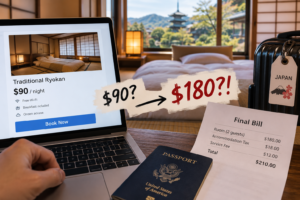
Kyoto’s Gion district is beautiful. It is also one of the most expensive neighborhoods to sleep in, with mid-range hotel prices running $180–$280 per night for rooms that cost $90–$130 in the neighborhoods 15 minutes away by bus.
I stayed four nights in Gion at $220 per night. A hotel of identical quality in Fushimi — 18 minutes by bus from central Higashiyama — was $110 per night. The $440 difference over four nights was pure location premium. The temples, shrines, and restaurants I visited were equally accessible from both locations. I gained nothing by sleeping inside the tourist zone except a higher bill and more crowds outside my window at 6am.
The rule: identify your target attractions, then search for accommodation in the adjacent residential neighborhood using Google Maps transit directions. In Tokyo, this means Koenji instead of Shinjuku, or Sangenjaya instead of Shibuya. In Kyoto, Fushimi or Nishikyo-ku instead of Higashiyama. In Osaka, Fukushima instead of Dotonbori. The savings are typically 30–50% per night.
Mistake #3: I Exchanged Money at the Airport (Cost Me: $95)
Narita Airport currency exchange desks offer rates approximately 8–12% worse than the mid-market rate. On my first trip I exchanged $800 USD at the airport immediately after landing — a completely understandable impulse after a 14-hour flight — and lost roughly $80–$95 in exchange rate markup compared to what I would have paid using a Wise card or a Charles Schwab debit card at a Japanese ATM.
Japan is still a heavily cash-based country, particularly outside of major tourist areas and for temple entrance fees, small restaurants, and vending machines. You do need yen in cash. But you do not need to get it at the airport exchange desk. Japan Post Bank ATMs and 7-Eleven ATMs both accept international cards and offer near-market-rate exchange with a flat fee of ¥110–¥220 per transaction. A Wise multi-currency card or a Schwab debit card (no foreign transaction fees, ATM fees reimbursed) reduces the cost further. Exchange only a small amount at the airport for immediate transit needs, then use ATMs for the rest.
Mistake #4: I Didn’t Know About Tax-Free Shopping (Cost Me: $220)
Japan operates a consumption tax refund system for tourists that provides a 10% discount on most purchases above ¥5,000 at participating retailers. Virtually every department store, drug store, electronics retailer, and many specialty shops participate. The process requires showing your passport at the register or at a dedicated tax-free counter — that’s it.
On my first trip I spent approximately ¥220,000 ($1,500) on cosmetics, electronics, and clothing across department stores and electronics retailers in Tokyo and Osaka. None of it was purchased tax-free because I simply didn’t know the system existed. At 10% that was ¥22,000 — roughly $150–$220 depending on exchange rate — left on the table across two weeks of shopping. The tax-free sign is displayed at the entrance of every participating store. If you see it, show your passport. It takes 90 seconds.
Mistake #5: I Traveled During Golden Week (Cost Me: $370)
Golden Week — Japan’s national holiday cluster running from late April through early May — is the most expensive travel period in Japan. Accommodation prices spike 40–80% above baseline. Popular attractions operate at maximum capacity. Restaurant waits double. The Shinkansen requires seat reservations weeks in advance or you stand.
I booked my trip for the first week of May, timing it for good spring weather without realizing I was booking the single most crowded and expensive week of the Japanese calendar. My Tokyo hotel cost ¥28,000 per night ($190) during Golden Week. The identical room in the same hotel costs ¥16,000 ($110) in late October. Across six Tokyo nights that difference was $480 — and the experience was objectively worse, with longer queues, crowded trains, and fully booked restaurants.
The three best-value periods for a Japan trip are late October to mid-November (autumn foliage, mild weather, lower international demand), the first two weeks of June (rainy season prices, genuinely uncrowded major sites, hydrangea in bloom), and late January to mid-February (cheapest prices of the year outside ski areas). Avoid Golden Week, New Year (December 28–January 3), and cherry blossom peak (late March to early April) unless you have no flexibility.
The $1,200 Summary
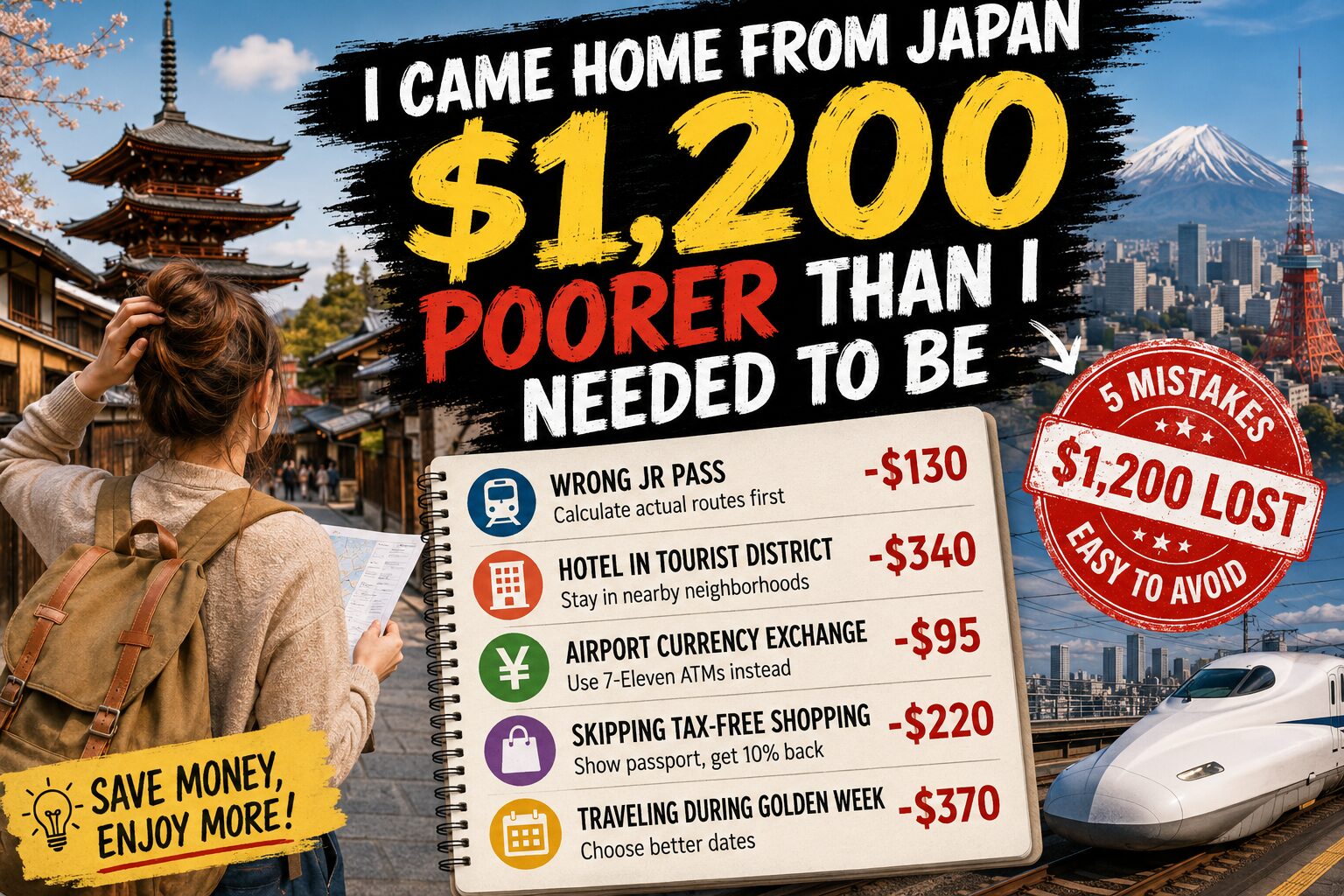
To put it plainly: the wrong JR Pass cost $130. The tourist-district hotel cost an extra $340 over four nights. Airport currency exchange cost $95. Skipping tax-free shopping cost $220. Traveling during Golden Week cost $370 in inflated accommodation alone. That’s $1,155 in avoidable spending on a $4,000 trip — nearly 30% of the total budget lost to five decisions that each felt reasonable at the time.
None of these mistakes required sacrifice to fix. The hotel 15 minutes from Gion is not a worse hotel. The Shinkansen ticket bought individually is the same seat. The yen from a 7-Eleven ATM spends identically to the yen from an airport exchange desk. The only difference is knowing the system before you book. Now you do.
| Mistake | What It Cost | The Simple Fix |
|---|---|---|
| Wrong JR Pass | $130 overpaid | Calculate your actual Shinkansen routes first — buy only if savings exceed $80 |
| Hotel in tourist district | $340 extra over 4 nights | Stay in adjacent residential neighborhoods — 30–50% lower, identical access |
| Airport currency exchange | $95 lost to poor rate | Use 7-Eleven ATMs with a Wise or Schwab card — near-market rate |
| Skipping tax-free shopping | $220 unclaimed | Show passport at every eligible store — 90 seconds, 10% back instantly |
| Traveling during Golden Week | $370 in inflated accommodation | Travel late October–November, early June, or late January instead |
Frequently Asked Questions
- Is the JR Pass ever actually worth buying?
- Yes — for specific itineraries. The JR Pass provides the best value for travelers doing long multi-city routes: Tokyo → Hiroshima → Hakata (Fukuoka) → Tokyo, or itineraries that include multiple regional JR lines and day trips (Nikko, Kanazawa, or multiple Kyoto day trips on JR lines). The 7-day pass (~$330) can break even on a Tokyo–Osaka round trip if you add a Hiroshima day trip and several regional JR excursions. It almost never breaks even for a standard two-city Tokyo–Kyoto trip. Run the calculation on Hyperdia or JR East’s price tool before purchasing — this takes 10 minutes and saves the guesswork.
- What are the genuinely best weeks to visit Japan in 2026 for value and light crowds?
- The three best windows are: (1) Late October to mid-November — autumn foliage is spectacular, international demand is moderate, and accommodation is meaningfully below summer peaks. (2) First two weeks of June — Japan’s rainy season brings lower prices and genuinely uncrowded major sites; most days are overcast but dry, and you need only an umbrella. (3) Late January to mid-February — cheapest prices of the year outside ski areas; cold but clear across most of Japan, with winter illumination events in Kyoto and Nara as a bonus. Avoid the inverse: Golden Week (late April–early May), cherry blossom peak (late March–early April), and New Year (December 28–January 3).
- How much should I realistically budget for a 10-day trip to avoid these mistakes?
- A well-planned 10-day trip covering Tokyo, Kyoto, and Osaka — mid-range accommodation in residential neighborhoods, full daily meals, transport, and a mix of paid and free attractions — typically runs $2,200–$2,800 per person when booked correctly. The same itinerary booked without these optimizations typically runs $3,500–$4,500. The gap is almost entirely in accommodation location, transport choices, and travel timing. The actual experiences — the temples, the food, the parks, the onsen — cost the same either way.