Most travel guides warn you about pickpockets and scams in Japan. Almost none of them warn you about the ¥12,000 fine for checking Google Maps on a rental bike, or the ¥500,000 penalty for a five-minute drone flight.
Japan’s rules for tourists changed more in the past twelve months than in the previous five years combined.
⭐ Bottom Line
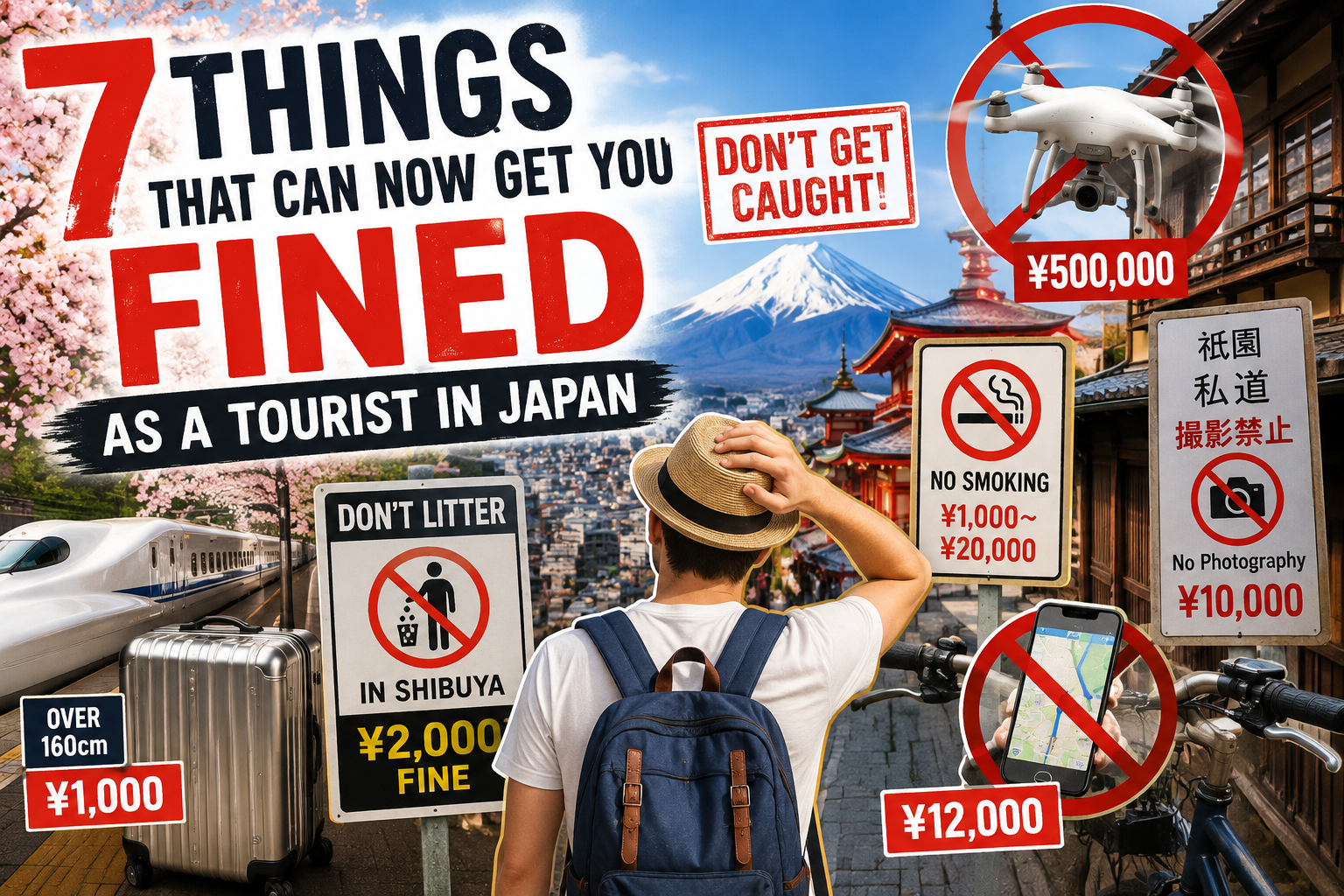
Seven rule changes now carry real, on-the-spot fines that catch tourists in Japan — from a ¥1,000 bullet-train luggage fee to a ¥500,000 drone penalty. Most took effect in 2026, and almost none of them are in guidebooks printed before this year.
- Best for: anyone taking the Shinkansen, renting a bike, visiting Gion, smoking, or bringing a drone
- Fine range: ¥1,000–¥500,000 (about $6.50–$3,100) depending on the rule
- How they’re paid: almost all are collected on the spot, in cash or by card
Search “can tourists be fined in Japan” and most results are outdated — written before this year’s biggest changes. Here’s the current answer: yes, and enforcement expanded significantly in 2026. Four of the seven rules below are brand new this year. None require breaking an obvious law; all seven are things ordinary, well-meaning tourists do by accident. The good news is that every one of them is easy to avoid once you know it exists — which is exactly what older guides don’t tell you.
1. Your Suitcase Can Get You a ¥1,000 Fine on the Bullet Train
If your bag’s combined length, width, and height exceeds 160cm, you need a free reservation for the oversized-luggage seat on the Tokaido, Sanyo, and Kyushu Shinkansen lines — the routes connecting Tokyo, Osaka, Kyoto, Hiroshima, and Fukuoka. Board without one and a conductor charges a ¥1,000 penalty on the spot, then moves your bag to a different car.

2. Checking Google Maps on a Rental Bike Can Cost You ¥12,000

From April 2026, Japan’s National Police Agency introduced a “blue ticket” (ao-kippu) system for cyclists 16 and older, including tourists. Officers can now issue on-the-spot fines for 113 minor violations that used to get a verbal warning at most.
This one catches tourists specifically because a phone is often doing everything at once on a Japan trip — map, translator, train times, hotel address. Check your route before you start riding, not while moving.
3. Dropping Trash in Shibuya Now Means an Instant ¥2,000 Fine

Since June 1, 2026, patrol staff in Shibuya Ward can issue an on-the-spot ¥2,000 fine for littering — cigarette butts, drink cans, food wrappers, anything — across the ward, not just around the famous crossing.
Japan’s famously trash-can-free streets used to run on social pressure alone. Shibuya is now the first ward to back that norm with an actual, immediately payable fine.
4. Lighting Up Outside a Smoking Area Can Cost ¥1,000–¥20,000
Street smoking outside designated zones is banned ward-by-ward across central Tokyo, and heated tobacco (IQOS, glo, Ploom) is usually covered too. Chiyoda, Shibuya, and Kita wards fine ¥2,000; Kyoto and Kobe fine ¥1,000 in designated zones; Fukuoka’s fine runs as high as ¥20,000 for repeat or flagrant cases. Dropping the butt afterward is a separate littering fine, even if the smoking itself goes unnoticed.
5. That Photo of a Geisha in Gion Could Cost You ¥10,000

A Gion residents’ and shop owners’ association, backed by official Kyoto city notices, has banned photography — and entry — on the district’s private side streets since 2019, with a ¥10,000 fine for violations, tightened further with multilingual signage added in 2024. The rule exists because tourists spent years chasing, cornering, and photographing geiko and maiko without consent on residential lanes.
You round a corner at dusk and a maiko in full dress crosses the street ahead of you, silk sleeves catching the last light before she disappears into a teahouse.
It’s a real moment plenty of visitors get to see — just from the public street, camera down until she’s clearly comfortable with it, not from the private alley she just came from.
6. Climbing Mt. Fuji Without a Reservation Now Isn’t an Option

All four Mt. Fuji trails now require a paid, advance reservation, and the busiest trail has a 2 PM gate cutoff for new climbers. This isn’t a fine so much as a hard stop — show up unregistered and you won’t be climbing that day at all, reservation or refund be damned.
Most guides still describe Fuji as a walk-up climb. That description is now several rule changes out of date.
7. Flying a Drone in the Wrong Spot Can Cost ¥500,000
Any drone 100g or heavier must be registered with Japan’s MLIT before you fly it — tourists included, no exceptions for a short visit. That’s the easy part. The harder part: nearly all of central Tokyo, Kyoto, and Osaka are classified as “densely inhabited districts,” where flying without a specific permit is illegal regardless of registration, and most temples, shrines, and city parks add their own outright bans on top of that.
If aerial shots are the goal, the realistic move is a legal outer-Tokyo location — Okutama, Mount Takao, or the Enoshima coast are all a day trip away and don’t require the near-impossible urban permit process.
What This Means for Your Trip
The common thread across all seven: none of this is Japan becoming unfriendly to tourists. It’s Japan responding to record visitor numbers by finally attaching real consequences to rules that used to run on a verbal warning or an honor system. Every one of these fines is easy to avoid once you know the rule exists — which is exactly the part most pre-2026 guidebooks and blog posts haven’t caught up to yet.
The practical takeaway: check signage before you photograph, register a drone before you pack it, reserve your Shinkansen seat and your Fuji trail before you show up, and treat “I didn’t know” as no longer a real excuse — enforcement in 2026 is built specifically to close that gap.
| Rule | Typical Fine | Where It Applies | Effective |
|---|---|---|---|
| Oversized Shinkansen luggage, no reservation | ¥1,000 | Tokaido, Sanyo, Kyushu lines | Ongoing (2020, refined 2025) |
| Bicycle “blue ticket” (phone use) | ¥12,000 | Nationwide, riders 16+ | April 2026 |
| Littering | ¥2,000 | Shibuya Ward (other wards vary) | June 2026 |
| Street smoking outside zones | ¥1,000–¥20,000 | Ward-by-ward, most major cities | Ongoing, varies by ward |
| Gion private-street photography | ¥10,000 | Kyoto’s Gion district | 2019, tightened 2024 |
| Unreserved Mt. Fuji climbing | Turned away, no refund | All 4 Fuji trails | 2026 season |
| Unregistered / restricted-zone drone flight | Up to ¥500,000 | Most cities, temples, parks | Registration since 2022, zones tightened 2026 |
FAQ
- Are tourists actually fined the same as locals in Japan?
- Yes. None of these seven rules carve out an exception for visitors — Japanese traffic, littering, and drone law applies to anyone physically breaking the rule, tourist or resident.
- What’s the most expensive tourist fine in Japan right now?
- Flying a drone without registration or in a restricted zone, which carries a penalty of up to ¥500,000 (about $3,100) and possible criminal prosecution.
- Do I need cash to pay an on-the-spot fine?
- Usually not anymore. Shibuya’s littering patrols carry mobile card terminals, and most bicycle blue tickets are paid later at a bank or post office within eight days. Cash still works everywhere these are accepted.
- Are these fines new, or have they always existed?
- Mixed. The bicycle blue-ticket system and Shibuya’s littering fine are brand new in 2026. Gion’s photography ban dates to 2019. Shinkansen luggage rules have existed since 2020 but were refined further in 2025.
- Will a fine affect my visa or future entry to Japan?
- For the fines on this list, generally no — these are administrative penalties, not criminal charges, except in serious or repeated drone violations, which can escalate to criminal prosecution.
- What’s the easiest way to avoid all of these?
- Reserve Shinkansen luggage seats and Fuji trail permits in advance, don’t touch your phone while cycling, use a bin (or hold your trash) in Shibuya, photograph only on Gion’s main public streets, and register any drone before you pack it.