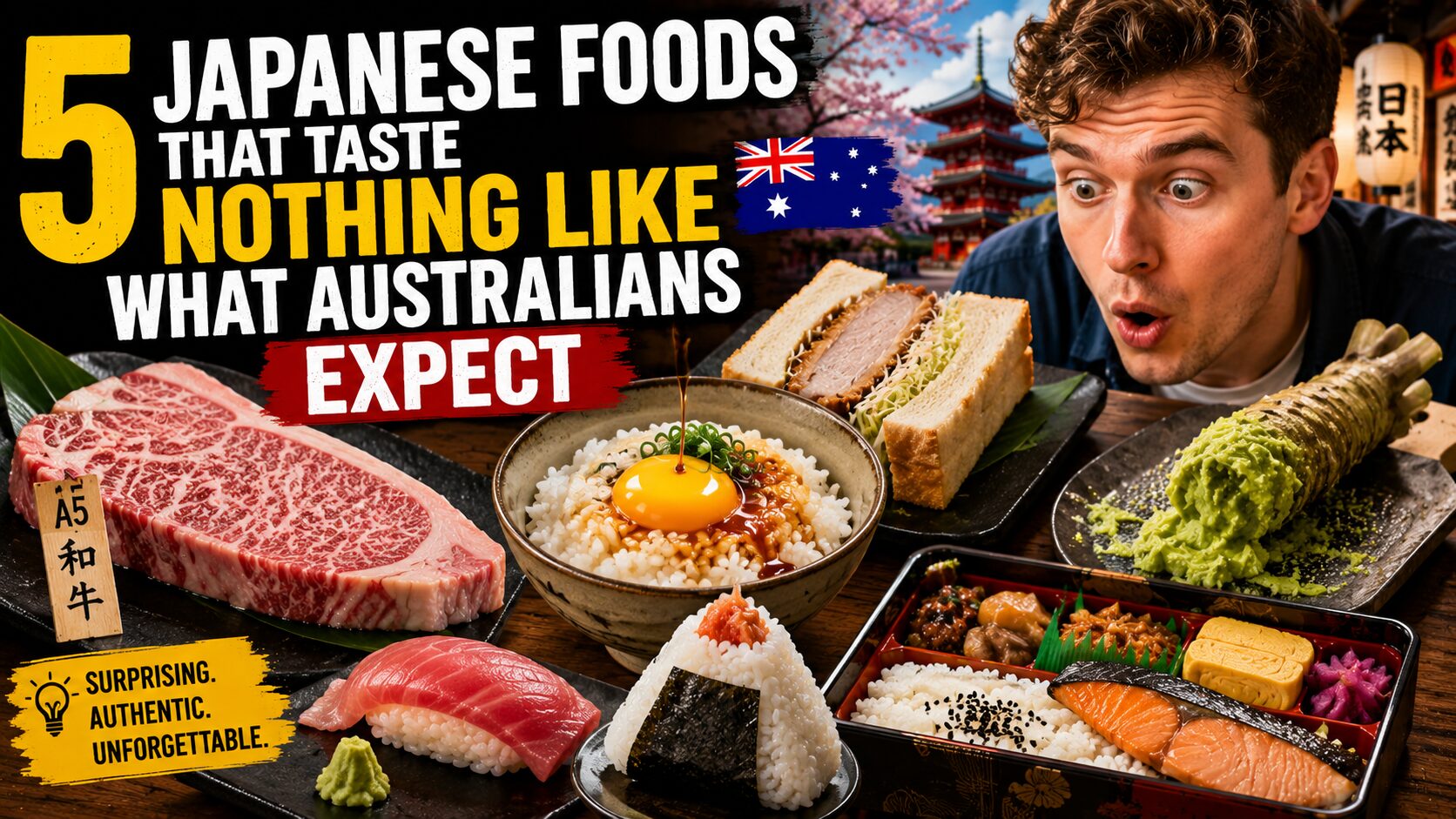
Australia is one of the biggest Wagyu-producing countries on earth. Most Australians still assume Japanese Wagyu is basically the same thing, just imported.
It isn’t — and the gap explains a lot about the other four foods on this list too.
⭐ Bottom Line
Five everyday Japanese foods consistently surprise Australian visitors, not because they’re exotic, but because Australia already has a version — and the Japanese original works completely differently.
- Best for: travelers who think they already know Japanese food from home
- Budget: most of these cost under $15 AUD per serving, even the famous one
- Try first: tamago kake gohan (raw egg on rice) — the one Australians are most nervous about and most won often win over
Here’s the number that reframes the whole list: Australia holds the world’s second-largest Wagyu herd, yet it’s still tiny next to Japan’s roughly 1.8 million head. Most Australians have eaten Wagyu. Very few have eaten Japanese Wagyu, and the difference is bigger than a shipping label — it comes down to genetics, feeding regimens, and grading systems that don’t map cleanly onto each other at all.
None of these five are obscure or hard to find — they’re everyday foods, sold everywhere from convenience stores to train station counters. The surprise isn’t in tracking them down. It’s in how different they turn out to be once you’ve actually tasted the real version against the mental picture you brought from home.
1. Wagyu: Sweeter, Richer, and Impossible to Eat a Full Steak Of
Australian Wagyu is mostly crossbred, grain-fed for 350–450 days, and graded 0–9 on the AUS-MEAT scale — robust and beefy enough to eat a full 12-ounce steak without your palate giving out. Japanese Wagyu is fed 600+ days on a stricter regimen, graded on a 1–12 BMS scale plus a letter yield grade, and the resulting marbling is so rich that most people can only comfortably eat 4–6 ounces before it becomes overwhelming.
The word itself is part of the confusion: “wagyu” simply means “Japanese cow,” and Australia’s herd — the world’s second largest, though still a fraction of Japan’s roughly 1.8 million head — descends from Japanese bloodlines crossed mostly with Angus cattle. Fullblood Australian Wagyu, genetically closest to the Japanese original, exists but is far less common on menus than crossbred versions.

2. Raw Egg on Rice: Safe by Design, Not by Luck
Tamago kake gohan — hot rice, a cracked raw egg, a splash of soy sauce — is a genuine everyday breakfast in Japan, not a dare. It’s been part of daily life since a journalist popularized the dish in 1872, and it’s so ordinary today that calling it “cooking” feels like an overstatement. It’s safe largely because of how Japanese egg production works: vaccinated hens, ozone-washed shells, and automated “super egg machines” that scan each egg for blood spots before packaging. Estimated in-egg salmonella risk in the US runs around 0.005% (roughly 1 in 20,000 eggs); Japan’s equivalent risk is generally cited as lower still.
The hot rice matters as much as the egg itself — when raw egg meets rice around 80°C, the proteins gently set, creating a silky, almost carbonara-like texture rather than something merely slimy.
3. Convenience Store Food: Genuinely Restaurant-Adjacent, Not Servo Snacks
Walking into a 7-Eleven, Lawson, or FamilyMart expecting Australian servo food — reheated pies, questionable sausage rolls — badly undersells what’s actually on the shelves: fresh onigiri made that morning, proper bento boxes, and hot food counters turning over stock multiple times a day. Japan’s three major chains each run their own private-label food development teams, competing seriously on taste rather than treating the food section as an afterthought to fuel and cigarettes.

4. Real Wasabi: Herbaceous, Not a Nose-Burning Dare
Most wasabi served outside Japan — and plenty served inside it — is dyed horseradish, not true wasabi root. Real wasabi is genuinely difficult to farm, needing clean running water and specific growing conditions found in only a handful of regions, which is exactly why the cheaper horseradish substitute became the global default. Genuine grated wasabi (hon-wasabi) has a green, grassy heat that fades in seconds, rather than the sinus-clearing burn horseradish delivers.
5. Milk Bread and Sando: A Texture Australia Doesn’t Really Make
Japanese shokupan (milk bread) uses a tangzhong-style method — a portion of flour and liquid pre-cooked into a paste before the rest of the dough comes together — that produces an unusually soft, faintly sweet, cloud-like crumb. It’s a different tradition entirely from Australia’s sourdough-leaning bakery culture, which prizes chew and crust over softness. Convenience store sandwiches (sando) built on this bread, especially the katsu sando, have developed a genuine international following for exactly this reason, with imitation versions now appearing on menus well outside Japan.
Picture the first bite of a proper katsu sando: bread that gives way like a pillow, a crumbed pork cutlet still audibly crisp underneath, no crust fighting you for it.
It’s a $5 convenience store sandwich that regularly out-textures $30 brunches back home — and it’s sitting in a fridge case, unremarkable, next to the drinks.
| Food | Australian Equivalent | Key Difference | Typical Price |
|---|---|---|---|
| Wagyu | Australian Wagyu (crossbred) | Richer, smaller ideal portion | AU$85–160 / 100–150g |
| Raw egg on rice | Not typically eaten raw | Engineered for raw-safety | AU$3–6 |
| Konbini food | Servo snacks | Fresh, restaurant-adjacent | AU$6–9 per meal |
| Real wasabi | Dyed horseradish paste | Milder, herbaceous, fades fast | Varies by restaurant |
| Milk bread / sando | Sourdough-style bakery bread | Airy, pillowy texture | AU$5–8 |
Who Should Seek These Out
None of these five require a food tour or a reservation weeks in advance. All five are things you’ll walk past within your first day in Japan — the only real skill involved is noticing them.
✅ Make time for all five if you are:
- Curious about food beyond the standard ramen-and-sushi checklist
- Willing to order less of something expensive to actually taste it properly
- Open to trying a raw egg with a genuinely good explanation behind it
❌ Skip the riskier ones if you are:
- Pregnant, immunocompromised, or traveling with young children — skip the raw egg specifically
- Not adventurous with texture — milk bread’s softness can feel unfamiliar at first
- On a tight food budget — save Wagyu for one deliberate splurge meal rather than every dinner
FAQ
- Is Japanese Wagyu actually better than Australian Wagyu?
- Not strictly better — genuinely different, with Japanese Wagyu sweeter and richer due to longer feeding and purebred lineage, while Australian Wagyu is more robust and easier to eat in larger portions. Which one you prefer often comes down to how much marbling and richness your palate actually enjoys in one sitting.
- Is it really safe to eat raw egg in Japan?
- Yes, for the general population — Japan’s egg production standards specifically minimize salmonella risk, though pregnant women, young children, and immunocompromised travelers should still avoid it.
- Is convenience store food in Japan actually good?
- Yes — it’s a genuinely different category from convenience food in most countries, with fresh preparation and multiple daily restocks at major chains.
- How do I know if I’m getting real wasabi?
- Real wasabi is typically grated fresh tableside or listed explicitly on the menu as hon-wasabi; the bright green paste in a small plastic packet is almost always horseradish-based.
- What’s the best place to try Japanese milk bread?
- Convenience stores and dedicated bakeries both carry it — a katsu sando from any major convenience chain is an easy, inexpensive first try.
- Are these foods easy to find outside major cities?
- Yes — convenience store food and milk bread are available nationwide, while good Wagyu and real wasabi are more concentrated in cities and specialty restaurants, though regional towns near wasabi-growing areas like Nagano and Shizuoka often serve it fresher and cheaper than Tokyo.
- Should I be worried about food safety in Japan generally?
- No — Japan maintains some of the strictest food hygiene standards in the world, which is precisely why practices like raw egg consumption that would be risky elsewhere are considered safe and unremarkable there.