Japan has dozens of trains marketed as “scenic.” Most guides list them all together, as if they’re interchangeable.
Pick the wrong one for your season and your route, and you’ve burned a full day on a train that shows you nothing.
⭐ Bottom Line
Five routes stand well above the rest, but each one only makes sense for a specific season, region, and traveler — get the match wrong and even the “best” route disappoints.
- Best for: travelers building one dedicated scenic-train day into a longer Japan itinerary
- Cost: CAD $15–60 for most routes; JR Pass covers several but not all
- Time it right: two of the five routes below don’t run year-round at all
Here’s the detail that trips up most first-time planners: the JR Pass covers the Tadami Line, the Gono Line, and every Shinkansen except the fastest Nozomi and Mizuho services — but it doesn’t cover several of the most photographed scenic trains in the country, including the Sagano Romantic Train and the Kurobe Gorge Railway, both privately operated. Assuming pass coverage before booking is one of the most common planning mistakes for this specific category of trip, and it’s an easy one to make since so many of these routes get lumped together in generic “best scenic trains” lists without noting who actually operates each line.
So this isn’t a simple ranked list. It’s a comparison by the factors that actually decide which route fits your trip: season, region, budget, and the kind of scenery you’re actually chasing. A route that’s genuinely the best in the country during its short operating window is worthless to someone travelling the wrong month — the “best” answer only exists once you know your own constraints.
Which Season You’re Traveling In
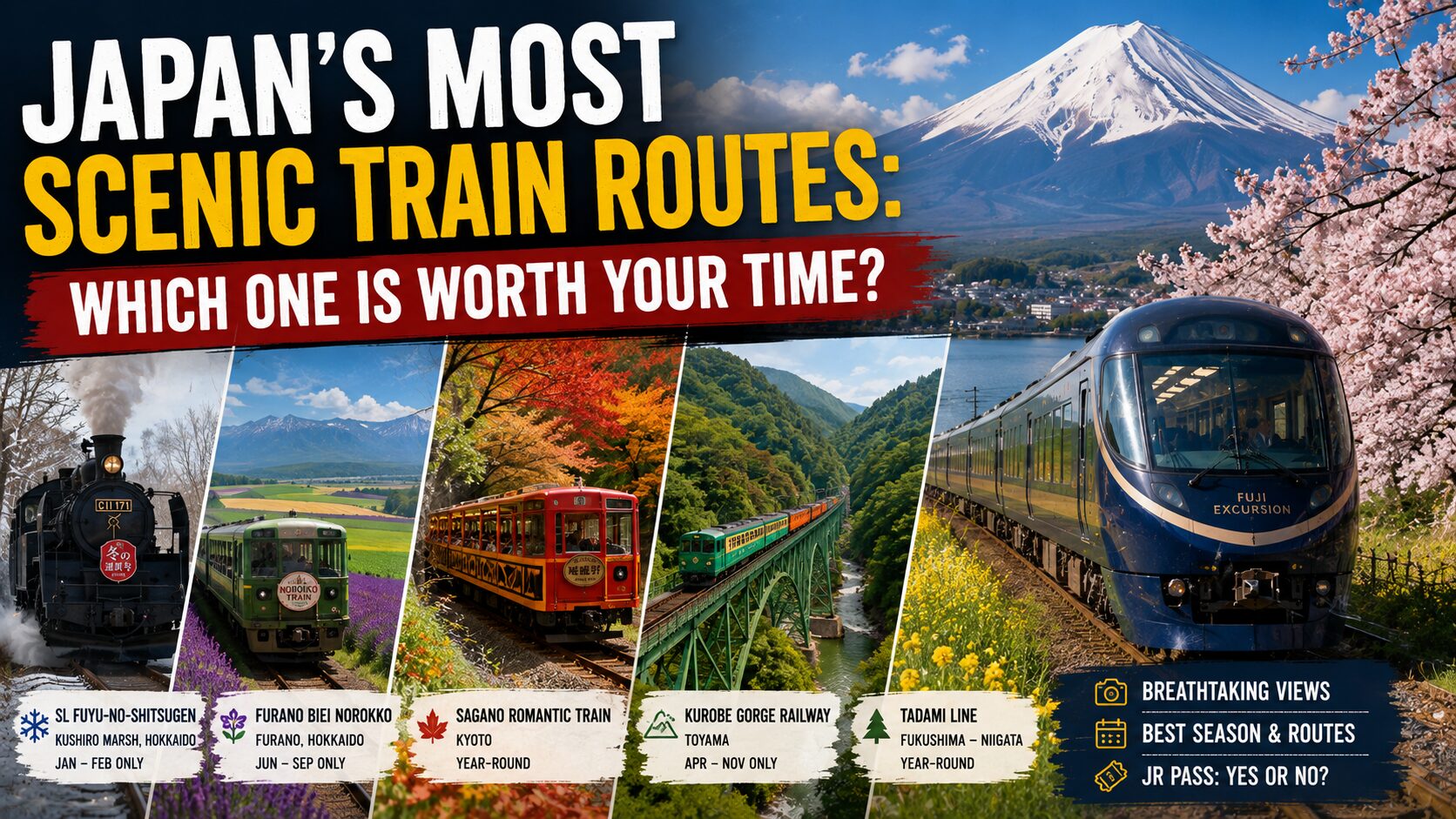
This factor eliminates options faster than any other. The SL Fuyu-no-Shitsugen steam train through Hokkaido’s Kushiro Marsh, with red-crowned cranes visible along the route, operates only in January and February. The Furano Biei Norokko open-air train through Hokkaido’s flower farms runs only June through September, timed to the lavender bloom that draws visitors to the region in the first place. The Kurobe Gorge Railway and the Tateyama Kurobe Alpine Route both close for winter entirely, reopening only once snow-clearing allows safe passage through the mountains — a process that can push the opening date later some years depending on snowfall.
How Close to Tokyo You’re Starting
The Fuji Excursion train reaches the Fuji Five Lakes region in about two hours from Tokyo, making it the easiest scenic route to slot into a standard itinerary without restructuring the whole trip — the spacious seating and large windows are specifically designed for sightseeing rather than pure commuting. The Sagano Romantic Train, running along Kyoto’s Hozu River gorge, works the same way for travelers already based in Kansai, sitting close enough to central Kyoto that it barely counts as a detour.
The Kurobe Gorge Railway in Toyama and Hokkaido’s steam and flower-farm trains sit much further out, each requiring a genuine day-trip commitment or an overnight stay nearby to make the travel time worthwhile. For Canadians already planning a Hokkaido leg around skiing or an onsen stay, the region’s scenic trains slot in naturally; for anyone without an existing reason to be in Hokkaido or Toyama, the travel time alone is worth weighing honestly before committing.
Budget and JR Pass Coverage
The Tadami Line, running through snow-covered forests in winter and reflecting autumn foliage off the Tadami River in fall, is fully JR Pass-covered — effectively free if you’re already holding one, since it operates as a standard JR East local line rather than a separately ticketed tourist train. The Sagano Romantic Train and Kurobe Gorge Railway are both privately operated and charge separately, typically CAD $15–35 one-way, regardless of any JR Pass you’re carrying, since neither falls under JR’s network at all.
The Fuji Excursion sits in between: it runs on JR tracks for part of its route but requires a limited express surcharge on top of any base pass, so budget for a small additional fee even with a JR Pass in hand.
What Kind of Scenery You’re Actually Chasing
Gorge and mountain drama belongs to the Kurobe Gorge Railway in Toyama, running through a dramatic ravine via a narrow-gauge line originally built for dam construction — open-air carriages put you directly in the mountain air rather than viewing it through glass. River and bamboo scenery belongs to the Sagano Romantic Train, its Hozu River gorge view changing completely by season — cherry blossoms in spring, cicada season greenery in summer, fire-toned maples in autumn, and occasional evening illumination events layered on top.
Alpine drama at serious scale belongs to the Tateyama Kurobe Alpine Route, home to the famous snow corridor where cleared walls of snow tower well above a standard bus, sometimes reaching 20 metres in peak years. Wetland and wildlife belongs to Hokkaido’s winter steam train, the only entry on this list built around spotting an animal — the red-crowned crane — rather than the landscape alone, with the marsh’s stark white winter palette making the birds’ red crowns strikingly visible from the windows.
Picture the exact moment a steam whistle cuts through silent, snow-blanketed marshland, and a pair of red-crowned cranes lift off just ahead of the tracks.
It’s an eight-week window, in one specific region, and it’s not remotely replicated by any other train on this list.
| Route | Region | Season | JR Pass Covered |
|---|---|---|---|
| Sagano Romantic Train | Kyoto | Year-round | No |
| Fuji Excursion | Yamanashi (near Tokyo) | Year-round, best clear weather | Partial |
| Kurobe Gorge Railway | Toyama | Spring–Autumn (closed winter) | No |
| Tadami Line | Fukushima | Best autumn and winter | Yes |
| SL Fuyu-no-Shitsugen | Hokkaido | January–February only | Partial |
Who Should Choose Which Route
None of these five routes are a wrong choice on their own merits — the mismatches happen entirely at the planning stage, when season, region, and budget don’t get checked against the actual trip dates before booking.
✅ Prioritize a dedicated scenic-train day if you are:
- Building your itinerary around nature and landscape over city sightseeing
- Flexible enough to time a trip around a narrow seasonal window, if chasing Hokkaido’s winter steam train or the alpine snow corridor
- Already holding a JR Pass and want to maximize routes it actually covers
❌ Stick to one easy add-on if you are:
- On a tight, city-focused itinerary with little flexibility for full day trips
- Traveling outside a route’s operating season without realizing it
- Budget-conscious and unwilling to pay separately for privately operated lines
FAQ
- Which scenic train is easiest for a first-time visitor?
- The Sagano Romantic Train or the Fuji Excursion, both close to major cities, running year-round, and requiring no overnight stay to fit into a standard itinerary. Either works well as a first scenic-train experience before attempting one of the more remote, seasonal routes.
- Does the JR Pass cover the Sagano Romantic Train?
- No — it’s privately operated and charges a separate fare regardless of any JR Pass.
- When does the Kurobe Gorge Railway operate?
- Roughly spring through autumn, closing entirely through winter months when snow makes the mountain route impassable.
- Is the Hokkaido winter steam train worth planning a whole trip around?
- For wildlife and winter-scenery enthusiasts, yes — but its January–February window is narrow enough that it needs to be the anchor of your dates, not an afterthought.
- What’s the most beautiful scenic train for autumn foliage?
- The Tadami Line is frequently cited as one of the most beautiful in the country for autumn, with foliage reflecting directly off the Tadami River — and since it’s JR Pass-covered, it’s also one of the most accessible options for that season.
- Can I combine more than one scenic train route in a single trip?
- Yes, if they’re in the same general region — pairing the Sagano Romantic Train with Kansai sightseeing, or the Fuji Excursion with a Tokyo-based itinerary, works well without major detours.
- Do I need to reserve seats on scenic trains in advance?
- For the more popular privately operated routes, yes — the Sagano Romantic Train and Kurobe Gorge Railway can sell out during cherry blossom and autumn foliage peaks, so booking a few days to a couple of weeks ahead is worthwhile.
- Is the Tateyama Kurobe Alpine Route a train the whole way?
- No — it’s a multi-stage journey combining trains, cable cars, and buses across the mountain range, with the snow corridor specifically experienced by bus rather than rail.