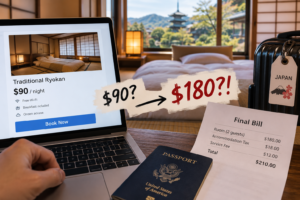
A ryokan listing shows ¥18,000 a night, and a lot of first-time bookers open their wallet expecting to pay it once.
They’re about to be surprised twice in one evening — once at checkout math, and once at dinner.
⭐ Bottom Line
A traditional ryokan stay is priced per person, not per room, typically includes a multi-course kaiseki dinner and breakfast, and runs on a fixed evening schedule most first-timers don’t expect.
- Best for: travelers who want at least one night built entirely around Japanese hospitality, not just a place to sleep
- Budget: ¥15,000–30,000 per person, per night is the range most travelers actually book
- Book ahead: 1–3 months for most properties; popular onsen towns and cherry blossom or foliage dates need longer
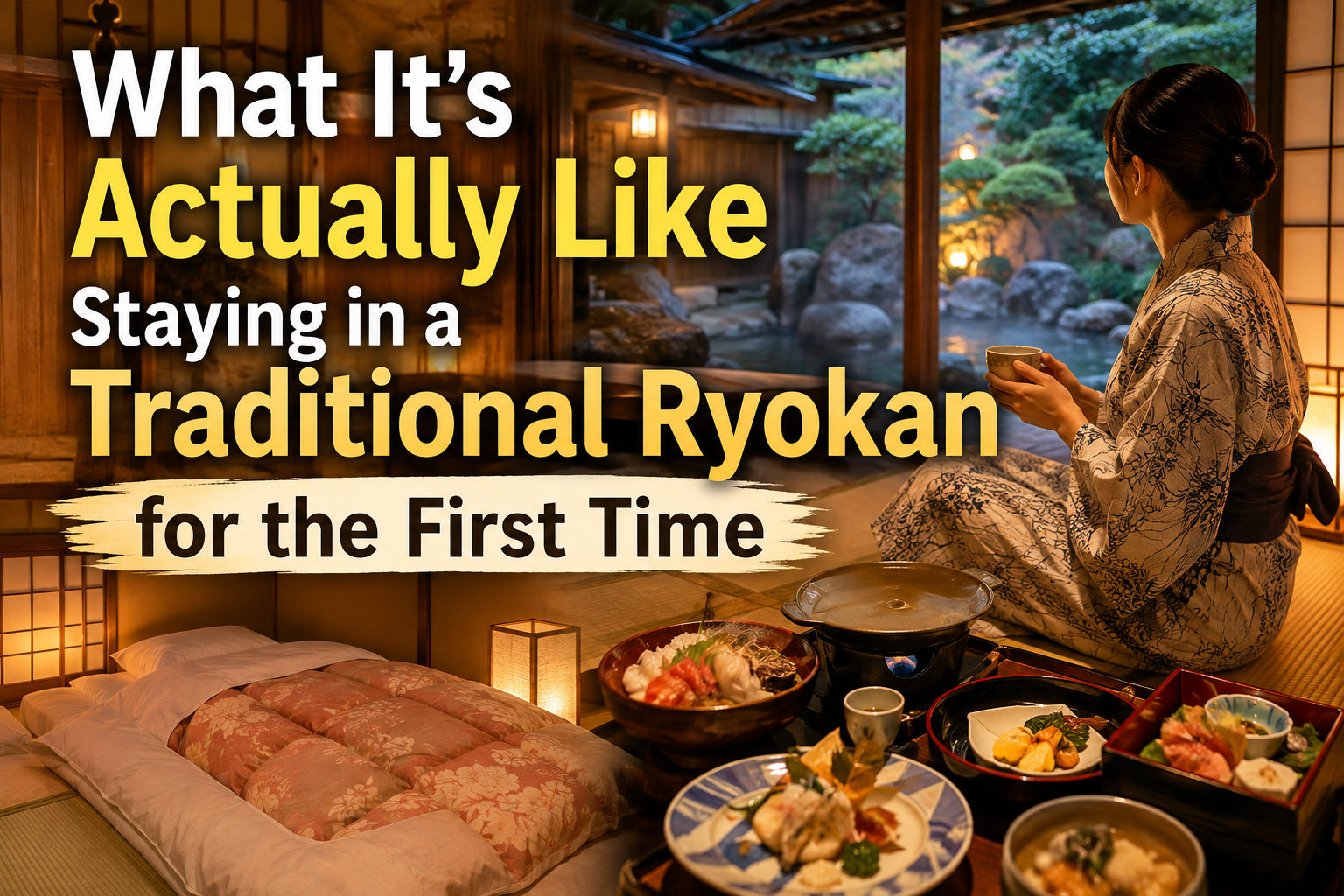
Here’s the direct answer to what a first ryokan stay is actually like, from arrival to checkout: you arrive in the afternoon, soak in a hot spring bath before dinner, eat a multi-course kaiseki meal served on a fixed schedule around 6 PM, change into a cotton yukata robe for the rest of the evening, sleep on a futon laid out on tatami flooring, and bathe again before or after breakfast. Almost everything about the evening is structured — which is exactly what makes it relaxing once you know the shape of it, and disorienting if you don’t.
None of this requires fluent Japanese, a big budget, or prior experience. It does require knowing a handful of things before you arrive, because a ryokan won’t necessarily explain them to you in English at check-in — and the small details are exactly what separate a first-timer who spends the evening quietly stressed from one who spends it actually relaxed.
Do You Need to Speak Japanese?

No — but the level of English support varies more than at a Western-chain hotel. City ryokan and larger onsen resorts in well-known towns typically have some English-speaking staff and English menus. Smaller, family-run properties in quieter towns sometimes don’t, though most now use translation apps comfortably and are used to foreign guests pointing and gesturing through the basics.
Booking is the one place language can actually matter. Major platforms (Rakuten Travel, Booking.com, Japanese Guest Houses) list ryokan in English with clear policies, which is the simplest way around any language gap entirely.
The Number on the Listing Isn’t What You’ll Pay
This is the single most common point of confusion for first-time bookers: ryokan prices are quoted per person, not per room. A ¥18,000 nightly rate for two guests means ¥36,000 total, not ¥18,000 — because the price bundles your room, dinner, breakfast, and bathing access as an individual package, not a flat room charge.
| Tier | Price per person/night | What’s included | Best for |
|---|---|---|---|
| Budget | ¥8,000–15,000 | Simple room, shared baths, may exclude meals | First-timers testing the format on a tight budget |
| Mid-range | ¥15,000–30,000 | Private or semi-private bath option, full kaiseki dinner | Most first-time visitors — the standard “real” experience |
| Luxury | ¥30,000–100,000+ | Private in-room open-air bath, premium kaiseki, dedicated attendant | Anniversaries, honeymoons, a single splurge night |
| Room-only (sudomari) | ¥6,000–13,000 | Room and bath access, no meals included | Travelers who’d rather eat at local restaurants |
The Order Nobody Explains: Bath, Dinner, Bath Again

The traditional order is bathe, then dinner, then a second bath before bed. Staff lay out your futon while you’re at dinner, so the room you left in the afternoon looks different by the time you return to it. Dinner itself typically runs 8 to 12 courses, served between 6:00 and 7:00 PM, prepared using ingredients ordered specifically for your stay — arriving noticeably late is genuinely disruptive to the kitchen, not just a minor faux pas.
Stepping from a steaming outdoor bath into cool evening air, then sitting down minutes later to the first course of a kaiseki dinner as the light fades outside your window — that specific sequence is what a ryokan stay is actually selling.
The honest caveat: the fixed timing means it’s not a spontaneous, order-whenever-you-want evening. You’re moving on the ryokan’s schedule, not your own.
You don’t need to know the name of every course or the “correct” way to eat each one. Staff expect first-timers, and the meal is designed to be experienced course by course rather than decoded in advance.
The Question About Tattoos Nobody Wants to Ask
Tattoo policies genuinely vary by property, and it’s a real, common source of anxiety for travelers who have one. Some ryokan still prohibit visibly tattooed guests from communal baths, a holdover association with organized crime in Japan. Many properties offer a private bath (kashikiri) that sidesteps the issue entirely, either included in your stay or bookable for an extra fee and a set time slot.
This is worth raising even if it feels awkward, because the alternative — arriving and discovering a policy at check-in — is a far worse version of the same conversation. Most booking platforms don’t surface tattoo policy as a filter, so a short email in plain English, sent a week or two ahead, is usually enough to get a clear answer and, if needed, a kashikiri slot held for you.
What Happens If You Need to Cancel

Ryokan cancellation policies are stricter than most Western hotels for a specific reason: kaiseki ingredients are ordered in advance for your exact reservation. Cancellation fees commonly kick in 7 to 10 days before arrival, and some properties charge close to the full rate inside a 3-day window. This isn’t a punitive policy — it’s a direct pass-through of a cost the ryokan has already committed to on your behalf.
If your itinerary still has any uncertainty — a flight that could shift, a connecting trip that depends on weather — it’s worth booking the ryokan night last among your reservations, or choosing a property that explicitly advertises a shorter cancellation window. Travel insurance that covers prepaid, non-refundable lodging is also worth checking before this specific booking, more than for a standard hotel night.
Your First Evening, Hour by Hour
Roughly what to expect, start to finish: check-in and tea in the afternoon, usually from 3 PM; time to explore the room and change into your yukata; a soak in the bath before dinner; kaiseki dinner around 6–7 PM while staff prepare your futon; a second, quieter bath afterward if you’d like one; sleep on the futon; breakfast the next morning, often on a similarly fixed schedule; checkout, typically by 10–11 AM.
None of these times are rigid to the minute, and staff will work with you if you’re running a little late from sightseeing. What matters is the overall shape: this is a stay built around a sequence, not a hotel room you come and go from freely all evening. Travelers who arrive expecting total Western-hotel flexibility are the ones most likely to feel thrown off by a ryokan; travelers who arrive expecting a rhythm to follow tend to describe the same evening as the highlight of their whole trip.
✅ Book a ryokan if you are:
- Comfortable with a structured evening rather than an à la carte one
- Budgeting per person, not per room, from the start
- Fine with limited or no English at smaller properties
- Looking for one specific, memorable night rather than your whole trip’s lodging style
❌ Reconsider a ryokan if you are:
- Traveling with young kids who can’t sit through a multi-course, fixed-time dinner
- Needing guaranteed flexible check-in or late arrival
- Set on fully public baths and uncomfortable with a visible-tattoo policy at a given property
- Traveling on a tight per-room budget without adjusting for per-person pricing
Frequently Asked Questions
- Do I need to speak Japanese to stay at a ryokan?
- No. Larger and city-area ryokan often have English-speaking staff, and even where they don’t, dinner and check-in are manageable with gestures, translation apps, and a few basic words.
- Is a ryokan stay safe for first-time visitors unfamiliar with the customs?
- Yes. Staff are accustomed to first-time and foreign guests, and nothing about ryokan etiquette is enforced strictly against visitors who make an honest attempt to follow along.
- Why is the price per person instead of per room?
- Because the rate bundles individual services — a full kaiseki dinner, breakfast, and bathing access — rather than just a bed, so pricing follows the number of guests rather than the room itself.
- What if I have a tattoo?
- Policies vary by property. Many ryokan offer a private bath (kashikiri) as a workaround, but it’s worth emailing ahead to confirm the specific rules before booking rather than assuming.
- Can I skip the included dinner if I’d rather eat elsewhere?
- Some properties offer a room-only (sudomari) rate without meals, generally in the ¥6,000–13,000 per person range, though most traditional ryokan are built around the full dinner-and-breakfast experience.
- How far in advance should I book a ryokan?
- 1 to 3 months is typical for most properties. Popular onsen towns during cherry blossom season, autumn foliage, or crab season in coastal areas can sell out considerably further ahead.