The Best Japanese Food Doesn’t Have an English Name
Japanese cuisine has given the English language several words it didn’t have before: sushi, ramen, tempura, yakitori. These have crossed over because they found audiences outside Japan willing to pay for approximations of the original. But Japanese food culture runs far deeper than the crossover hits — and some of its most distinctive, most beloved, most Japan-specific foods remain unknown outside the country simply because no Western equivalent exists to translate them into.
This is a list of those foods. Not the internationally famous ones. The ones that take international visitors by surprise, that generate the most food photos sent home, and that are hardest to find or replicate once the trip is over. Where to find each one is included, because half the pleasure is the discovery.
1. Tamago Sando (コンビニのたまごサンド)
(引用:https://www.moneypost.jp/uploads/2021/03/12/tamago_3-1.jpg)
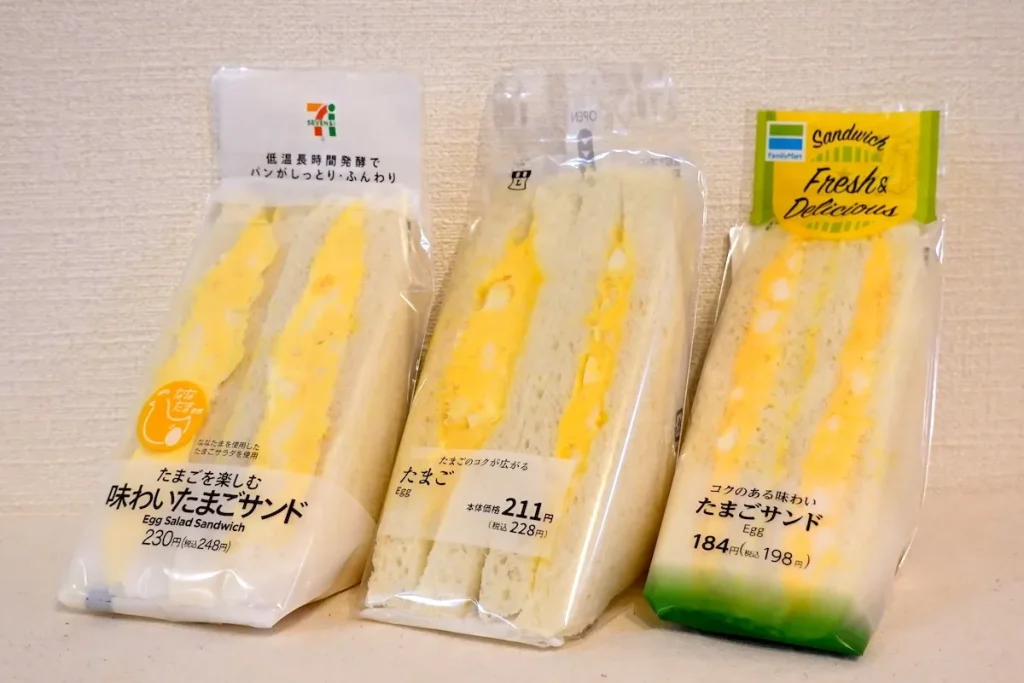
The egg sandwich at a Japanese convenience store — specifically the shokupan (Japanese milk bread) version filled with a smooth, slightly sweet egg salad — is one of those foods that produces a disproportionate reaction in first-time visitors. It looks ordinary. The bread is white and soft, the filling is pale yellow, the packaging is unremarkable. And then you eat it, and you understand why Japanese convenience store food has a global reputation it absolutely deserves.
The filling is made from hard-boiled eggs mashed with Japanese mayonnaise (Kewpie brand, made with rice vinegar and egg yolks only, distinctively richer than Western mayo) and a small amount of sugar. The bread is the key: shokupan is made with tangzhong, a cooked flour and water mixture that produces a uniquely soft, pillowy texture with a faint sweetness that has no equivalent in Western bread. The combination costs ¥220–¥270 and is better than most cafe sandwiches at twice the price.
Where to find it: 7-Eleven, FamilyMart, and Lawson — any Japanese convenience store. Available everywhere, all day. The 7-Eleven version (Tamago Salad Sando) and Lawson’s equivalent are both excellent. Fresh batch typically restocked by 8am.
2. Hitsumabushi (ひつまぶし)
(引用:https://www.maruya-honten.com/)
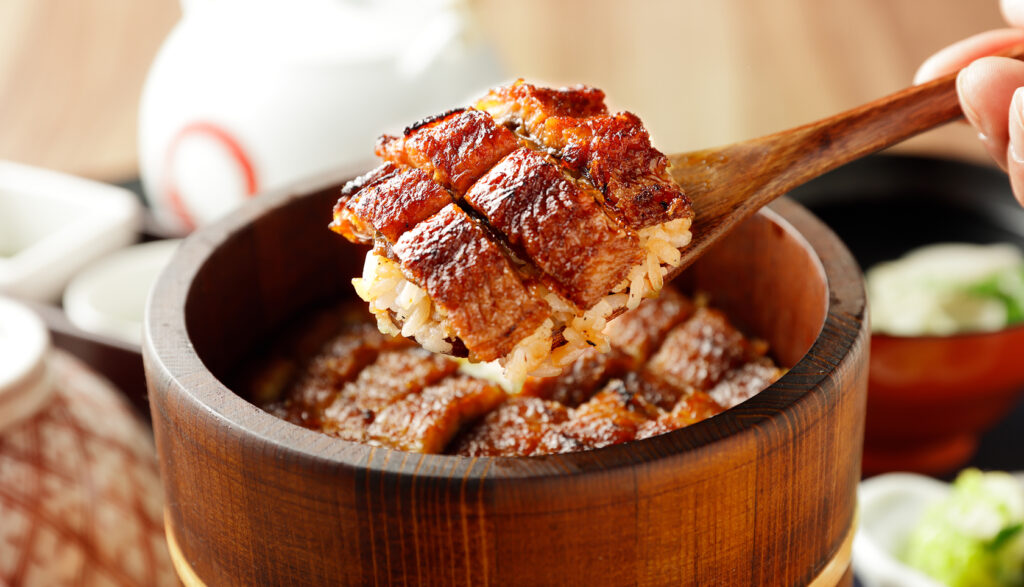
Hitsumabushi is the Nagoya method of serving unagi (freshwater eel) over rice, and it is one of the most carefully constructed eating rituals in Japanese food culture. The dish arrives in an ohitsu (a wooden serving vessel) with the lacquered eel cut into small pieces over white rice. You eat it in three stages, each with instructions provided on a printed card: first, as is, from the vessel to a rice bowl; second, with the provided condiments (wasabi, nori, spring onion) mixed in; third, as ochazuke — with dashi broth poured over the remaining rice and eel to create a savory tea-rice soup.
Each stage genuinely tastes different. The third stage in particular — the broth diluting and warming the remaining rice, softening the eel skin — is a different experience from the first two. The dish rewards patience and sequential eating in a way that most restaurant food doesn’t require.
Where to find it: Nagoya is the origin and has the best versions. Atsuta Horaiken (founded 1873) is the most famous hitsumabushi restaurant in Japan, with queues routinely exceeding 90 minutes at peak times. Worth it. In Tokyo, Nodaiwa in Azabu-Juban serves a comparable version of the Edo-style grilled eel that predates the Nagoya presentation.
3. Kissa Morning (喫茶店モーニング)
(引用:https://cdn-ak.f.st-hatena.com/images/fotolife/M/Meshi2_IB/20160719/20160719152848.jpg)
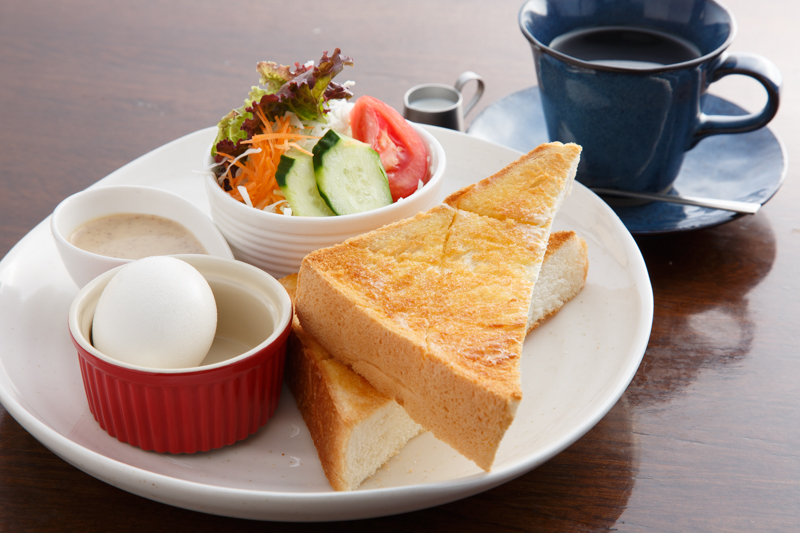
The kissa morning — morning set at a traditional Japanese coffee shop — is a breakfast institution with no equivalent in any other food culture. The concept originated in Nagoya in the 1950s: coffee shops, competing for morning customers, began offering free food with the purchase of a morning coffee. The tradition evolved until the morning set became the economic anchor of the entire kissa (kissaten, or traditional Japanese coffee shop) business model.
A typical kissa morning set costs ¥350–¥550 for a coffee and includes, at minimum, a thick slice of toasted shokupan with butter and jam, a soft-boiled egg, and sometimes a small salad. At Nagoya kissaten, the morning set has escalated over decades to include additional items — small dishes of pasta salad, mini desserts, additional bread — that effectively constitute a full breakfast for the price of the coffee alone.
Where to find it: Nagoya’s Komeda Coffee is the most famous kissa chain and the gold standard of the morning set; locations throughout Japan but most concentrated in the Nagoya area. In Tokyo, independent kissaten in residential neighborhoods like Shimokitazawa, Koenji, and Sangenjaya serve morning sets. Look for coffee shops with handwritten signs indicating モーニング (morning) service, available typically 7am–11am.
4. Teppan Napolitan (鉄板ナポリタン)
(引用:https://hicbc.com/magazine/article/?id=delalover-column-23092101)
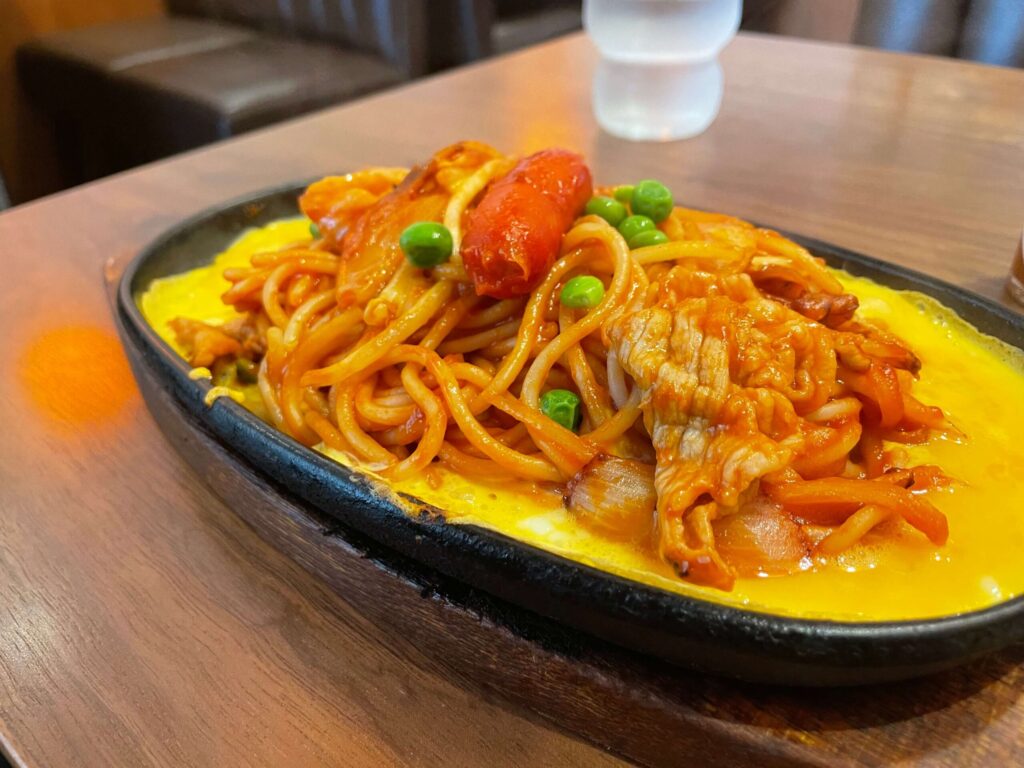
Napolitan is Japan’s version of spaghetti with tomato-based sauce — developed in occupied postwar Japan using American ketchup as the primary sauce ingredient, named after Naples despite having no Italian precedent, and now a genuinely beloved part of Japanese comfort food culture. Teppan Napolitan adds a specific serving method: the pasta arrives sizzling on a cast-iron teppan (iron plate), often with a raw egg cracked over the top that cooks on contact with the hot metal. You stir the egg through the pasta at the table.
The dish is aggressively nostalgic for Japanese people who grew up eating it at school cafeterias and family restaurants in the 1970s–1990s. For international visitors, it represents something genuinely novel: a food culture borrowing an ingredient (ketchup), transforming it into something distinct, and then maintaining it as a serious comfort food for 70 years.
Where to find it: Traditional kissaten and retro-style yoshoku (Western-influenced Japanese) restaurants across Japan. Tokyo’s Ginza has several kissaten serving classic versions. Look for yoshoku restaurants (洋食) or old-style coffee shops with the dish on the menu.
5. Cake Set at a Pure Kissa (純喫茶ケーキセット)
The pure kissa — jun-kissa, or coffee shop serving no alcohol — is a Japanese institution that peaked aesthetically in the 1960s–1980s and has been slowly disappearing for 40 years. The survivors are treasures: dark wood interiors, jazz or classical music at careful volume, coffee served in ceramic cups, and a cake set (keiki setto) of coffee plus a slice of homemade cake for ¥600–¥900. The cake is typically a Western-style layer cake — cheesecake, strawberry shortcake, chocolate gateau — made in-house to a standard that rivals dedicated patisseries.
The experience is explicitly slow. These are not places designed for quick visits. Staying for 90 minutes over one coffee and one slice of cake is the correct way to use a pure kissa, and no one will rush you.
Where to find it: Ginza, Shibuya, Shinjuku, and Shimokitazawa in Tokyo all have surviving pure kissa. The website and Instagram account Jun Kissa Tokyo documents surviving locations. Kyoto’s Teramachi shopping arcade area has several well-preserved examples.
6. Noriben (のり弁)
The noriben is the most fundamental Japanese bento box — white rice topped with a sheet of nori (dried seaweed), a thin layer of soy-marinated bonito flakes under the nori to season the rice, and a small selection of side dishes (typically a piece of fried fish or chicken, tamagoyaki, pickles). It costs ¥390–¥490 at convenience stores and bento chain restaurants like Hotto Motto, and it represents an entire approach to food: complete nutrition, portioned correctly, priced fairly, eaten quietly.
What makes it worth trying: the nori layer, warmed slightly by the rice beneath it, softens to a texture that’s not quite crispy and not quite wet — a state that only exists in this specific context. The bonito flakes beneath it dissolve into the rice and season it from inside. It is the kind of food that rewards attention.
Where to find it: Hotto Motto bento chain across Japan (most accessible and highest-quality noriben at this price point), or any convenience store bento section. Hotto Motto makes their noriben fresh when ordered, which is meaningfully better than the pre-packaged convenience store version.
7. Tachigui Soba (立ち食いそば)
Standing noodle restaurants — tachigui, literally “eat while standing” — are positioned inside or adjacent to train stations across Japan, designed to serve a complete hot noodle meal in under five minutes. The soba (buckwheat noodles) or udon (thick wheat noodles) in a dashi broth costs ¥350–¥500 for a basic bowl, making it the fastest and cheapest hot meal available in Japan.
The experience is deliberately minimal: stand at a counter or waist-high shelf, order from a ticket vending machine, receive your bowl within two minutes, eat, leave. There are no seats in most locations, no table service, no lingering. The cooking method — the noodles are pre-cooked and rehydrated in hot broth to order — means the quality ceiling is lower than a dedicated soba restaurant, but the best tachi-soba shops (Fuji Soba chain in Tokyo, station-adjacent operators in Osaka and Kyoto) produce a broth that’s genuinely good by any standard.
8. Gyudon (牛丼) — The Yoshinoya Experience
(引用:https://cdn.sbfoods.co.jp/recipes/04611_l.jpg)
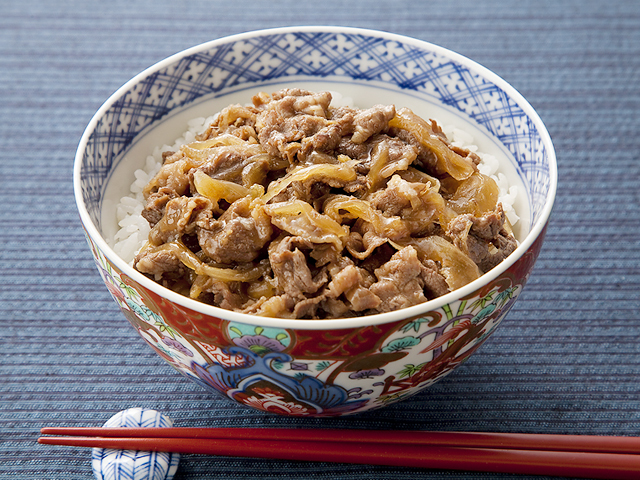
Gyudon — thinly sliced beef and onion simmered in dashi, soy, and mirin, served over rice — is one of Japan’s great working-class foods. Yoshinoya, the chain that defines the format, has been serving it since 1899. The standard bowl costs ¥426 ($2.85) and arrives within 90 seconds of ordering. It is nutritionally complete, filling, and tastes significantly better than its price and speed suggest.
For international visitors, the gyudon experience matters not just as food but as cultural observation: the long narrow counter, the solo diners eating efficiently, the specific wooden partition (mokuhei) that Yoshinoya installed between seats during COVID and never removed, the small pot of pickled red ginger (beni shoga) provided on the counter for self-service. This is Japan’s fast food, and it operates by entirely different rules than any equivalent in the West.
Where to find it: Yoshinoya, Sukiya, and Matsuya locations throughout Japan — in train stations, on shopping streets, and in standalone locations open 24 hours. Yoshinoya is the original; Sukiya has a wider toppings menu; Matsuya sells miso soup separately (buy it — the miso soup from Matsuya is genuinely good).
9. Melon Pan (メロンパン)
Melon pan is a sweet bread roll with a thin, crisp cookie crust on the outside and a soft, slightly sweet bread interior — named for the melon-like crosshatch pattern scored into the cookie layer before baking, though the traditional version contains no melon flavor. It is sold at bakeries, convenience stores, and specialized melon pan street stalls across Japan, costs ¥100–¥200, and is one of those foods that requires almost no explanation once you eat one.
The texture combination — the snap of the thin cookie shell followed by the soft enriched bread — has no precise Western equivalent. Freshly baked (look for stalls advertising yaki-tate, or just-baked), the cookie crust is at its most crisp and the bread interior is still warm. Convenience store melon pan is good; freshly baked from a specialist stall is significantly better.
Where to find it: Convenience stores everywhere. Specialist melon pan stalls in Asakusa (Tokyo), Dotonbori area (Osaka), and Nishiki Market (Kyoto). Kagetsudo in Asakusa is among the most famous melon pan destinations in Tokyo.
10. Japanese-Style Cheese Dakgalbi (チーズタッカルビ)
Cheese dakgalbi is Korean in origin — spicy marinated chicken stir-fried in a cast-iron pan — but the Japanese interpretation, developed in Tokyo and Osaka in the mid-2010s, added an escalated cheese component (typically melted mozzarella in a separate pan section or poured over the entire dish at tableside) that became a social media phenomenon before the concept filtered back to Korea. The Japanese version is distinctly different from the original: richer, more cheese-forward, often with additional toppings including rice cakes (tteok) and vegetables, designed as much for visual impact as taste.
It represents something specific about Japanese food culture: the ability to take an imported dish, refine and intensify it toward a local aesthetic, and produce a version that becomes popular in its country of origin as a Japanese innovation.
Where to find it: Specialized cheese dakgalbi restaurants in Shibuya, Shinjuku, and Harajuku in Tokyo; Dotonbori area in Osaka. Search for チーズタッカルビ on Google Maps in either city — the concentration of options reflects how fully the dish has embedded itself in Japanese food culture.
The Common Thread
What connects these ten foods is not their origin or their price point. It is that each of them is optimized for a specific context, a specific moment, a specific way of eating that developed in Japan and didn’t develop anywhere else. The convenience store egg sandwich is optimized for a four-minute train station breakfast. Hitsumabushi is optimized for slow, deliberate eating with building complexity. Tachigui soba is optimized for eating without sitting down. Each reflects something true about how Japanese food culture works: that context and execution matter as much as ingredients, and that the best meal is always the one that fits exactly where you are.
Japan has more Michelin-starred restaurants than any country in the world. But these ten foods — most of them cheap, none of them famous outside Japan — are the ones that visitors remember longest. Find them, eat them where they belong, and you will understand something about Japan that no guidebook can explain directly.
| Food | Price Range | Where to Find It | English Equivalent? |
|---|---|---|---|
| Tamago Sando | ¥220–¥270 ($1.50–$1.80) | Any 7-Eleven, FamilyMart, or Lawson | No — the shokupan bread has no Western equivalent |
| Hitsumabushi | ¥3,500–¥5,000 ($23–$33) | Nagoya (Atsuta Horaiken); Tokyo (Nodaiwa) | No — the three-stage eating ritual is unique |
| Kissa Morning Set | ¥350–¥550 ($2.30–$3.70) with coffee | Komeda Coffee chain; independent kissaten nationwide | No — the free-food-with-coffee model is Japan-only |
| Teppan Napolitan | ¥800–¥1,200 ($5–$8) | Yoshoku restaurants; Ginza-area kissaten | No — ketchup pasta with sizzling egg is Japan’s invention |
| Noriben Bento | ¥390–¥490 ($2.60–$3.30) | Hotto Motto bento chain; convenience stores | No — the softened nori-on-rice texture is untranslatable |
| Gyudon | ¥426–¥600 ($2.85–$4) | Yoshinoya, Sukiya, Matsuya — nationwide | Distant parallel to fast food, but the culture is entirely different |
| Melon Pan | ¥100–¥300 ($0.70–$2) | Convenience stores; Kagetsudo in Asakusa | No — the cookie-crust-over-soft-bread combination is unique |
Frequently Asked Questions
- Are these foods available in Tokyo, or do some require travel to specific cities?
- Most are available throughout Japan, but three are worth traveling for. Hitsumabushi is a Nagoya specialty — the versions in Tokyo exist but are notably inferior to Atsuta Horaiken. The kissa morning set in its fullest form is a Nagoya institution; Tokyo kissaten serve morning sets but with less extravagance. Cheese dakgalbi originated in Tokyo and Osaka and is widely available in both cities. The rest — tamago sando, noriben, gyudon, melon pan, tachigui soba — are genuinely national, present in every city with identical quality standards.
- Which of these are vegetarian or vegan-friendly?
- This is complicated, because most Japanese food contains dashi (fish stock) even when no fish is visible. The clearest vegetarian option on this list is melon pan (contains eggs and dairy but no meat or fish). Tamago sando contains egg but no meat. Teppan Napolitan is typically pork-free but the sauce may contain anchovy-derived Worcestershire. Gyudon is beef. Tachigui soba broth almost always contains fish dashi. If you are vegetarian, melon pan and pure-kissa cake sets are the safest options on this list; if vegan, melon pan (check the label for milk/egg content at convenience stores).
- What’s the best order to try these if I only have one week in Japan?
- Day 1 breakfast: tamago sando from 7-Eleven (¥230) before you do anything else — it sets the baseline for what Japanese food quality actually means. Day 1 lunch: gyudon at Yoshinoya (¥426, 90 seconds, eat at the counter). Day 2: tachigui soba at a train station counter. Day 3 morning: kissaten morning set. Day 4: noriben bento from Hotto Motto for lunch — eat it while sitting in a park. Day 5: pure kissa cake set in the afternoon. Day 6: teppan Napolitan for dinner at a yoshoku restaurant. If you are in Nagoya for any day: hitsumabushi for lunch. Melon pan can be picked up at any bakery at any point — buy it fresh, eat it immediately.