A recent Japanese survey found that 90% of respondents think ¥1,000 is already too much to pay for a bowl of ramen.
That same ¥1,000 ceiling — about S$8 — turns out to buy an entire tier of Japan’s best food.
⭐ Bottom Line
Ten specific dishes, all reliably under ¥1,000, deliver Japan’s actual everyday food culture better than most restaurants charging triple the price for a tourist-facing menu.
- Best for: travelers who want to eat like a local without hunting down hidden gems
- Budget: S$3–9.50 per dish, most well under S$8
- Time it right: supermarket bento gets discounted 20–50% in the evening before closing
Here’s the number that reframes Japan’s food reputation: that same ¥1,000 ramen-price survey reflects something Singaporeans will recognize immediately — a food culture where price discipline is a point of pride, not a sign of low quality, similar to how a good hawker stall earns loyalty on value as much as taste. Chain restaurants compete hard to stay under that ceiling while still delivering genuinely good food, and the result is a whole category of dishes that punch far above their price.
None of these require hunting down a hidden alley restaurant. Most are chains with hundreds of locations nationwide — the kind of food Japanese office workers eat on an ordinary Tuesday, not a special find. That’s precisely what makes the list useful: every item here is something you can walk into on your first day without any advance research or reservation.
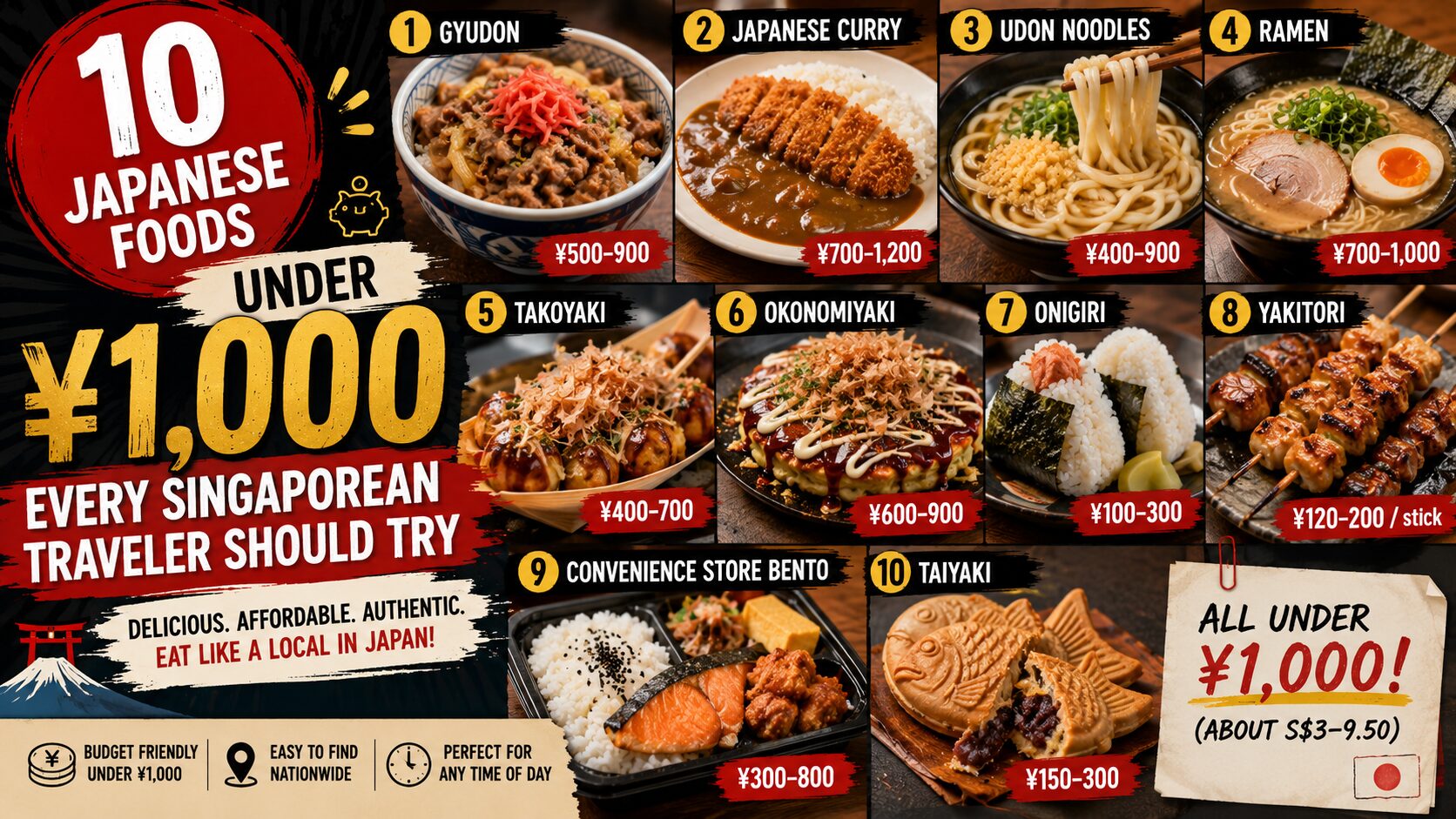
1. Gyudon (Beef Bowl)
Simmered beef and onion over rice, served in under two minutes at chains like Yoshinoya and Matsuya. ¥500–900 (S$4–7). Available nationwide, including inside most major train stations, until late at night — some locations run 24 hours, making this the reliable fallback for a late arrival or an early departure.
2. Japanese Curry Rice
A thick, mildly spiced curry over rice with a breaded cutlet option, best known through CoCo Ichibanya’s fully customizable spice-level and topping system, where you choose your own spice level from mild to extreme and add toppings individually. ¥700–1,200 (S$5.60–9.50). Found in every major city and most train stations, with picture-based ordering that makes customization easy even without reading Japanese.
3. Udon Noodles
Thick, chewy wheat noodles in hot or cold broth, at their freshest at self-serve chains like Marugame Seimen where you watch the noodles cut to order. ¥400–900 (S$3.20–7). Fastest-moving lunch option in most city centers, with a self-serve tempura counter alongside letting you build a full meal without ever waiting for table service.

4. Ramen (The Right Kind)
Despite ramen’s reputation for creeping prices, plenty of well-regarded shops still hold a basic bowl under ¥1,000 — Tokyo’s THANK in Daimon, known for a thick chicken-based broth, starts at ¥900 (S$7.10). Look for a basic bowl on the menu rather than the premium specialty version, which often adds ¥300–500 for extra toppings that don’t change the core broth quality much.
5. Takoyaki
Octopus-filled batter balls, crisp outside and molten inside, cooked fresh at street stalls throughout Osaka especially, where the dish originated and remains a genuine local staple rather than a tourist novelty. ¥400–600 for 6–8 pieces (S$3.20–4.80). Best eaten immediately, standing, while still hot — the molten center cools fast and loses its signature texture within minutes.
6. Okonomiyaki
A savory grilled pancake, customizable with pork, seafood, or cheese, with some restaurants offering a DIY grill-it-yourself table experience. ¥800–1,000 (S$6.30–7.90). Osaka and Hiroshima both claim their own distinct style — Osaka mixes everything into the batter, while Hiroshima layers ingredients including noodles in stacked stages.
Picture the grill sizzling right at your table, batter and cabbage folding together under your own spatula, the smell hitting before the first bite even happens.
It’s dinner and a small performance, for under S$8.
7. Tsukemen
A deconstructed ramen — cold noodles served alongside a separate, concentrated hot dipping broth, for dipping rather than swimming, keeping the noodles firmer and the broth flavor more concentrated than standard ramen. Tokyo’s long-running Fuuji charges ¥1,000 (S$7.90) for its signature bowl.
8. Tempura Don
Battered, fried seafood and vegetables over rice, at their most consistent at chains like Tenya. ¥600–1,000 (S$4.80–7.90). A lighter option than curry or gyudon for a midday meal, with the batter kept notably thinner and crisper than tempura served at higher-end restaurants.
9. Standing Sushi Bars
No-frills counters where you eat standing, order set menus, and pay a fraction of a sit-down sushi restaurant’s price. Set menus routinely stay under ¥1,000 (S$7.90) for a genuine, fresh sushi experience — a meal that would run well over S$30 at a comparable sit-down restaurant in Singapore.
10. Discounted Supermarket Bento
Prepared meal boxes at any major supermarket, marked down 20–50% roughly an hour or two before closing. A full meal that started at ¥800–1,200 often drops to ¥400–700 (S$3.20–5.60) late in the day — the same quality bento, just sold on a countdown rather than at full price.
| Dish | Price Range | Where | Best For |
|---|---|---|---|
| Gyudon | S$4–7 | Yoshinoya, Matsuya | Fast solo meals |
| Curry rice | S$5.60–9.50 | CoCo Ichibanya | Customizable spice levels |
| Udon | S$3.20–7 | Marugame Seimen | Freshest noodle option |
| Takoyaki | S$3.20–4.80 | Osaka street stalls | Snacking while walking |
| Discounted bento | S$3.20–5.60 | Any supermarket, evening | Maximum value |
Who Should Eat This Way
✅ Lean into ¥1,000-and-under meals if you are:
- Traveling on a longer trip where every meal at a specialty restaurant adds up fast
- Curious about everyday Japanese food culture, not just tourist-facing menus
- Happy eating quickly at a counter rather than a full sit-down experience every meal
❌ Budget differently if you are:
- Specifically chasing a wagyu, omakase, or kaiseki splurge meal — those sit well above this price tier by design
- Traveling with dietary restrictions that limit chain-restaurant options
- On a very short trip where a few memorable sit-down meals matter more than daily savings
FAQ
- Is cheap Japanese food actually good, or just cheap?
- Genuinely good — Japan’s chain restaurant culture competes hard on quality even at low price points, unlike fast food in many other countries, since restaurants compete on reputation within a genuinely price-sensitive local market.
- Do these chains have English menus or picture menus?
- Most major chains have picture menus or ticket machines with visual options, making ordering straightforward even without Japanese.
- What time do supermarkets mark down bento boxes?
- Typically starting 1–2 hours before closing, with steeper discounts closer to closing time — schedules vary by store and chain.
- Is tipping expected at any of these cheap eats spots?
- No — tipping isn’t practiced anywhere in Japan, including at casual chains and street stalls.
- Can I find these dishes outside Tokyo and Osaka?
- Yes — gyudon, curry rice, and udon chains in particular are nationwide, available in nearly every city and many train stations.
- Is it rude to eat standing up at a takoyaki stall or sushi bar?
- No — it’s the normal, expected way to eat at these specific formats, not a compromise or shortcut.
- How much should I budget per day if I stick to this list?
- Three meals from this list typically run S$15–25 total for the day, leaving plenty of room in a daily budget for one splurge meal elsewhere.