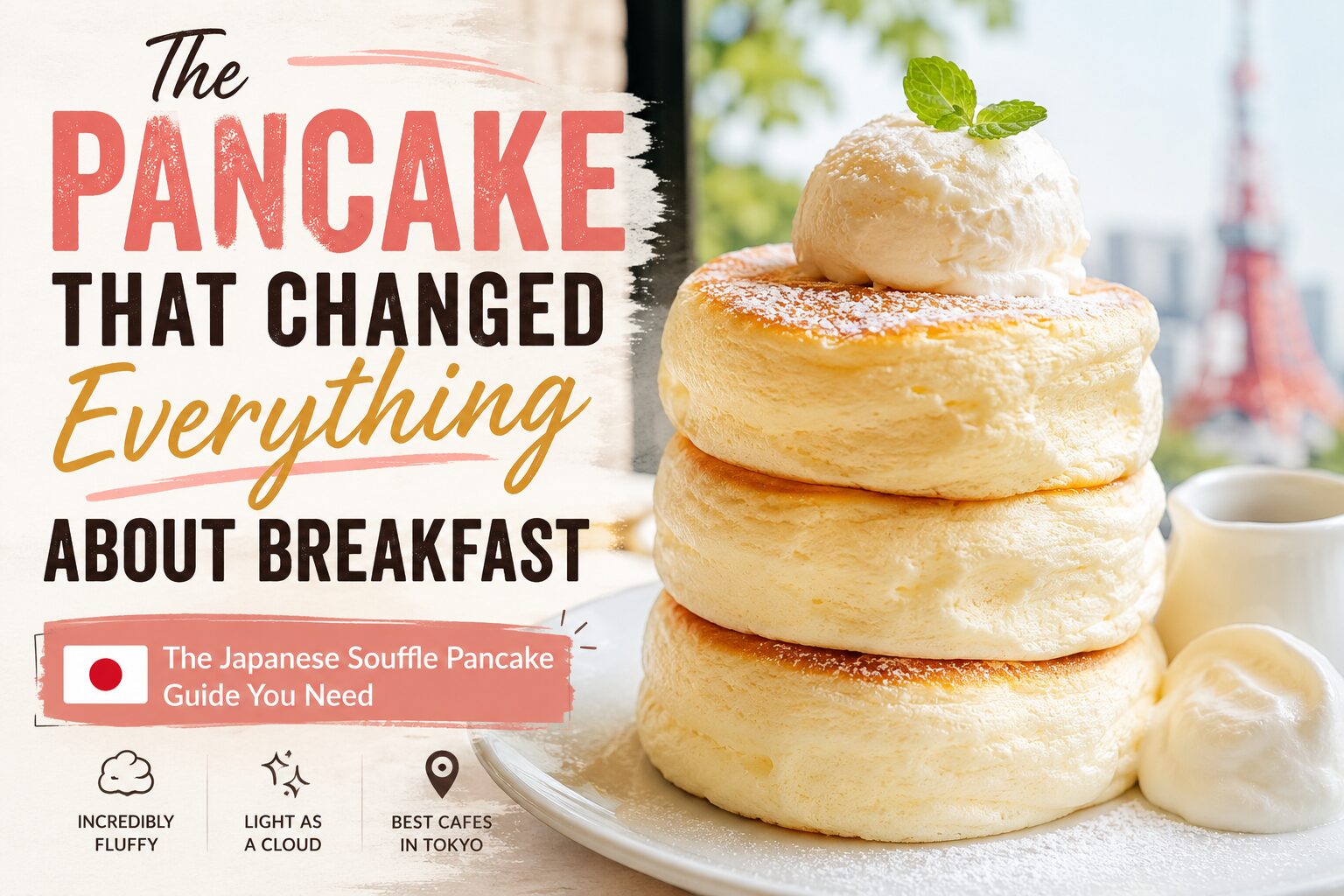
The Pancake That Changed Everything About Breakfast
Somewhere around 2016, a video of a pancake jiggling on a plate went viral across Asia and then the world. The pancake was roughly three inches tall, cloud-white, and wobbled with a physical improbability that made it look like it belonged in a cartoon. It was Japanese. It was served in Osaka. And within two years, the queue to eat one stretched around the block.
Japanese souffle pancakes are not a novelty item. They are, by any serious assessment, a genuine culinary achievement: a radically different execution of a familiar format that produces something with a texture entirely unlike anything most people have eaten before. Understanding what makes them distinctive — and knowing where to find the best versions — is the point of this guide.

What Makes Japanese Souffle Pancakes Different
The Science of the Jiggle
A standard American pancake achieves its lift from baking powder — a chemical leavening agent that releases carbon dioxide bubbles when heated, expanding the batter and creating a fluffy but relatively dense interior. A Japanese souffle pancake achieves its extraordinary height and texture through a completely different mechanism: meringue. Egg whites are beaten to stiff peaks separately from the yolk batter, then folded in very gently just before cooking. The result is a batter that is largely air — a foam structure that, when cooked slowly over low heat with a lid, sets into a stable but extraordinarily light form.
The texture has no real analogue in Western baking. It is not like a crepe, not like a waffle, not like an American pancake. The closest comparison is a warm, cooked mousse — something that collapses under gentle pressure and bounces back, that dissolves almost immediately on the tongue with a faint eggy sweetness. The wobble that makes the videos compelling is a genuine quality indicator: a pancake that jiggles is one that has retained its meringue structure through the cooking process. A flat, firm pancake has had the air cooked out of it.
Why They’re So Hard to Make
Japanese souffle pancakes are technically demanding to produce consistently. The egg whites must be beaten to exactly the right stage — too soft and the pancake collapses; too stiff and the batter doesn’t incorporate smoothly. The folding must be done gently enough to preserve the air bubbles. The cooking temperature must be low enough that the exterior doesn’t set before the interior has risen, and high enough that the interior cooks through. Most cafes that serve them cook each order to order, in a ring mold, under a domed lid, and the process takes 15 to 20 minutes per serving. This is why the waits are long: you cannot batch the product.
Where the Japanese Pancake Trend Came From
The souffle pancake was developed in Osaka and is associated with two cafes whose competition for the defining version drove the format’s evolution. A Happy Pancake (エイハッピーパンケーキ) opened in Osaka in 2013 and was among the first cafes to serve the tall, jiggly format that became internationally famous. Gram Cafe and Pancakes (グラムカフェアンドパンケーキ) opened around the same time and introduced what became the signature version of the format: three perfect rounds, served with whipped cream and maple syrup, photographed from the side in natural light against white backgrounds.
By 2017–2018, both chains had expanded to Tokyo, and the format had generated dozens of imitators across both cities. The international food media — Buzzfeed, Bon Appetit, food Instagram broadly — amplified the format through the mechanism that drives all modern food trends: the extreme photogenicity of a three-inch-tall wobbling pancake. A thing that looks like that on a screen will draw queues, and queues will draw more coverage, and more coverage will draw more queues. The cycle ran for several years before stabilizing into the current state: a format that has earned its permanent place in Tokyo’s cafe culture, supported by genuine quality rather than novelty alone.
Where to Eat the Best Japanese Pancakes in Tokyo
Gram Cafe and Pancakes (Tokyo Locations)
Gram introduced the premium pancake concept that is now the reference format. The Tokyo branches (Harajuku, Ikebukuro, Shibuya) maintain the quality of the Osaka original. The signature “premium pancakes” are served in limited quantities — typically 20 portions per seating, three seatings daily at 11 AM, 2 PM, and 4 PM — and the daily supply sells out. Arriving 30 minutes before a seating time is recommended. Price is approximately ¥1,000–¥1,200 per serving of three.
A Happy Pancake (Omotesando)
A Happy Pancake’s Omotesando location is its Tokyo flagship and operates from a converted space in a low-rise building off Cat Street. The version here leans toward the dessert end of the pancake spectrum — thicker cream applications, more elaborate toppings available — with the same foundational technique. Waits of 60–90 minutes on weekends are common; the cafe takes walk-in queuing only, no reservations. Price runs ¥1,200–¥1,800 depending on toppings.
Flippers Pancake (Multiple Tokyo Locations)
Flippers has become the most accessible high-quality souffle pancake option in Tokyo, with branches in Shibuya, Shinjuku, Ebisu, and several other neighborhoods. The format here is “premium fluffy pancakes” — the technique is genuine, the quality consistent, and the waits are significantly shorter than at the original players. For visitors who want to try the format without committing to a two-hour queue, Flippers is the pragmatic choice. Price is ¥1,100–¥1,500.
Eating Alone at the Counter
Japanese pancake cafes uniformly prioritize table efficiency, and solo diners are typically directed to counter seats if available. If you are traveling alone, ask explicitly for counter seating on arrival — waits are often significantly shorter than the main table queue, and the counter view of the kitchen is genuinely interesting.
Beyond the Souffle: Other Japanese Pancake Variations Worth Knowing
The souffle pancake is the most internationally famous Japanese pancake format, but it is not the only one worth eating. Hotcakes (ホットケーキ) are the Japanese interpretation of American-style pancakes — denser, sweeter, and served in kissaten (old-school coffee shops) across Japan as a breakfast item. The best version is served at Tokyo’s Café de l’Ambre in Ginza, a cafe that has operated since 1948 and serves their hotcakes with an almost ceremonially old-fashioned formality. The texture is different from American pancakes — somehow both denser and more tender — and the experience of eating them in a 70-year-old coffee shop with a cup of aged single-origin coffee is an argument that not everything needs to be new to be exceptional.
Okonomiyaki (お好み焼き) is sometimes translated as “Japanese pancake” in English menus, but it is a fundamentally different animal — a savory, cabbage-forward batter-based dish cooked on a griddle and topped with mayonnaise, bonito flakes, and a sweet brown sauce. It has nothing in common with souffle pancakes except a shared cooking surface. Both are worth eating; neither prepares you for the other.
If you leave Japan having tried souffle pancakes at a serious cafe, you will understand why the lines form. Not everything that goes viral deserves to — but this one did.