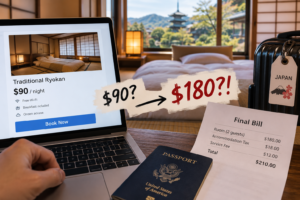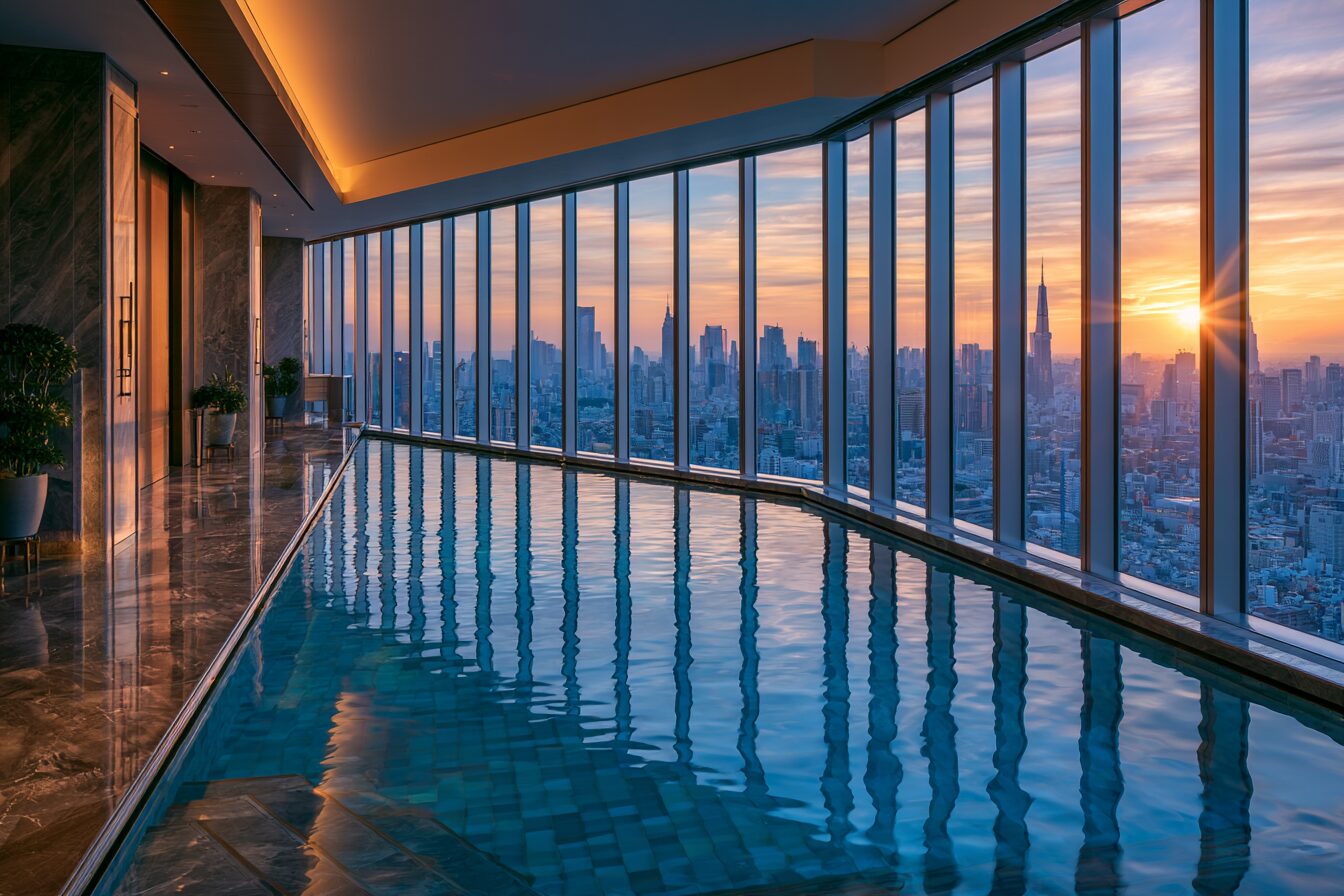
The most visually stunning hotel room in Kyoto — tatami floors, cedar soaking tub, paper screen diffusing garden light at dusk — costs ¥28,000 a night. That is $187.
A similar aesthetic in a New York boutique hotel costs $450. The same room in London costs £320. Japan’s currency situation created a window that most travelers still don’t know exists.
Japan has always had beautiful hotels. What changed is the math. At the 2019 exchange rate of roughly ¥110 to the dollar, a ¥28,000 hotel room cost an American $255. At the current 2026 rate of approximately ¥150–¥155 to the dollar, that same room costs $180–$187. No renovation, no downgrade — just currency. The quality stayed; the dollar price dropped by about 30%.
The hotels in this guide were selected on one criterion: they look dramatically more expensive than they are. That means meaningful design (not just clean), a sense of place that photographs well, and amenities that punch above their price class. The selection covers business hotel chains with outstanding interiors, machiya townhouse conversions, design-forward boutique properties, and mid-tier ryokan that deliver 80% of the full onsen-kaiseki experience at 40% of the price.
The myth this guide corrects: that beautiful Japan accommodation requires either a trust fund or a sacrifice of sleep quality. Neither is true in 2026.
The Framework: Four Hotel Types That Over-Deliver in Japan

Japan’s hotel market has four distinct categories that regularly produce the over-delivery effect. Understanding which type fits your priorities is more useful than chasing any single property name.
① Japanese Business Hotel Chains — The Underestimated Category
Japanese business hotel chains (Mitsui Garden Hotels, Daiwa Roynet, Vessel Hotel, Richmond Hotels) operate at a level of design consistency that their Western counterparts simply don’t match. The rooms are compact — typically 18–25 m² — but the finishes are high-quality: proper blackout curtains, excellent mattresses, rain showers, and thoughtful storage design. Many Mitsui Garden properties incorporate Japanese design elements (shoji-inspired room dividers, cypress bath basins, regional textile accents) that would cost a premium in a boutique hotel in Paris or London. Price range: ¥15,000–¥25,000 ($100–$167) in Tokyo and Osaka; slightly higher in Kyoto.
② Machiya Townhouse Conversions — Kyoto’s Best-Kept Secret
A machiya (町家) is a traditional wooden townhouse, built in a style that dominated Kyoto’s residential streets for centuries — long and narrow, with rooms connected by a central corridor, a small garden at the rear, and latticed wooden facades on the street. Kyoto has converted hundreds of these into private-stay accommodations, ranging from one-room guesthouses to full townhouse rentals sleeping 4–6 people. The best machiya conversions include private ofuro (deep soaking tub), tatami sleeping rooms with futon, and a small engawa garden terrace. They look extraordinarily expensive. Many are available under ¥30,000 per night ($200) for two people — cheaper per person than a standard mid-range hotel in the same area. Booking platforms: Rakuten Travel, Jalan, and specific Kyoto machiya agencies (Machiya Residence Inn, Piece Hostel Sanjo machiya section).
③ Mid-Tier Ryokan With Onsen — The 80/40 Rule
The ryokan experience most travelers imagine — tatami, yukata robe, communal onsen bath, Japanese breakfast — begins at approximately ¥15,000 per person (~$100) at the budget end and delivers something genuinely close to what ¥40,000 mid-tier properties provide. The differences at the lower price point: shared rather than private bathroom, simpler (but still excellent) Japanese breakfast, fewer attendant services. What remains: the tatami room, the futon, the yukata, the onsen access. This tier is dramatically underrepresented in English-language hotel guides.
④ Art Hotel and Design Boutique — The Creative Category
Japan’s art hotel scene produces some of the most visually striking rooms in the world at prices that reflect domestic rather than global luxury market rates. BnA_WALL in Tokyo’s Nihombashi district has 26 rooms each designed by a different Japanese artist — a portion of every booking goes directly to the artist. Book & Bed Tokyo wraps guests in a library of books with sleeping loft design that photographs as an architectural statement. These properties charge ¥15,000–¥25,000 ($100–$167) for rooms that would be editorial-worthy at three times the price in a Western capital.
Tokyo: Specific Properties Under $200
| Property | Type | Price/Night | The Look | Best For |
|---|---|---|---|---|
| Mitsui Garden Hotel Ginza Premier | Design business hotel | ¥25,000–¥35,000 (~$167–$233) | 36th-floor views of Tokyo Bay, Tokyo Tower and Ginza skyline. Japanese lacquer accents throughout. Floor-to-ceiling windows in corner rooms. | Couples, anyone who wants Tokyo’s best skyline view without paying Park Hyatt rates |
| BnA_WALL Nihombashi | Art hotel | ¥18,000–¥26,000 (~$120–$173) | 26 artist-designed rooms, each unique. Speakeasy bar in basement. Historic Nihombashi district setting. Zero corporate feel. | Design-conscious travelers, Tokyo first-timers who want something memorable |
| Yuen Bettei Daita | Boutique ryokan-style | ¥22,000–¥30,000 (~$147–$200) | Blonde wood and shoji screens framing garden views. Shimokitazawa neighborhood — Tokyo’s most creative district. Looks like a ¥60,000 property. | Repeat Tokyo visitors wanting a different neighborhood; design travelers |
| Book & Bed Tokyo (Shinjuku) | Literary design hotel | ¥12,000–¥18,000 (~$80–$120) | Sleeping lofts built into floor-to-ceiling bookshelves. Each room has its own library. Photographs as an architectural installation. Compact but the aesthetic justifies every yen. | Solo travelers, couples wanting a Tokyo story to tell |
| Hotel Noum Osaka (Tokyo sister properties) | Minimalist riverside boutique | ¥15,000–¥22,000 (~$100–$147) | Natural materials, plants, original artwork. Berth Coffee café on-site. Looks like a Pinterest hotel account brought to life. | Design travelers, slow-travel types who spend mornings in the café |
Kyoto: Where the Money Goes Furthest

Kyoto is simultaneously Japan’s most expensive hotel city and its best argument for the over-delivery phenomenon. The city’s limited supply of quality hotel rooms (60,000 total versus Tokyo’s 350,000) keeps prices high — but that scarcity also means even mid-range properties maintain standards that justify their price. At the $150–$200 range, Kyoto offers things Tokyo cannot: proximity to genuine historical architecture, machiya stays with private gardens, and a density of traditional experience within walking distance of almost any hotel.
Specific Kyoto properties under ¥30,000 (~$200):
Mitsui Garden Hotel Kyoto Sanjo (¥22,000–¥32,000 / ~$147–$213): Standard mid-range Kyoto hotel in terms of category — but executed with the Mitsui attention to Japanese design details that makes it look and feel 40% more expensive than the price suggests. Central Sanjo location, walking distance to Nishiki Market.
Cross Hotel Kyoto (¥25,000–¥38,000 / ~$167–$253): Modern design with traditional Kyoto material palette — dark wood, stone, washi paper light panels. Rooftop public bath with night views. The communal baths feel like a boutique ryokan experience; the room feels like a design hotel. Best of both.
Machiya stays via Machiya Residence Inn (¥25,000–¥45,000 for whole property): Full townhouse rentals that sleep 2–4 people. At the two-person rate, many machiya falls under $200/person/night and delivers a private engawa garden, traditional construction, and a morning in Kyoto that no conventional hotel can replicate. The lack of staff on-site is the trade-off — check-in is typically self-service via lockbox.
Budget ryokan: Ryokan Shigetsu, Asakusa-equivalent properties: Kyoto has no direct equivalent of Shigetsu (Tokyo’s ¥22,500 benchmark ryokan), but multiple comparable properties exist — traditional inn, modest public bath, excellent Japanese breakfast — in the ¥15,000–¥20,000 per person range. Search Jalan.net (Japan’s primary ryokan booking platform) with an English browser and filter by price.
You wake on a futon in a machiya townhouse, morning light filtering through shoji screens onto 100-year-old cedar beams, the sound of temple bells from two blocks away the only alarm you need.
You paid $160 for this. Your friend staying at a design hotel in Brooklyn paid $320 for a room that looked like a WeWork.
Osaka: The Underrated Value Capital
Osaka is Japan’s hotel value leader — the combination of enormous hotel supply, a more business-travel-oriented market, and lower baseline prices than Kyoto means that the $200/night budget goes further here than anywhere else in Japan’s major cities.
Hotel Noum Osaka (¥15,000–¥22,000 / ~$100–$147): A riverside minimalist boutique with natural materials, curated artwork, and a ground-floor café that anchors the experience. This hotel photographs like a much more expensive property. The Nakazakicho neighborhood location is 20 minutes from Dotonbori but in a far more interesting, creative part of Osaka that most tourists miss entirely.
Cross Hotel Osaka (¥18,000–¥28,000 / ~$120–$187): Rooftop open-air bath in central Shinsaibashi, design-forward common areas, rooms with Japanese textile accents. Similar model to Cross Hotel Kyoto at a lower price point.
The Barn Tokyo — Osaka equivalent properties: Osaka’s boutique hotel scene has several family-run 10–20 room properties with distinctive design at prices that reflect owner-operated rather than chain-operated economics. These require more research (TripAdvisor, Japanese travel blogs translated via browser) but regularly produce the best Instagram-versus-price ratio in any Japan city.
| City | Average 4-star rate (2026) | Best $200 value category | Booking lead time needed |
|---|---|---|---|
| Tokyo | ¥25,000–¥35,000 ($167–$233) | Design business hotel + art hotel | 4–8 weeks (12+ for cherry blossom) |
| Kyoto | ¥28,000–¥42,000 ($187–$280) | Machiya stays + mid-tier ryokan | 8–16 weeks (sells out fastest) |
| Osaka | ¥18,000–¥28,000 ($120–$187) | Design boutique + riverside minimalist | 3–6 weeks |
| Hakone (onsen town) | ¥25,000–¥50,000/person ($167–$333) | Mid-tier ryokan with private bath | 8–12 weeks minimum |
| Takayama / Kanazawa | ¥18,000–¥30,000 ($120–$200) | Traditional inn + machiya | 4–8 weeks |
The Ryokan Entry Point: What $150/Person Actually Gets You
The most persistent myth about ryokan is that the genuine experience requires ¥30,000+ per person. It does not. The experience people imagine — tatami room, futon prepared by a staff member, yukata robe, access to communal onsen baths, a Japanese breakfast of grilled fish, miso, rice, and pickled vegetables — begins at approximately ¥15,000 per person (~$100) at legitimate ryokan in onsen towns outside the major cities.
At ¥15,000–¥20,000 per person, what you get versus what you give up compared to a ¥40,000+ tier:
You get: Tatami room with futon bedding, yukata and tabi socks, shared communal onsen baths (often multiple pools), a genuine Japanese breakfast, and the core hospitality experience — shoes at the door, communal dining area, the sense of being in a functioning traditional inn rather than a hotel.
You give up: Private in-room bath (the defining feature of luxury ryokan), multi-course kaiseki dinner (included at higher tiers; separate purchase or nearby restaurant at budget tier), personal attendant service, guaranteed garden views, premium linens.
For first-time ryokan visitors, the ¥15,000–¥20,000 tier delivers 80% of the experiential value at 40% of the price. The upgrade to private bath and full kaiseki dinner is meaningful — but not necessary for a first encounter with the form.
- Do I need to book Japanese hotels directly or can I use Booking.com/Expedia?
- For Western-style hotels, Booking.com and Expedia work fine. For ryokan, the inventory on these platforms is incomplete — many of Japan’s best mid-tier ryokan list exclusively on Japanese platforms (Jalan, Rakuten Travel). Jalan works with a browser translation tool and accepts international credit cards on most properties. For machiya stays, search “Kyoto machiya” directly on Booking.com and AirBnB — coverage has improved significantly in 2025–2026.
- What is the “bathing tax” and how much does it cost?
- Several Japanese prefectures and cities levy a small onsen or accommodation tax on top of the hotel rate. Kyoto charges ¥200–¥1,000 per person per night depending on room rate; Tokyo charges ¥100–¥300. Onsen towns may charge a separate bathing tax of ¥150–¥300. These are collected at checkout, not included in online listed prices. Budget a flat ¥500/person/night as a buffer for accommodation taxes.
- Can I get a beautiful ryokan experience near Tokyo without going to Hakone?
- Yes. Nikko (2 hours from Tokyo) has several traditional inns in the ¥15,000–¥25,000/person range within walking distance of the World Heritage temple complex. Yugawara and Atami (both under 90 minutes on the Shinkansen) have established onsen towns with budget-friendly ryokan. These are less internationally famous than Hakone but offer the same experiential elements at lower prices.