For as long as commercial aviation has connected the US mainland to Japan, there has never been a nonstop flight to Sapporo.
That changes this December — and it changes the math on a Niseko ski trip more than most headlines about it suggest.
⭐ Bottom Line
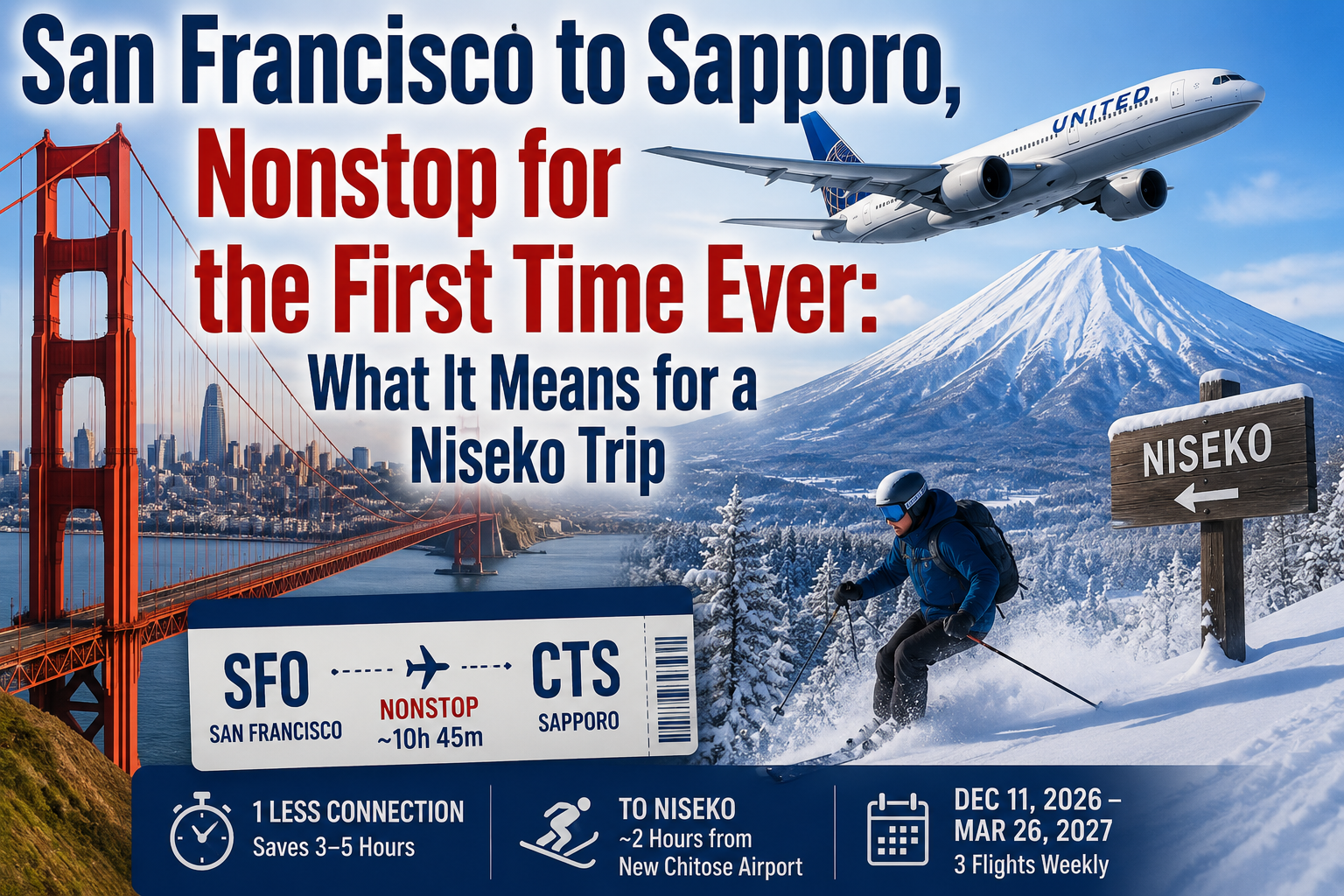
United’s new San Francisco–Sapporo route launches December 11, 2026, flying 3 times weekly through March 26, 2027 — the first-ever nonstop service between the continental US and Hokkaido, cutting a Niseko-bound trip by roughly a full connection.
- Best for: West Coast skiers who’ve put off a Niseko trip because of the routing hassle
- Flight time: about 10 hours 45 minutes westbound, 9 hours 5 minutes returning
- Book ahead: seasonal routes like this typically sell through their first winter faster than airlines initially expect
Search “how to get to Niseko from the US” today and every answer still involves a connection — fly into Tokyo or Osaka, then a domestic leg or long transfer up to Hokkaido. That changes on December 11, 2026, when United launches UA234, a nonstop San Francisco to Sapporo flight — the first nonstop service between the continental US and Sapporo in the history of commercial aviation.
The direct answer for a Niseko trip specifically: this doesn’t put you at the resort, but it removes an entire connection. New Chitose Airport, where the flight lands, is about 2 hours from Niseko by road — the same transfer skiers already make today. What disappears is the domestic flight or multi-hour transfer from Tokyo or Osaka that used to come before that transfer even started.
This is a seasonal route, running through March 26, 2027, three flights a week. Whether it’s worth building a trip around depends on where you’re flying from and how firm your dates already are.
The Flight Itself

United’s new route runs on a Boeing 787-9 Dreamliner, seating 257 passengers. The schedule: UA234 departs San Francisco at 10:30am, arriving Sapporo at 2:15pm the next day — a flight time of about 10 hours 45 minutes. The return, UA235, departs Sapporo at 4:15pm and lands back in San Francisco at 8:25am the same day, taking roughly 9 hours 5 minutes.
Westbound flights run Sundays, Wednesdays and Fridays; eastbound flights run Mondays, Thursdays and Saturdays. At 4,796 miles, it’s United’s shortest true transpacific route from the continental US — genuinely closer than flying to Tokyo, even though Sapporo can feel like the more remote destination. United will connect the route to nearly 80 US cities through its San Francisco hub, meaning travelers well beyond the Bay Area can reach it with a single domestic connection rather than needing to already live near SFO.
A new flight only matters if it actually changes the trip. Here’s the direct comparison against how skiers reach Niseko today.
Old Route vs New Route: What Actually Changes
A side-by-side of the realistic travel day, SFO to Niseko, before and after this route exists:
| Leg | Old Routing (via Tokyo/Osaka) | New Routing (via SFO–CTS direct) | Difference |
|---|---|---|---|
| US to Japan | ~10.5–11 hrs to NRT/HND/KIX | ~10.75 hrs direct to CTS | Roughly the same |
| Connection | Domestic flight or Shinkansen + transfer to Hokkaido | None — you land in Hokkaido | Saves 3–6 hours |
| Airport to Niseko | ~2 hrs from New Chitose either way | ~2 hrs from New Chitose | No change |
| Total door-to-resort | ~16–18 hrs realistic | ~13–14 hrs realistic | ~3–5 hrs saved |
Time and money saved on paper is one thing. What actually drove an airline to bet on this specific route is a different, more interesting question.
Why Sapporo, and Why Now

United frames this as serving both ends of its Japan market — skiers headed to Hokkaido’s resorts and business travelers exploring Asia further afield — and it lands at a moment when American demand for Japan is already unusually strong. The US became Japan’s fourth-largest inbound market in 2025, with arrivals topping 3 million for the first time. More than 1.5 million seats were scheduled between the US and Japan in summer 2025 alone, a 6.4% increase year over year — this winter’s Sapporo route extends that same growth into a market United hadn’t served nonstop before.
United isn’t alone in spotting the gap. Air Canada is launching its own first-ever nonstop Vancouver–Sapporo route around the same window, meaning two major North American carriers independently concluded Hokkaido was under-served at the same time — a stronger signal than either airline’s move on its own.
None of that explains the part that actually matters for trip planning: what this looks like once you’re on the ground.
What This Means for Niseko Specifically
New Chitose Airport (CTS), where the flight lands, is Hokkaido’s main hub — and the same airport skiers already fly into today via Tokyo or Osaka connections. The transfer to Niseko is unchanged: roughly 2 hours by resort shuttle, private transfer, or rental car. What changes is everything before that transfer, not the transfer itself.
For a one-week ski trip, that’s the difference between arriving with a full day still ahead of you versus arriving already worn down by two flights and an airport transfer stacked on top of each other. For West Coast skiers specifically — the exact audience this route is timed for — it also means a Niseko trip is now genuinely comparable in total travel time to flying to a European ski destination.
It’s worth being honest about what doesn’t change, too: Niseko itself remains a resort built around deep, dry powder and a spread-out, car-or-shuttle-dependent layout — this flight changes how you arrive, not what the week on the mountain actually involves. Lift tickets, accommodation booking timelines and the general shape of a Niseko trip stay exactly as they were; only the first, most exhausting leg of getting there is different.
The route also opens up Sapporo itself as a genuine stopover rather than just a transit point. Japan’s Snow Festival, held in the city each February, and a food scene built around fresh Hokkaido seafood and the region’s own ramen style are both realistic additions to a trip that used to treat Sapporo as somewhere you merely passed through on the way to the slopes.
What Existed Before vs What’s New

Niseko’s reputation among American skiers has been building for years — deep, dry powder, a growing English-speaking hospitality scene, lift tickets that still undercut comparable US resorts. What hasn’t kept pace is direct access: every previous US-to-Hokkaido trip has required routing through a Honshu hub first, regardless of how well-known Niseko became.
That gap is exactly what’s closing this winter, from two directions at once — United from San Francisco, Air Canada from Vancouver — both landing in the same 2026–27 winter season. For a resort town that has spent years building an international reputation without matching flight access, having two independent nonstop options arrive in the same winter is a bigger structural shift than either single route suggests on its own.
Should You Book This Winter?
If you’re on the West Coast and have been putting off a Niseko trip specifically because of the routing hassle, this route removes your best excuse. If you’re not near San Francisco, the calculation is less clean — a connecting flight to SFO to catch this route may not beat flying directly into Tokyo or Osaka and connecting domestically from there.
Picture stepping off a direct flight from San Francisco into Hokkaido’s driest, deepest powder season, a transfer away from a resort that used to take a full extra travel day to reach.
It’s a seasonal route on a new schedule — worth confirming your exact dates against United’s calendar before building a whole trip around it.
✅ Book This Route If You’re:
- Based on the West Coast, ideally within easy reach of SFO
- Planning a Niseko or broader Hokkaido trip for winter 2026–27
- Looking to cut a connection out of an already long travel day
- Flexible enough to fly on the specific Sun/Wed/Fri or Mon/Thu/Sat schedule
✅ Stick With the Old Routing If You’re:
- Based on the East Coast or Midwest, where connecting to SFO adds its own time
- Also planning to spend time in Tokyo or Osaka on the same trip
- Traveling outside the December–March seasonal window
- Already holding a booking through an existing hub routing
- When does the San Francisco to Sapporo flight start?
- December 11, 2026, running through March 26, 2027, three times weekly.
- How long is the flight from San Francisco to Sapporo?
- About 10 hours 45 minutes westbound and 9 hours 5 minutes on the return.
- How far is Niseko from the Sapporo airport?
- Roughly 2 hours by road from New Chitose Airport — the same transfer distance as today, unchanged by this new flight.
- Is this the only new nonstop route to Hokkaido this winter?
- No — Air Canada is separately launching a first-ever nonstop Vancouver–Sapporo route around the same season, giving West Coast Canadian and American skiers new direct options at the same time.
- What aircraft does United use on this route?
- A Boeing 787-9 Dreamliner configured with 257 seats.
- Will this route return for future winters?
- Unconfirmed. It’s currently scheduled as a single winter 2026–27 seasonal service, with no announcement yet on 2027–28.
- Does this flight also work for a Sapporo-only trip, without skiing?
- Yes. Sapporo’s own attractions — the February Snow Festival, its seafood and ramen scene, and easy access to Hokkaido’s hot springs — make it a reasonable standalone destination, not only a gateway to Niseko.