A family of four spent $3,000 less visiting Tokyo Disneyland than Disney World — and they flew across the Pacific to do it.
That claim went viral. The math is real. But it only works for some Americans — and for others, the numbers flip completely.
The viral posts are not wrong. Tokyo Disneyland tickets genuinely cost roughly half what Disney World charges per day in 2026. Food inside the park runs about $20–$30 less per person per day. The yen’s extended weakness against the dollar has made every yen-denominated cost roughly 30% cheaper for Americans compared to five years ago. That’s real money.
But the viral posts stop there. They don’t tell you about the flight math, the no-multi-day-ticket rule, the credit card problem that locks out most foreign visitors before they can even buy a ticket, or the single factor that flips the entire comparison upside down depending on where you live. This guide does the full math — honestly.
The answer is not Tokyo or Disney World. The answer is it depends on one number — and most comparison articles never tell you which one.
Tickets: Where the Gap Is Biggest

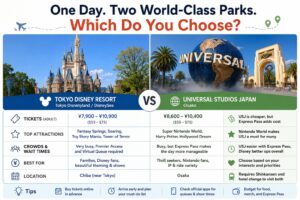
Tokyo Disneyland 2026: ¥7,900–¥10,900 per adult per day ($52–$71 USD), priced by date. Weekdays are cheapest; peak weekends and holidays hit the top tier. Children ages 4–11 pay $31–$37. Under 3 is free.
Disney World 2026: Single-day Magic Kingdom tickets range from $139 to $209 for adults depending on date — and that’s just one park. EPCOT and Hollywood Studios have their own separate ticket prices. The only way to get Disney World’s per-day cost below $100 is to buy a 7-day pass, which averages around $70–$80/day.
| Factor | Tokyo Disneyland 2026 | Disney World 2026 | Winner |
|---|---|---|---|
| Adult 1-day ticket (off-peak) | $52 | $139 (Magic Kingdom) | Tokyo ✅ |
| Adult 1-day ticket (peak) | $71 | $209 (Magic Kingdom) | Tokyo ✅✅ |
| Multi-day discount available? | No | Yes (7-day ≈ $71/day) | Disney World (long trips) |
| Skip-the-line cost (busy day) | Premier Access: ~$16/ride × 6 = $96 | Lightning Lane Multi: $15–$39/day | Roughly equal |
| Child ticket (off-peak) | $31 | $134 (Magic Kingdom) | Tokyo ✅✅ |
| Ticket buying difficulty (foreign cards) | High — official site rejects most foreign Visa/MC | Standard — US cards work normally | Disney World |
Mini-verdict: On tickets alone, Tokyo wins by a massive margin for 1–3 day visits. For 5+ day park-heavy vacations, Disney World’s multi-day pricing erases most of that gap. Tokyo wins hardest for families with young children, where the child ticket savings are dramatic.
But tickets are rarely where Disney trips break the budget. Keep reading — this is where it gets surprising.
Flights: The Factor That Decides Everything
Most comparison articles treat the flight as a footnote. It is not a footnote. For many Americans, the flight alone determines the winner before a single ticket is purchased.
From the West Coast (LAX, SFO, SEA): Round-trip flights to Tokyo average $500–$900 per person in 2026 on economy. For a family of four flying LAX–NRT, budget $2,000–$3,600 for flights.
From the East Coast (NYC, BOS, MIA): Round-trip flights to Tokyo average $800–$1,400 per person. A family of four from New York faces $3,200–$5,600 in airfare alone — before touching a single yen.
To Orlando: From most US cities, flights are under $300 round-trip, and many Americans drive. The transportation cost difference between Orlando and Tokyo is effectively zero for some East Coast families driving to Florida — and enormous for others.
The flight math is the single most important number in this comparison. West Coast travelers often find that Tokyo is genuinely cheaper end-to-end. East Coast travelers frequently find the opposite. Everyone in between gets a complicated answer.
Most guides skip the next factor — and it may cost you $500.
Hotels: Closer Than You Think, With One Catch

The conventional wisdom says Tokyo is dramatically cheaper for hotels. The reality is more specific.
Off-site hotels near Tokyo Disney Resort (Maihama area, 5–10 min walk): Clean business hotels run $120–$180/night for two adults. That is genuinely cheaper than comparable Disney World off-site options, which run $150–$250/night for the same quality tier.
On-site Disney hotels in Tokyo: The Disney-branded hotels (Tokyo Disneyland Hotel, DisneySea Hotel MiraCosta) start at $200–$350/night — directly comparable to Disney World’s moderate and deluxe resorts at $200–$400/night.
Mini-verdict: Off-site hotel costs are slightly lower in Tokyo, but the gap is smaller than most articles suggest. The real hotel savings come from Tokyo’s extraordinary transit system — you can base yourself in a mid-range Maihama business hotel and reach any Tokyo neighborhood in under an hour for $3–5 by train, eliminating the car rental or Uber costs that inflate Disney World trips.
Food: The Clearest Win for Tokyo

This is where Tokyo pulls ahead most consistently — and where the gap is genuinely surprising.
Inside Tokyo Disney Resort, a full meal averages $15–$25 per person. Counter-service meals (burgers, rice bowls, ramen) run $8–$14. The popcorn that became a TikTok sensation costs $2.50–$3.50 a bucket.
Inside Disney World, a quick-service meal averages $18–$28 per person, table service is $40–$80 per person, and a family of four can casually spend $120 on lunch without ordering anything extravagant.
Outside the parks, the gap widens further. Tokyo’s convenience stores (7-Eleven, Lawson, FamilyMart) serve genuinely excellent food — onigiri, sandwiches, hot meals — for $2–$6. A ramen lunch in a sit-down restaurant outside the park runs $8–$14. Orlando’s equivalent off-site dining is routinely $18–$30 for the same quality tier.
You’re sitting at an open-air counter inside Tokyo DisneySea at dusk, eating a perfectly seasoned gyoza set for $9, watching the volcano glow against the darkening sky as a live band plays across the water.
The meal at the equivalent Disney World sit-down location would cost $45 — and the view would be a parking structure.
Food is Tokyo’s clearest, most consistent win. No asterisks.
The Hidden Costs Both Parks Bury
Both parks have developed robust systems for charging you more money after you’ve already paid admission. The mechanics differ. The impact doesn’t.
Disney World 2026: Lightning Lane Multi Pass costs $15–$39 per person per day depending on date and park. Lightning Lane Single Pass for headliners (TRON, Guardians) adds another $7–$20 per ride. A family of four visiting on a busy day can easily spend $150–$200 on skip-the-line fees alone, on top of tickets.
Tokyo Disney Resort 2026: Premier Access is sold per attraction, not as a day pass. Each access costs approximately ¥1,500–¥2,500 ($10–$16). On a busy day, using Premier Access for 5–6 headliners costs roughly $60–$96 per person — comparable to Disney World’s Lightning Lane Multi Pass for a busy day. The difference: Tokyo’s system is optional in a more granular way, and slower rides genuinely don’t need it.
Mini-verdict: Hidden costs are roughly equivalent on busy days for families. Tokyo has a slight edge for small parties who choose selectively. Both parks charge you significantly more than the ticket price implies on high-crowd days.
The Experience Gap: This Is Not the Same Park
The most important fact that almost no cost comparison article mentions: Tokyo DisneySea has no American equivalent. It does not exist in the United States. Disneyland and Disney World are genuinely similar to each other in experience, layout philosophy, and ride mix. Tokyo Disneyland is modestly different. Tokyo DisneySea is in a different category entirely.
DisneySea’s Mediterranean Harbor, the Mysterious Island volcano area, the Fantasy Springs expansion (Frozen, Tangled, Peter Pan), the nautical steampunk aesthetic — none of this exists in Florida or California. If you have done Disney World multiple times and are weighing a return trip against Tokyo, you are not comparing similar things. Tokyo offers a genuinely new experience. Disney World offers a familiar one, with ongoing upgrades.
This experiential gap is impossible to put in a spreadsheet but should weigh heavily in your decision. Cost comparison is the wrong question for Disney veterans. Value per dollar is the right question — and value includes novelty.
The Full Math: Side by Side for Real Americans
Two couples. One trip each. Four days in the parks. Let’s do the actual math for 2026.
| Cost Category | Tokyo (West Coast couple) | Tokyo (East Coast couple) | Disney World (either coast) |
|---|---|---|---|
| Flights (round-trip, 2 people) | $1,200–$1,800 | $1,600–$2,800 | $200–$600 |
| Park tickets (4 days, 2 adults) | $420–$570 | $420–$570 | $700–$900 (4-day pass) |
| Hotel (5 nights) | $600–$900 | $600–$900 | $750–$1,250 |
| Food (5 days, 2 people) | $400–$600 | $400–$600 | $600–$900 |
| Skip-the-line (2 busy days) | $120–$200 | $120–$200 | $120–$200 |
| TOTAL | $2,740–$4,070 | $3,140–$5,070 | $2,370–$3,850 |
West Coast couples: Tokyo is comparable or cheaper end-to-end. East Coast couples: Disney World wins on total cost by $500–$1,200. But the experience Tokyo offers doesn’t exist at Disney World, so that savings buys you something familiar.
How to Buy Tokyo Disneyland Tickets (Without the Credit Card Problem)
This is the section most guides bury at the bottom. It should be near the top, because the Tokyo Disney official website rejects the majority of American credit cards. The site requires 3D Secure verification, which most US-issued Visa and Mastercard do not support in the way TDR’s system expects. You will click “purchase,” enter your card details, and receive an error — sometimes with no explanation.
The reliable workaround: Klook. Klook is an authorized reseller that processes the transaction for you and delivers a valid QR code. The price is identical to the official site. Klook accepts standard US credit cards and PayPal. Book through Klook as your default, not as a backup.
Alternatively, cards that tend to work on the official TDR site: American Express (US-issued), and some Chase Sapphire cards with 3D Secure enabled. Test your card on a small purchase elsewhere in Japan before attempting TDR if you insist on the official site.
- How far ahead do I need to buy Tokyo Disneyland tickets?
- For busy periods (weekends, Japanese holidays, December, cherry blossom season in late March–early April), buy 4–8 weeks in advance. For quiet weekdays in June, September, or January, 1–2 weeks is usually fine. The 60-day sale window opens precisely at 2:00 PM Japan time — set an alarm if your date is popular.
- Do I need to speak Japanese to visit Tokyo Disneyland?
- No. The Tokyo Disney Resort app has English-language support, attraction wait times are displayed in English on signs throughout both parks, and most cast members in guest-facing roles have basic English. Menus have pictures. The language barrier at TDR is essentially zero for English speakers.
- Is Tokyo Disneyland really busier than Disney World?
- On peak days, yes — TDR operates on a single large complex rather than four spread-out parks, so crowds concentrate more visibly. The parks use date-based ticket pricing specifically to manage crowds, and the quietest Tokyo weekdays feel comparable to a moderate Disney World day. Avoid Japanese school trip season (May–June and October–November on weekdays) and Japanese national holidays.
- Can I visit both Tokyo Disneyland and DisneySea in the same day?
- No. As of 2026, park-hopper tickets are not available at Tokyo Disney Resort. Each ticket is valid for one park on one specific date. Most visitors allocate one full day per park. DisneySea is worth a full day — do not rush it.
- Is the yen exchange rate still favorable for Americans in 2026?
- Yes. As of mid-2026, the exchange rate remains around ¥152–¥155 per USD, which is significantly weaker than the historical average of ¥110–¥120. Every yen-priced purchase in Japan — tickets, food, souvenirs, hotels — costs roughly 30% less in real dollar terms than it did before 2022. This favorable rate is the single biggest structural reason Tokyo trips are cheaper than they look on paper.
- What’s the biggest mistake Americans make when budgeting for Tokyo Disney?
- Underestimating the flight cost and overestimating the hotel cost. The flight makes or breaks the comparison. The hotel savings are real but modest. The food savings are dramatic and underappreciated — budget $40/person/day inside the park vs $60+ at Disney World, and even less if you eat one meal outside the park each day.