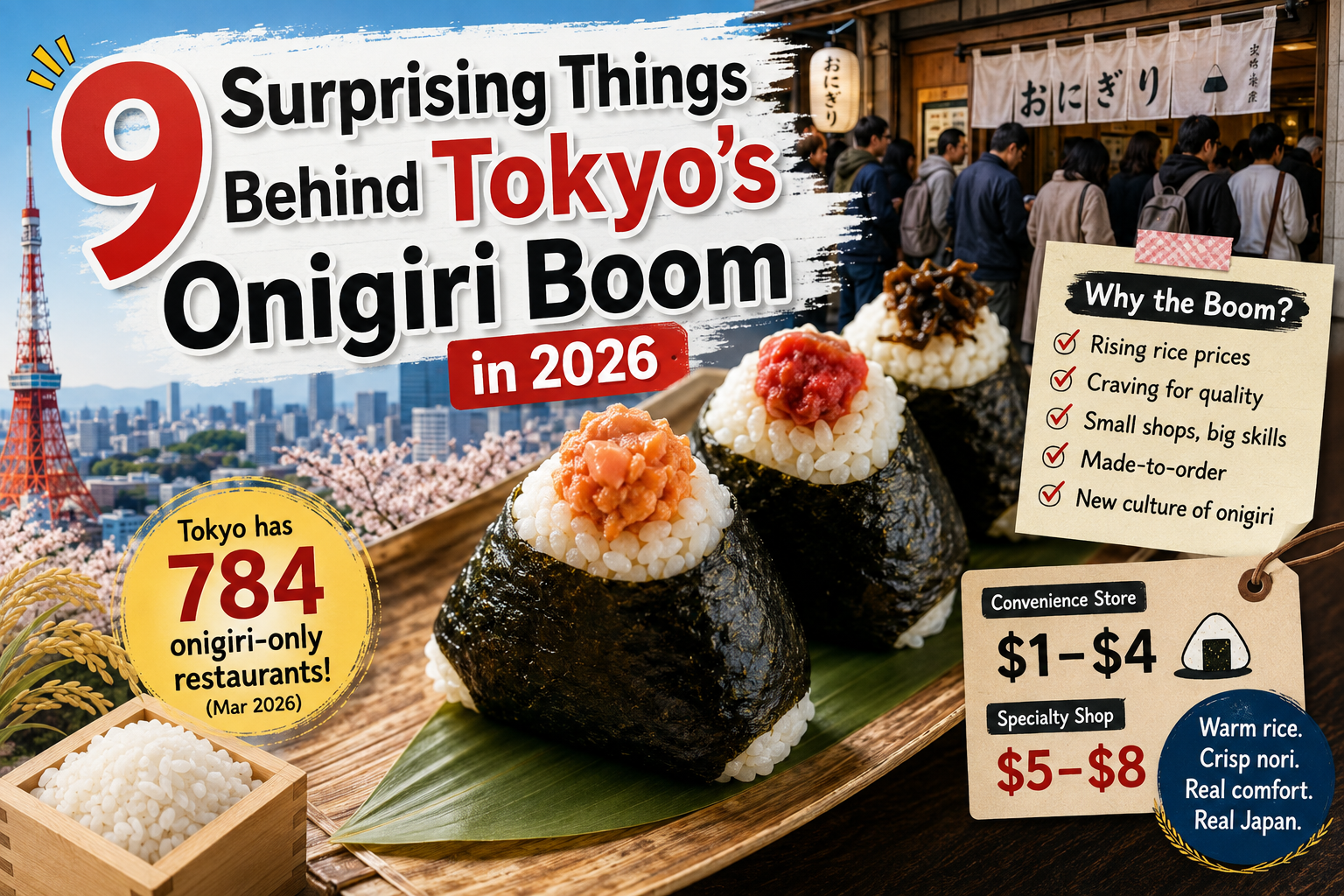
Most travelers think of onigiri as the ¥150 rice ball grabbed at a 7-Eleven counter on the way to a train. In one Tokyo neighborhood, people now wait up to eight hours for one.
The reason has nothing to do with the price — and everything to do with what just happened to rice itself.
⭐ Bottom Line
Tokyo now has an estimated 784 onigiri-only restaurants, and the boom is real — driven by rising rice prices, a craving for made-to-order comfort food, and a wave of shops built to survive on skill alone, with no expensive kitchen required.
- Best for: travelers who want an easy, cheap, deeply Japanese meal between sightseeing stops
- Budget: $1–$4 at a convenience store, $5–$8 at a specialty counter, per person
- Book ahead: not required anywhere — but the most famous counters mean waiting in a physical line, sometimes for hours
As of March 2026, Tabelog lists 784 restaurants in Tokyo that serve nothing but onigiri — rice balls, hand-shaped and wrapped in seaweed, that most visitors have only ever eaten cold from a plastic triangle. That number has roughly tripled in a few years. The obvious question is why a food this simple suddenly needed its own restaurant category.
Part of the answer is money. Japan’s rice prices spiked hard enough in 2024 and 2025 that the moment picked up a nickname — the “Reiwa rice riot” — and that same price pressure turned into an opportunity for small operators. A dedicated onigiri counter doesn’t need a fryer, a grill, or years of chef training; it needs good rice, good hands, and a space the size of a closet. Onigiri went from side dish to main event partly because it was one of the few foods where a tiny shop could compete on quality alone.
The other part is cultural momentum. According to the Japan Onigiri Association’s 2025 survey, 2026 is expected to be the year onigiri finishes its shift from “something you grab” to “something you choose” — a real lunch decision, not an afterthought. For a visitor, that shift is good news: the shops below are where Tokyo’s rice ball boom actually lives, from a decades-old counter with an hours-long line to a chain that just opened inside Haneda Airport.
1. The Decades-Old Counter With an 8-Hour Line
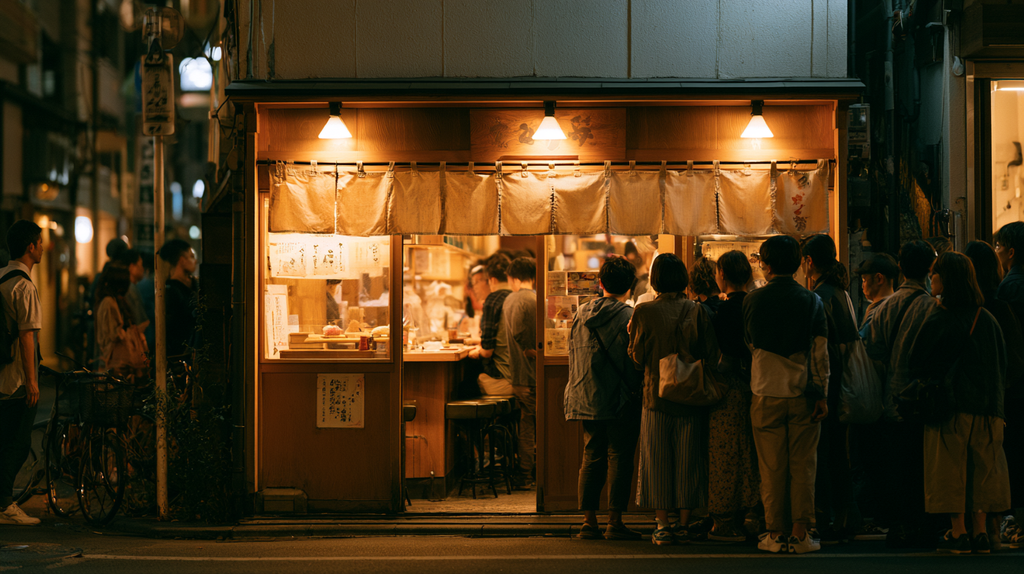
Nine counter seats. Over 1,200 rice balls hand-shaped every day. A menu of 56 fillings, from classic salted salmon to soy-marinated bacon. Onigiri Bongo in Otsuka has been run by the same owner, Yumiko Ukon, for more than five decades — and on a busy weekend, the line to get in can outlast most people’s entire visit to a museum.
A single onigiri runs ¥300 to ¥600 (about $2–$4) depending on the filling, with a two-filling combination available for a ¥50 surcharge. The shop draws a steady stream of Japanese celebrities, but the real pull is simpler: rice that’s still warm and nori that’s still crisp, because nothing is made until it’s ordered.
Most guides stop at “expect to wait.” The more interesting question is why so many people are suddenly willing to.
2. Tokyo Quietly Built 784 Onigiri-Only Restaurants
According to a Tabelog search cited by gourmet outlet Fun! Japan, Tokyo alone counted 784 dedicated onigiri restaurants as of March 2026 — a category that barely existed as a distinct listing a decade ago. The trigger wasn’t a marketing campaign, and it wasn’t tourism either. It was something that happened to rice itself.
3. The Real Ingredient Behind the Boom Isn’t a Filling — It’s the Rice
Every shop on this list is really selling the same starting point: white rice, cooked and salted with more attention than a bowl at home ever gets. That’s not incidental. Japan’s rice prices climbed sharply enough in 2024 and 2025 that the moment earned its own nickname, the “Reiwa rice riot,” and the shortage pushed some shops toward single-origin, higher-grade rice varieties as a selling point rather than a cost to hide.

A dedicated onigiri counter needs no fryer, no grill, and minimal staff training — just good rice, good hands, and a space the size of a closet. That low barrier to entry is exactly why hundreds of new shops could open even as ingredient costs rose everywhere else in Japan’s food industry. For a visitor, it translates into a genuine taste difference: the rice at a specialty counter is usually a named, single varietal, cooked in small batches through the day rather than a rice cooker’s worth made once each morning.
Understanding that shift makes the shop that came before all of it even easier to appreciate.
4. The City’s Oldest Shop Has a Michelin Badge — and an English Menu
Onigiri Asakusa Yadoroku, open since 1954, bills itself as Tokyo’s oldest onigiri specialty shop and earned a spot in the Michelin Guide Tokyo Bib Gourmand list from 2019 to 2021. It sits a few minutes’ walk from Asakusa Station, in a room that looks and feels like a small sushi counter — a display case of fillings out front, seats where you can watch the owner shape each order by hand.
Because Asakusa is one of the most visited neighborhoods in Tokyo, the shop has adapted: it offers a photo-illustrated English menu, and the owner communicates comfortably in English when guests aren’t sure what to order.
Yadoroku earned its reputation the slow way, over seven decades. The fastest way to eat onigiri in Tokyo works completely differently.
5. Your Convenience Store Onigiri Was Never the Downgrade You Thought
Here’s the unexpected comparison: the ¥150 (about $1) onigiri sitting in a 7-Eleven, Lawson, or FamilyMart cooler is not the budget compromise it looks like. Japan’s convenience store chains treat onigiri as a genuine flagship product, rotating fillings seasonally and engineering the seaweed wrapper so it stays crisp until the moment it’s opened.
That doesn’t make it identical to a hand-pressed onigiri from a specialty counter — the rice is colder, the portion smaller, the filling more modest. But it means a traveler with five minutes and no reservation is never actually settling. It’s a genuinely different, genuinely good version of the same food, not a lesser one.
6. One Chain Put a Location Inside Haneda Airport
Onigiri Kongawa, staffed by craftspeople trained at one of Tokyo’s veteran onigiri counters, has expanded to 10 locations as of April 2026 — including one inside Haneda Airport, plus outposts in Kamakura and Kobe’s Motomachi district. For a visitor, that airport location solves a real problem: a genuinely good, freshly made meal in the minutes before a flight, instead of another packaged sandwich.
Kongawa isn’t the only Japanese onigiri brand thinking beyond Tokyo — some have started thinking beyond Japan entirely.
7. Paris and Grand Central Station Now Sell Onigiri Too
The Japanese chain Omusubi Gonbei has opened onigiri counters in Paris and near New York’s Grand Central Station, part of a wider export of Japan’s rice-ball culture. A Hong Kong specialty chain has grown from a single shop to roughly 120 locations in about a decade. In parts of Paris, supermarkets now stock onigiri in the lunch aisle, described to shoppers as a “Japanese sandwich.”

Picture the version that started all of this: a nine-seat Tokyo counter, steam rising off a rice cooker the size of a washing machine, a rice ball pressed to order and handed over still warm enough to fog the plastic wrap.
It’s a five-minute meal that some visitors plan an entire afternoon around — and honestly, the wait is part of the story people tell afterward.
For American, Australian, Canadian, and Singaporean travelers, that global spread means onigiri is no longer a food you have to explain when you get home. Increasingly, it’s one your friends have already tried.
8. The New Shops Are Making Onigiri Weird on Purpose
Global expansion is one direction the category is moving. Inside Tokyo, it’s moving somewhere weirder. Yamataro, a newer counter near Zoshigaya with a Futako-Tamagawa branch that opened in March 2025, pairs its rice balls with a pork-and-miso soup and stocks about 20 fillings that include spicy ahi poke and soy-marinated fried chicken tossed in Korean-style yangnyeom sauce.
It’s a sign of where the category is heading: onigiri as a format flexible enough to absorb almost any cuisine, not a fixed traditional dish. Miso soup refills are free, which regulars treat as license to keep ordering.
9. What This Means for Your Trip
Treat onigiri the way Tokyo increasingly does: as a real meal option, not a backup plan.
- Only have 10 minutes? A convenience store onigiri is a legitimately good ¥150 lunch.
- Visiting Asakusa anyway? Yadoroku turns a quick stop into a genuine food-tourism moment.
- Food is a main reason you’re visiting Tokyo? Build an afternoon around Bongo and treat the wait as part of the story.
- Flying out of Haneda? Onigiri Kongawa beats another packaged airport sandwich.
- Want something nobody back home has tried? Yamataro’s fusion fillings are still mostly undiscovered by English-language guides.
Either way, it’s one of the few Tokyo experiences that costs less than a coffee back home and needs zero Japanese to order — point at the display case, and the rest takes care of itself.
| Shop | Neighborhood | Price Range | Best For |
|---|---|---|---|
| Onigiri Bongo | Otsuka | ¥300–¥600 ($2–$4) per piece | The full Tokyo rice-ball experience, if you have hours to spare |
| Asakusa Yadoroku | Asakusa | ¥814–¥1,100 ($5–$7) per set | First-timers — English menu, shorter wait, near major sightseeing |
| Onigiri Kongawa (Haneda) | Haneda Airport | ¥300–¥500 ($2–$3) per piece | A real meal in the minutes before a flight |
| Convenience store (7-Eleven / Lawson / FamilyMart) | Everywhere | ¥120–¥180 ($1) per piece | Speed, zero wait, genuinely decent quality |
| Yamataro | Zoshigaya / Futako-Tamagawa | Set menus from ¥900 ($6) | Adventurous fillings and free miso soup refills |
- Is onigiri safe for someone who doesn’t eat raw fish?
- Yes — most fillings are cooked or pickled (grilled salmon, tuna mayo, pickled plum, seasoned kelp), and staff can point out which options contain raw ingredients if you’re unsure.
- Do I need to speak Japanese to order?
- No. Convenience stores have printed labels, and specialty shops like Yadoroku offer English menus with photos — pointing at the display case works everywhere.
- Can I get onigiri to go?
- Yes, at almost every shop mentioned here, including Bongo and Yadoroku — takeout is standard, and it travels well for an hour or two before the rice cools.
- Why do specialty shops charge so much more than convenience stores?
- Specialty shops hand-shape each order with warm, freshly cooked rice and higher-grade ingredients, and many use single-origin rice varieties — the price gap reflects labor and ingredient quality, not just branding.
- What’s the busiest time to avoid at Onigiri Bongo?
- Weekend lunch hours see the longest lines, sometimes four to six hours by visitor reports. A weekday afternoon between the lunch and dinner rush is the closest thing to a shortcut.
- Are there vegetarian onigiri options?
- Yes — pickled plum (umeboshi), seasoned kelp (kombu), and various pickled vegetable fillings are common at both convenience stores and specialty shops, though it’s worth confirming ingredients if fish stock or bonito flakes are a concern.