Tokyo Disneyland is consistently ranked the most polished Disney park in the world — cleaner, more detailed, more hospitable than anything in Florida or California.
It is also significantly more confusing for first-timers. Three different pass systems. A credit card that rejects most foreign cards. And a crowd calendar driven entirely by Japanese school holidays that no American guide explains correctly.
Tokyo Disneyland opened on April 15, 1983 — making it the first Disney park built outside the United States. It was designed by Walt Disney Imagineering in close collaboration with Japan’s Oriental Land Company (OLC), which owns and operates the resort independently of The Walt Disney Company. That independence matters: OLC has consistently reinvested profits into the parks at a rate and quality level that the American parks have not matched, producing a guest experience that Disney fans who visit for the first time describe, almost universally, as the best Disney day they’ve ever had.
That said, Tokyo Disneyland is not a copy of Disneyland California. About 60% of the attractions are unique to this park — you cannot ride Enchanted Tale of Beauty and the Beast, Pooh’s Hunny Hunt, or The Happy Ride with Baymax anywhere else in the world. The park shares some classics with the US (Haunted Mansion, Pirates of the Caribbean, It’s a Small World) but the ratio of exclusives to shared attractions is far higher than most first-timers expect.
In 2026, the park is mid-construction on its biggest Tomorrowland overhaul in decades. Both Space Mountain and the Buzz Lightyear attraction are closed, being replaced by entirely new rides opening in spring 2027. If Space Mountain is on your bucket list, plan your visit for 2027. If you’re visiting in 2026, Tomorrowland is the one area with obvious construction walls — every other land is fully operational and exceptional.
Tickets: How to Buy Without the Credit Card Problem

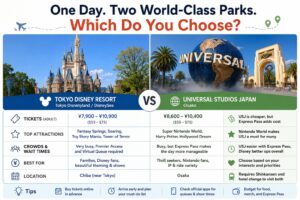
Tokyo Disneyland uses date-specific pricing — every day has its own ticket price based on expected demand. There is no fixed “standard” price. The range for adults in 2026 is ¥7,900–¥10,900 ($52–$71 USD). Juniors (12–17) pay ¥6,600–¥9,000 ($43–$59). Children (4–11) pay ¥4,700–¥5,600 ($31–$37). Under 4 is free.
Tickets are date-locked: you buy a ticket for a specific date and that date cannot be changed after purchase. Choose your date before you buy.
There is also no multi-day discount and no park-hopper option. Each ticket covers one park on one day. If you want both Disneyland and DisneySea, you need two separate tickets on two separate days.
The sale window on the official site opens 60 days before your visit date at 2:00 PM JST. Popular dates — Golden Week (April 29–May 6), summer weekends, Christmas week — sell out within hours of that window opening. Set an alarm. For most Americans visiting on a planned Japan trip, buying through Klook 4–8 weeks in advance is the practical approach.
One more ticket option worth knowing: Evening Passports allow entry from 3:00 PM (weekends/holidays) or 5:00 PM at a reduced price of ¥6,500–¥8,700 ($42–$57) for adults. If you’re arriving in Tokyo on a late afternoon and want a half-day introduction to the park, this is a real option — the evening parade and castle projections are legitimately excellent and don’t require a full-day ticket.
| Ticket Type | Adult (18+) | Junior (12–17) | Child (4–11) | Under 4 |
|---|---|---|---|---|
| 1-Day Passport (off-peak weekday) | ¥7,900 (~$52) | ¥6,600 (~$43) | ¥4,700 (~$31) | Free |
| 1-Day Passport (peak weekend/holiday) | ¥10,900 (~$71) | ¥9,000 (~$59) | ¥5,600 (~$37) | Free |
| Evening Passport (from 3 PM, weekends) | ¥6,500–¥8,700 (~$42–$57) | ¥5,300–¥7,200 | ¥3,800–¥4,400 | Free |
| Best booking platform for foreigners | Klook (US cards accepted, same price as official site) | |||
The Three Pass Systems: Premier Access, Priority Pass, and Standby
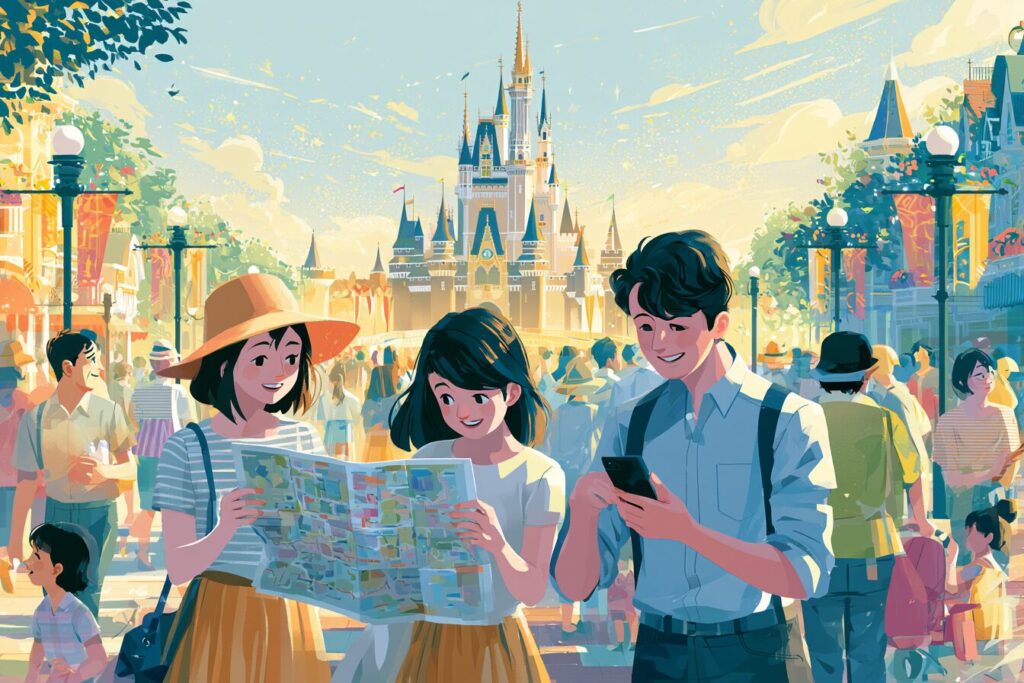
This is the section that confuses every first-timer, and the one that matters most for actually enjoying the park. Tokyo Disneyland has three ways to experience an attraction: standing in the regular queue (Standby), using a free timed-entry pass (Priority Pass), or paying for a guaranteed time slot (Disney Premier Access). Each system works differently, and understanding all three before you walk through the gate is the difference between riding 8 attractions and riding 4.
Disney Premier Access (DPA) — Paid, per-ride: Each DPA purchase reserves a specific ride time at a specific attraction, cutting your wait from 90+ minutes to under 15. Prices run ¥1,500–¥2,500 (~$10–$16) per person per ride. Purchased in the Tokyo Disney Resort app or at kiosks. Key rule: buy your first DPA within 30 minutes of park opening — morning slots for top rides sell out by 10:00 AM on weekends.
Priority Pass — Free, limited, luck-based: A free timed-entry pass for select attractions, available through the app. Limited quantity daily and distributed on a first-come-first-served basis. The pass assigns you a return time; you arrive in that window and enter a shorter queue. Priority Pass is available for Pooh’s Hunny Hunt, Monsters Inc., and a rotating selection of attractions. It is worth claiming if the return time works for your day — but do not build your entire plan around it. Supplies run out by mid-morning on busy days.
Standby — Free, always available: The regular queue. On quiet weekdays, standby for headliners runs 30–60 minutes. On busy weekends, Beauty and the Beast regularly hits 140–160 minutes standby. The strategy is to use DPA for your top 1–2 headliners and standby for everything else.
The Must-Do Attractions: What’s Unique, What’s Closing, What’s Coming

Tokyo Disneyland’s attraction lineup in 2026 splits into three categories: world-exclusive rides you cannot experience anywhere else, shared classics you may know from US parks, and one closed zone (Tomorrowland headliners) coming back bigger in 2027.
World-exclusive — get these first:
Enchanted Tale of Beauty and the Beast — a trackless dark ride through the castle, with a ballroom scene that has become one of the most photographed moments in any Disney park globally. Opened 2020. DPA recommended — standby routinely hits 140–160 minutes. This is the single most important attraction to plan around.
Pooh’s Hunny Hunt — a trackless ride through the Hundred Acre Wood with vehicles that move independently and unpredictably, creating a different ride experience every time. No equivalent exists at any other Disney park. Priority Pass when available; 60–100 min standby.
The Happy Ride with Baymax — a spinning disc ride set to an original J-pop soundtrack with choreographed lighting. Less intense than most thrill rides, deeply joyful. DPA on weekends; 30–60 min standby on quieter days.
Monsters, Inc. Ride & Go Seek! — a Japanese-exclusive dark ride version of the film where guests use flashlights to activate Boo and friends. Priority Pass or 45–75 min standby.
Minnie’s Style Studio — the world’s first dedicated Minnie Mouse meet-and-greet facility, in Toontown. Minnie changes her outfit seasonally. Free; modest wait.
Shared with US parks — still worth doing: Haunted Mansion (lovingly maintained), Pirates of the Caribbean (fully operational, excellent), It’s a Small World (the Japanese version has country-specific additions), Big Thunder Mountain (reliable crowd-pleaser, 50–80 min standby).
2026 Special: Vanellope’s Sweet Pop World (April 9–June 30, 2026): A limited seasonal event featuring the “It’s a Sweetsful Time” parade with Vanellope, Ralph, Mickey and friends through a candy-themed world. Approximately 35 minutes long. If your visit falls in this window, add the DPA for reserved parade seating early — it sells out faster than ride DPA.
Your First Day, Hour by Hour
This plan works for most first-timers on a moderately busy day (weekend or popular weekday). Adjust based on your priorities — if young children are part of the group, substitute the opening sprint with a Fantasyland loop instead.
7:45 AM: Arrive at the gate. Park opening is typically 8:00 AM on busy days, 8:30 AM on quieter ones. Download the Tokyo Disney Resort app the night before and log in. Have your Klook QR code screenshot saved offline in case of poor cell signal at the gate.
8:00 AM (Park opens): Go directly to Enchanted Tale of Beauty and the Beast. This is the only priority that matters at rope drop. Standby waits begin climbing immediately — by 9:00 AM the queue is already 60+ minutes. If you have DPA already purchased (you can buy it in the app starting at park opening), go straight to the DPA entrance lane.
8:05–8:10 AM (while walking or in queue): Open the app. Simultaneously: (1) Claim a Priority Pass for Pooh’s Hunny Hunt or Monsters Inc. if available. (2) Purchase DPA for The Happy Ride with Baymax for a mid-morning return time.
9:00–10:30 AM: After Beauty and the Beast, follow your DPA/Priority Pass return times. Fill gaps with Haunted Mansion (lines are shorter early), Pirates of the Caribbean (large capacity, steady queue), or Big Thunder Mountain. 10:00 AM is the crowd inflection point — the park fills noticeably after this on any day with decent attendance.
11:30 AM–1:00 PM: Lunch. This is the best time to eat — the queues for restaurants also peak at noon. Center Street Coffeehouse for Baymax Curry Rice (shaped rice, fun to photograph). Eastside Café for sandwiches. Counter service in Westernland and Fantasyland for faster turnaround. Avoid Crystal Palace Restaurant at peak lunch — the wait for table service becomes its own attraction.
1:00–2:30 PM: This is the worst standby period of the day. Use this window for: Toontown (lower crowds than the main lands), It’s a Small World (high capacity, shorter waits), Jungle Cruise, or a character meet-and-greet. If you have remaining DPA to use, this is the ideal window.
2:30 PM: Claim a parade viewing spot for the afternoon parade — arrive 30 minutes early for a seated spot on the curb. As the last float passes your position, move immediately to rides. The crowd is pinned behind the parade route for 10–15 minutes. This is consistently the lowest-wait window of the afternoon for headliners.
5:00 PM onward: Shopping (save this for end of day — carrying bags through the park all day is miserable), dinner, and the nighttime electrical parade. The castle projections and fireworks (when running) are best viewed from the hub area in front of Cinderella Castle. Crowds thin noticeably after 8:30 PM on weekdays — this is when experienced visitors ride headliners with sub-30-minute waits.
Food: What to Eat, What to Skip, and the Popcorn Situation
Tokyo Disneyland’s food program is widely considered the best of any Disney park — not because of fine dining, but because of the consistent quality of park snacks, the creativity of limited-edition items, and prices that are lower than comparable US parks.
The popcorn circuit: Tokyo Disneyland has more popcorn varieties and more elaborate character buckets than any Disney park in the world. Flavors rotate by land and season. Current 2026 flavors include Cookie & Cream, Caramel & Cheese, and Strawberry Milk at The Big Pop in Tomorrowland. Curry popcorn remains a perennial favorite throughout the park. A regular popcorn bag costs approximately ¥500–¥600 (~$3–$4); character buckets run ¥1,800–¥2,200 (~$12–$14) and come with discounted refills at any popcorn booth in the park. Buy one bucket, refill throughout the day.
Must-eat snacks:
— Baymax Curry Rice (Center Street Coffeehouse, ~¥1,300): A Baymax-shaped white rice mound surrounded by two curry types, photogenic and genuinely tasty. Best ordered at 11:00 AM before the lunch rush.
— Mickey-Shaped Waffle (Great American Waffle Co., ~¥700): The classic. Maple syrup version is the default; seasonal toppings vary.
— Little Green Alien Mochi (~¥500–¥600): Soft mochi shaped as the Toy Story aliens; green tea or strawberry filling. Sold at Tomorrowland snack locations.
— Turkey Leg (~¥900): The American classic is here and remains one of the most satisfying park foods — large enough to share, savory, unfussy.
— Seasonal Churros (~¥500): Rotating flavors by season and event. Worth checking what’s currently available at the churro carts near the castle hub.
Skip list: The Crystal Palace Restaurant (table service at peak lunch is a 30+ minute wait for the table, not just the food). Anything near the castle hub at 12:30–1:30 PM has the longest food queues. The park’s restaurant lines move fast once you’re seated — the wait to be seated is the issue.
The Language Question — Answered Directly
You do not need Japanese to visit Tokyo Disneyland. The park’s English accessibility is excellent and has been designed specifically to accommodate international visitors.
The Tokyo Disney Resort app is available in English and covers all core functions: real-time wait times, DPA purchase, Priority Pass claiming, show schedules, and restaurant information. Physical wait time signs throughout the park display in Japanese and English simultaneously. Cast members in major guest-facing roles — attraction operators, restaurant staff, guest relations — have basic English, and many are fully conversational.
Menus at counter service restaurants have pictures and English text. Table service restaurants typically have English menus available on request. The main merchandise shops have English-speaking staff available.
When to Go: The Crowd Calendar Americans Get Wrong
Tokyo Disneyland’s crowd patterns are driven by the Japanese school and holiday calendar, not by American travel patterns. This is the most important planning insight that US-written guides consistently miss. An American who books during what looks like a “quiet” spring week may arrive during Japanese school trip season and face 120-minute waits. An American who avoids summer (thinking “peak season”) may miss the fact that mid-June weekdays are among the quietest days of the year.
| Period | Tier | Why | What It Means |
|---|---|---|---|
| Jan 4–mid-Feb (weekdays) | ✅ BEST | School is in session; post-New Year lull | Sub-30 min waits on headliners; DPA optional |
| Late Feb–mid-Mar (weekdays) | ✅ GOOD | Pre-spring break; mild weather | Manageable crowds; cherry blossom starts late March |
| Late Mar–Apr 28 (any day) | ⚠️ RISKY | Spring break + cherry blossom season | Very busy; guides recommend it anyway — book far ahead |
| Apr 29–May 6 (Golden Week) | 🚫 AVOID | Japan’s biggest domestic holiday week | Maximum crowd level; tickets sell out weeks ahead |
| Mid-May–mid-Jun (weekdays) | ✅ BEST | School in session; rainy season deterrent | Among the quietest days of the year |
| Mid-Jun–Aug (any day) | ⚠️ BUSY | Summer school holiday; Obon mid-August | Busy but manageable with strategy; avoid Obon week |
| Sep 5–Oct (weekdays) | ✅ GOOD | School back; mild autumn weather begins | Best weather + manageable crowds; sweet spot for Americans |
| Oct–Nov (weekdays) | ⚠️ RISKY | School trip season; Japanese class trips | Weekday crowds from school groups; weekends are fine |
| Dec 20–Jan 3 | 🚫 AVOID | Christmas + New Year; peak domestic travel | Most expensive tickets; sold out weeks ahead |
- Is Tokyo Disneyland safe to visit as an American? Is English enough?
- Yes and yes. Japan has one of the lowest crime rates of any country in the world, and Tokyo is consistently ranked among the safest major cities globally. Within the park, the guest experience is designed explicitly for international visitors — English signage, English app, English-fluent staff at major guest points. The only logistical challenge is buying tickets (use Klook) and the credit card situation at the official site (also solved by Klook).
- Should I visit Tokyo Disneyland or Tokyo DisneySea first?
- For a first-time visit to Japan: DisneySea first, Disneyland second. DisneySea is genuinely unlike anything in the world — no equivalent exists in the US, and it anchors a Disney trip to Japan in a way that Disneyland (which shares DNA with US parks) cannot. Visit Disneyland on day two after DisneySea has reset your benchmarks. If you only have one day: DisneySea wins for Disney fans; Disneyland wins for families with very young children (under 6) who may be overwhelmed by DisneySea’s more complex environment.
- Do I need to tip at Tokyo Disneyland restaurants?
- No. Tipping is not practiced in Japan. At restaurants, counter service, or any food location in the park, you pay the stated price and that is the complete transaction. Attempting to leave a tip causes confusion and is often politely declined. The price you see is the price you pay, including service.
- Can I bring outside food into Tokyo Disneyland?
- Outside food and beverages are generally not permitted inside the park per Tokyo Disney Resort policy. A picnic area is available near the entrance for eating before you enter. Guests with food allergies or specific dietary needs can bring their own food after informing staff — approach Guest Relations at the front of the park when you arrive. The park has designated areas for nursing/feeding infants.
- What should I do if I have dietary restrictions?
- Inform Guest Relations at the park entrance when you arrive. Tokyo Disneyland has a dedicated allergy management system and can provide ingredient lists for all menu items. Vegetarian and vegan options are limited but exist — the park’s allergy guide (available in English through Guest Relations or the app) lists them. For serious allergies, this conversation should happen at the gate, not at the restaurant counter.
- How do I get to Tokyo Disneyland from central Tokyo?
- Take the JR Keiyo Line from Tokyo Station to Maihama Station — the journey takes approximately 15 minutes and costs about ¥220 (~$1.50). From Maihama, Tokyo Disneyland is a 5-minute walk or you can take the Disney Resort Line (monorail) one stop for ¥260. From Shinjuku or Shibuya, add approximately 30–40 minutes of train travel. The park’s location is easily accessible from anywhere in central Tokyo with a single transfer at Tokyo Station.