Japan is, by any measure, one of the most photographed countries on earth. Not because it’s exotic in the dismissive tourist-brochure sense, but because it has built a visual culture where beauty is embedded in the ordinary: a raked gravel garden, a convenience store at 2am, a red bridge over still water in autumn fog. Every major city has a corner that looks like a film still from a movie you haven’t seen yet.


But the most Instagrammable spots are not always the most famous ones — and the most famous ones are rarely photographed well. The torii gate tunnel at Fushimi Inari has been shot a billion times; most of those shots look identical because most people shoot it at noon with twenty strangers in frame. The difference between a forgettable photo and a genuinely striking one is almost never the location. It’s the hour, the angle, and knowing what everyone else is doing so you can do the opposite. This is the 2026 ranking — with the practical specifics that actually matter.
#1 Fushimi Inari Taisha — The Torii Tunnel at Dawn


Fushimi Inari Taisha in Kyoto is the most photographed Shinto shrine in Japan, and the photograph everyone wants is the same: the Senbon Torii — a tunnel of thousands of bright orange torii gates climbing the wooded hillside — seen from within, looking up toward the mountain, the gates converging to a vanishing point. It’s one of the most visually striking compositions in travel photography. It is also surrounded by crowds from 9am to 5pm every day of the year.
The solution is straightforward: arrive before 7am. The shrine is open 24 hours, admission is free, and the lower tunnel (the first 10 minutes of hiking from the main torii) is accessible without any hiking. Before 7am on weekdays, you can stand in the middle of the tunnel for extended periods with minimal crowds. The light in early morning filters through the gate wood in a way that the harsh midday sun entirely eliminates — long horizontal rays catching the dust between gates, the orange intensifying in low-angle morning light. Bring a wide-angle lens or use your phone’s panorama mode from a low position.
For the less-photographed shot: climb past the main tunnel for another 20 minutes to reach the Yotsutsuji intersection, where the hillside opens on one side to reveal a view over southern Kyoto. Most visitors turn back before this point. The view at Yotsutsuji at sunrise, with the city below catching its first light and a few lone hikers at the intersection, is quieter and more personal than anything in the lower tunnel — and almost never appears in travel feeds.
#2 Shibuya Crossing — The Shot Everyone Gets Wrong


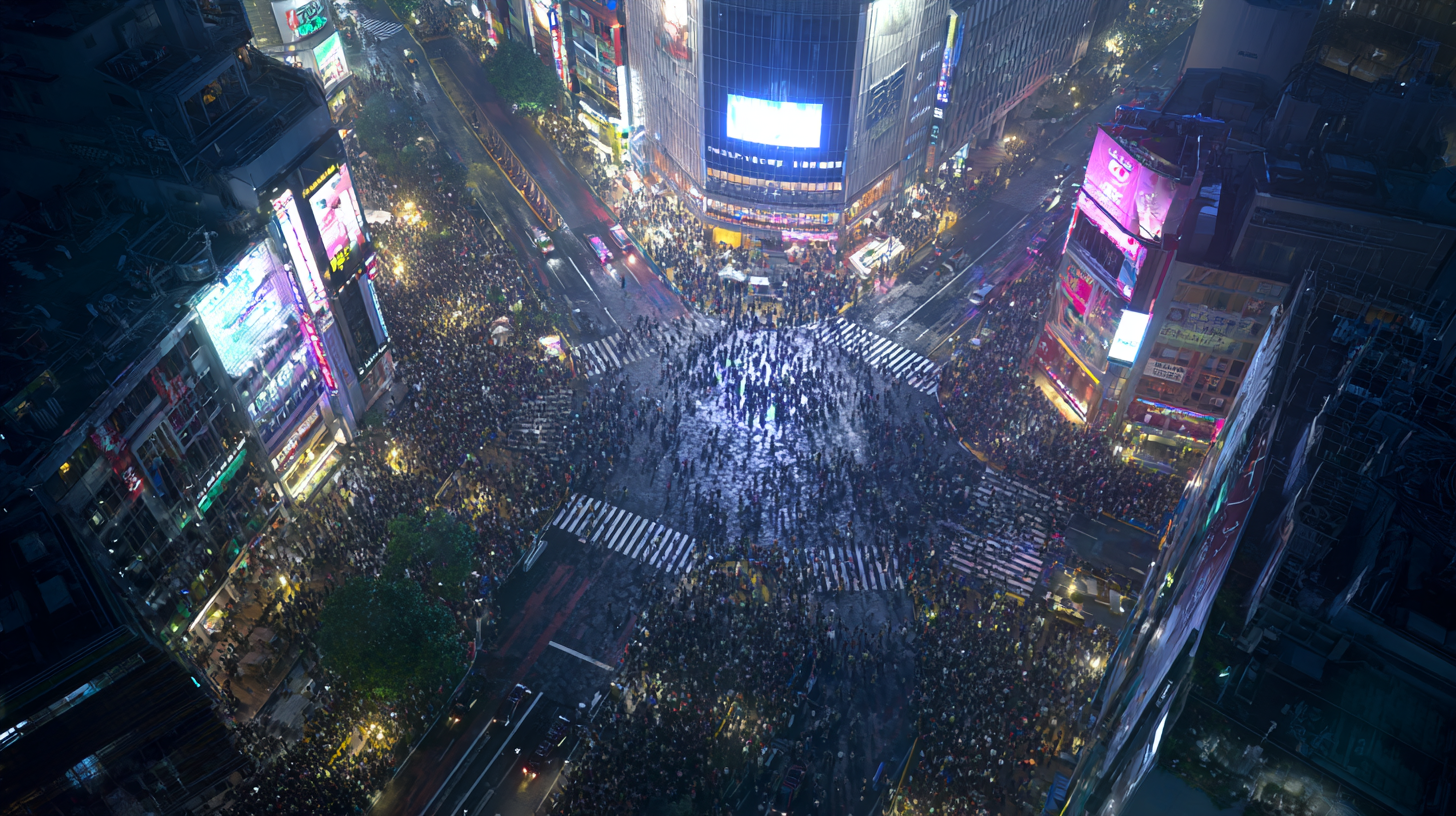
Shibuya Crossing is the busiest pedestrian intersection on earth. At peak crossing moments during rush hour, over 1,000 people cross simultaneously from five directions. It is exactly as visually overwhelming in person as it appears in travel photography. The question is how to photograph it well, because the default approach — standing on the crossing itself, shooting in all directions — produces a shot that looks like everyone else’s shot.
The elevated angle is the one that works. The Mag’s Park Starbucks, on the second floor of the building directly at the crossing’s northwest corner (above the Starbucks on the ground floor, accessible by elevator), has floor-to-ceiling windows facing the crossing. It opens at 8am, which is before the crossing reaches its full morning rush density. The window seats are claimed immediately and not easily surrendered, so arrive at opening and wait. The alternative: Shibuya Sky, the rooftop observation deck at the Shibuya Scramble Square building, gives a full overhead view at ¥2,000 per person and allows photography in all directions. The nighttime view, with the Scramble’s neon and the crossing lit by headlights and storefronts, is one of the best nocturnal cityscapes in Tokyo.
The unexpected shot: the crossing at 3am on a weeknight, when foot traffic drops to dozens per cycle and the neon reflects in wet pavement with almost no pedestrian movement. The visual contrast between this version and the rush-hour image — same location, same neon, completely different emotional register — is the frame that actually performs on Instagram because almost no one shoots it.
#3 Arashiyama Bamboo Grove — How to Get the Real Shot


The Arashiyama bamboo grove in western Kyoto is Japan’s most reproduced natural landscape image: tall bamboo stalks rising to a sky-blocking canopy, the path between them shaded and cool even in summer, light filtering down in diffused shafts. In photographs it looks serene and empty. In reality, from 9am until closing, it holds a continuous stream of visitors shoulder to shoulder.
The grove opens at 9am but the path through it — a 5-minute walk from east to west — can be accessed from the Okochi Sanso Garden gate on the western side before official opening hour. Arrive at the garden gate at 7:30am and walk east through the grove — you’ll have a 15–20 minute window before the volume builds. Alternatively, arrive at the main eastern entrance at exactly 9am (before tour buses deposit large groups at 9:30am) and move quickly to the center section, where the bamboo is tallest and most visually dense.
For the composition: shoot upward from a low position with a wide angle, the bamboo stalks converging overhead, the path invisible at the frame’s bottom. This is the shot that communicates the grove’s actual scale — the sense of the canopy closing above you — rather than the flat, eye-level photograph that reduces it to a decorative background. After the grove, the Togetsukyo Bridge with Arashiyama’s forested hills reflected in the Oi River is worth the 5-minute walk.
#4 Mount Fuji from Kawaguchiko — The Frame That Works


Mount Fuji (3,776 meters) is the most photographed mountain on earth and appears on Japan’s ¥1,000 banknote. The challenge is not finding it — it’s visible on clear days from Tokyo — but finding the angle and conditions that elevate it beyond a simple landscape. The mountain’s symmetry means almost any composition works technically. The ones that stand out are the ones that add scale or context: a torii gate in the foreground, cherry blossoms along a lakeside path, a lone fisherman on a predawn shoreline.
Lake Kawaguchiko, the most accessible of the Fuji Five Lakes, is the primary base for Fuji photography. The iconic Chureito Pagoda shot — a five-story pagoda on a hillside with Fuji behind it — requires climbing 398 stone steps from Fujiyoshida Station and arriving well before 9am in spring (cherry blossoms frame the pagoda between late March and mid-April in normal years). For the simpler lakeside compositions, the north shore of Kawaguchiko offers unobstructed Fuji reflections in early morning when the water is still. The Kawaguchiko Music Forest garden on the lake’s north shore, which opens at 9am, has meticulously maintained flower gardens that provide colorful foregrounds year-round.
Weather is everything. Fuji is frequently cloud-obscured from late June through September. The clearest windows are typically October through December (when the air dries after typhoon season) and January through March (cold, dry, high visibility, snow cap at its deepest). Check the Fuji Five Lakes area weather forecast rather than the Tokyo forecast, as microclimates differ significantly. Access from Tokyo: the Fuji Excursion limited express from Shinjuku reaches Kawaguchiko in approximately 1 hour 45 minutes for ¥2,530 reserved; alternatively, highway buses from Shinjuku Bus Terminal take 1 hour 40 minutes for ¥1,800.
#5 Dotonbori Osaka — Japan’s Neon Capital at Night


Dotonbori is a 1-kilometer stretch of canal in central Osaka lined with LED signage, mechanical restaurant mascots, and a density of food stalls unmatched in any Japanese city. The giant Glico Running Man — a 33-meter illuminated billboard of a running athlete that has been Osaka’s visual icon since 1935 — faces the canal from the Ebisubashi Bridge. At night, with the canal reflecting the neon and the bridge crowded with people eating street food, it’s one of Japan’s most viscerally alive visual environments.
The best photograph is taken from the Dotonboribashi footbridge, approximately 50 meters west of Ebisubashi, at an angle that frames the canal, the bridge crowd, the Glico sign, and the dense signage of the adjacent buildings in one composition. The shot works in any weather — rain adds reflections on the canal surface that multiply the light sources; fog diffuses the neon into a general glow. Visit between 7pm and 10pm for the highest sign density and canal activity. After 11pm the crowds thin but the signage remains fully lit until midnight.
Beyond Dotonbori itself: Hozenji Yokocho, a stone alley 5 minutes’ walk from the canal, runs between two narrow rows of small restaurants and bars, with a moss-covered stone Fudo Myoo statue at its center. The alley is lit by soft amber lanterns and holds none of Dotonbori’s commercial energy. It’s the photograph that surprises people who only planned to shoot neon — a single alley that feels like a different city entirely.
#6 Senso-ji Temple, Asakusa — Tokyo’s Most Photogenic Dawn


Senso-ji is Tokyo’s oldest temple, the city’s most visited landmark, and between 9am and 5pm one of its most congested spaces. The Kaminarimon gate — the giant red lantern flanked by deity statues — is the shot: in context, framed against the lantern’s underside with Nakamise shopping street receding behind it, the temple gate is one of Japan’s most architecturally dramatic photographs. In isolation, cropped to the lantern alone, it’s one of the most iconic travel images in Asia.
At 5:30am, the temple and its grounds are quiet. The Kaminarimon gate photograph — the one with no people, with early morning light catching the lantern’s red lacquer — is entirely achievable in the first hour of daylight. The incense smoke (the bronze incense burner in the temple courtyard is lit by worshippers from early morning) creates a natural atmospheric element that midday photographs lack. The inner temple opens at 6:00am; arrive early and you’ll have the main hall largely to yourself.
The adjacent Nakamise shopping street, 250 meters of souvenir stalls leading to the inner gate, is also photographable before opening (stalls open around 10am): the red-lantern-lined street, empty and perfectly symmetrical, with the Hōzōmon gate at the end, is a different image entirely from the crowded afternoon version. For the Sumida River view, walk 5 minutes east to the Azumabashi bridge — the skyline from here includes the Asahi Beer Tower (the golden flame building), the Tokyo Skytree, and the river, a combination of Tokyo’s old and new that photographs well from either bank.
Photography Tips That Apply Everywhere in Japan
The single most effective thing you can do for travel photography in Japan is shift your schedule by two hours. Every major tourist site in Japan is crowded between 9am and 4pm. Every major tourist site becomes manageable, and often empty, before 8am and after 5pm. Japan has a culture of early-morning shrine and temple visits that means these spaces function as working religious sites before the tourist wave arrives; you are not intruding by being there at dawn — you are experiencing the place as it primarily functions.
For smartphone photography: Japan’s overhead lighting (street lights, sign neon, lanterns) is exceptionally well-suited to night mode photography. The iPhone 15 and 16 Pro, the Sony Xperia 1 VI, and recent Samsung Galaxy models all produce striking results at Dotonbori, Shinjuku Kabukicho, and Shibuya without additional equipment. The one technique worth practicing: hold the phone very still during the extended night mode exposure (1–4 seconds on most phones). Brace your elbows against your body or rest the phone against a railing. The difference between a blurred night shot and a sharp one is purely camera stability.
What not to photograph: in Japan, photographing people’s faces without permission is legally permissible but socially sensitive. Shrine priests, festival participants in traditional dress, and geiko (geisha) in Kyoto’s Gion district are frequently photographed without consent; this practice has become contentious enough that signs in parts of Gion explicitly prohibit photography on certain streets. If you want to photograph someone in Japan, a smile and a questioning gesture (pointing to your camera, then to them) is universally understood and generally welcomed. The photographs taken with permission are invariably better than those taken covertly.