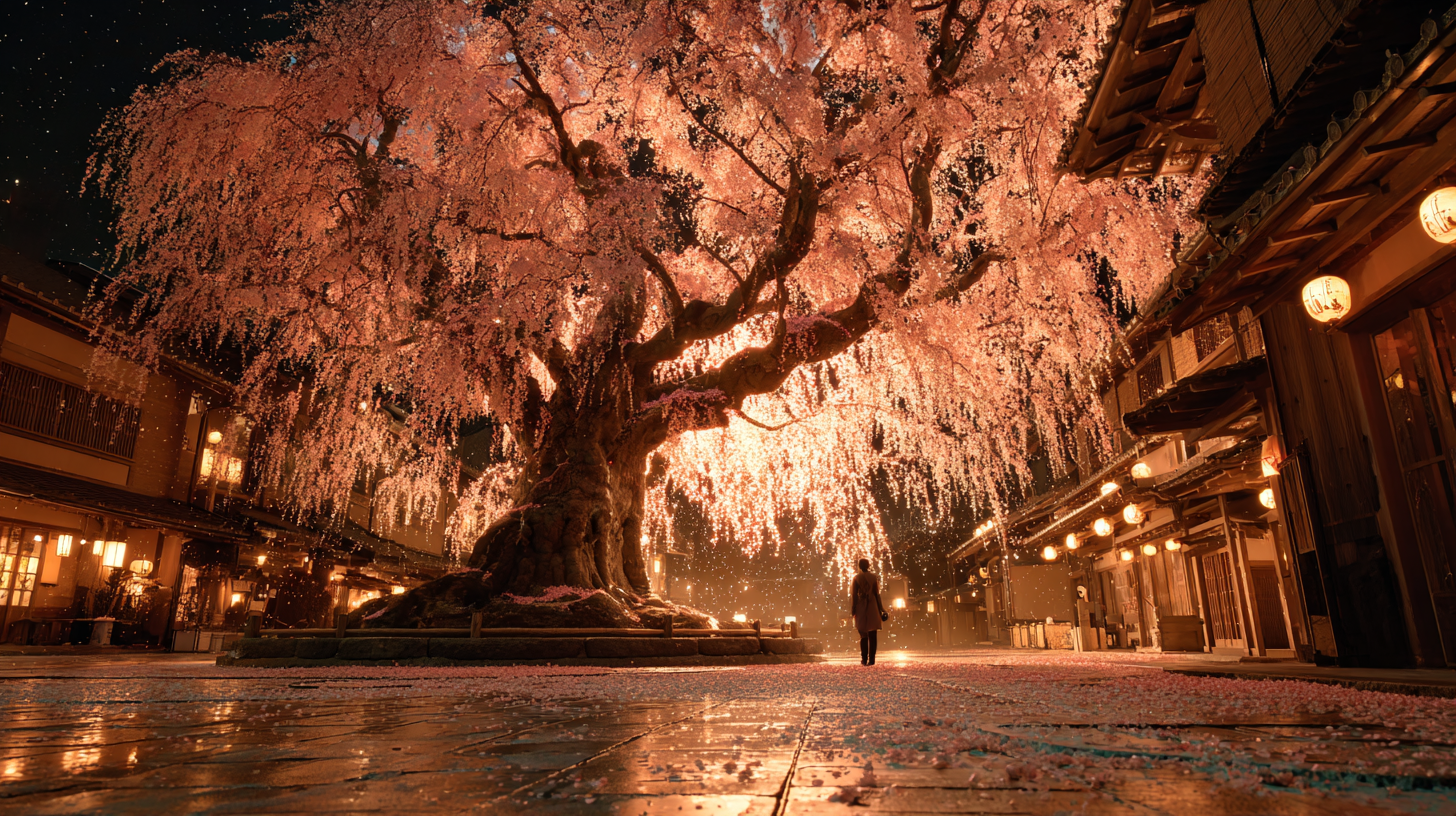
I almost missed it entirely. My plan had been to check into the ryokan early, drop my bag, and walk through Gion in the dark. But something pulled me toward Maruyama Park first — maybe the soft orange glow I could see from the main street, or maybe just the quiet you don’t expect in the middle of a Japanese city.
There it was: the great weeping cherry of Maruyama Park, alone on a low rise, lit from below by floodlights, its branches trailing nearly to the ground. A crowd had gathered in near-silence. A woman standing to my left was crying. I understood why.
Kyoto is Japan’s undisputed cherry blossom capital. With more than 1,600 temples and shrines — many surrounded by hundreds of sakura trees — the city holds more iconic hanami spots per square kilometer than anywhere else in the country. Knowing which spots to prioritize, when to visit, and how to sidestep the worst crowds can transform the experience entirely.
Here is where to go in 2026.
2026 Bloom Forecast for Kyoto
Cherry blossoms in Kyoto typically peak between late March and early April. Based on historical averages and Japan Meteorological Corporation forecasts, the 2026 full bloom window is expected to fall between March 27 and April 5. The most common variety — Somei Yoshino — tends to peak for about one week before petals begin to fall.
The best viewing moment, called mankai (満開), lasts roughly seven to ten days. After that comes hanafubuki — the “petal blizzard” — which many regulars quietly prefer: canal paths and stone temple steps covered in pale pink petals, the crowds thinning slightly, the light just as beautiful. For the Maruyama Park weeping cherry, which blooms slightly earlier than Somei Yoshino, plan for the third week of March if possible.
Maruyama Park — Kyoto’s Most Iconic Cherry Tree
Every conversation about Kyoto cherry blossoms starts here. The park’s gion shidare zakura — a 600-year-old weeping cherry (枝垂れ桜) at the center — is Kyoto’s most photographed single tree. By day it draws tourists from every country. After 7pm, when the floodlights come on and the crowd thins to a more manageable hum, it becomes something worth traveling across the world for.
Access is free and the park is open 24 hours. From Keihan Gion-Shijo Station (京阪祇園四条駅), it’s a 10-minute walk east through Gion’s lantern-lit alleys. From Hankyu Kawaramachi Station (阪急河原町駅), allow 15 minutes. Food stalls open by late afternoon and stay until around 9pm, selling yakitori from ¥200 and matcha soft serve from ¥400. Hanami picnics on spread sheets are normal and expected — buy something from a nearby convenience store, claim a spot on the grass before 5pm, and stay as long as you want.
Philosopher’s Path — The Canal Walk You Need to See
The Philosopher’s Path (哲学の道) is a 1.5-kilometer stone path that follows the Shishigatani Canal through eastern Kyoto. It takes its name from philosopher Nishida Kitaro, who reportedly walked it daily as a meditative practice. During cherry blossom season, the canal’s edges are lined with roughly 450 Somei Yoshino trees, their branches arching overhead to form a pale pink tunnel.
It’s best in the morning — arrive before 8am and the low-angle light comes through the petals in a way that makes the whole path glow. By 10am the path fills with visitors shoulder-to-shoulder. The walk connects Nanzenji Temple (南禅寺) to the south and Ginkakuji Temple (銀閣寺) to the north. Both are worth adding before or after; a combined visit takes three to four hours at a relaxed pace. The path itself is free to walk. From Keihan Demachiyanagi Station (京阪出町柳駅), take city bus 17 to Ginkakuji-michi (銀閣寺道) — about 20 minutes, ¥230.
Kiyomizudera — Cherry Blossoms from the Hillside


Kiyomizudera Temple (清水寺) perches on the eastern hills of Kyoto, its famous wooden stage jutting out over a 13-meter drop into a valley of cherry and maple trees. During sakura season the view from the stage becomes one of the most photographed scenes in all of Japan: the three-tiered pagoda rising above a sea of pink and white blossoms, with the city spread out below.
Entry costs ¥400 for adults. The temple opens at 6am — a detail worth using. The first hour of daylight offers the clearest views and significantly fewer people, and the morning light on the blossoms is noticeably different from the flat midday glare most visitors experience. Access: from Keihan Kiyomizu-Gojo Station (京阪清水五条駅), it’s a 25-minute uphill walk through the Kiyomizuzaka (清水坂) slope, lined with ceramics shops and matcha sweet stalls. Alternatively, take city bus 206 to Kiyomizumichi (清水道).
Arashiyama — Cherry Blossoms by the River


Arashiyama (嵐山) is better known for its bamboo grove, but the riverbank around Togetsukyo Bridge (渡月橋) is one of Kyoto’s most underrated hanami locations. The Oi River reflects the cherry trees on its banks, and the surrounding hills — forested in both sakura and fresh spring green — create a depth that flat city parks simply can’t match.
The area around the bridge gets busy but stays manageable if you arrive before 9am or return after 4pm. Renting a rowing boat on the river — around ¥1,500 for 30 minutes from the boathouse near the bridge — turns a crowded riverside walk into something private and unhurried. Access: Arashiyama Station on the Randen Arashiyama Line (嵐電嵐山本線嵐山駅), approximately 30 minutes from Shijo-Omiya Station.
Nijo Castle — Where Fewer People Are Looking


Nijo Castle (二条城) sits near the center of Kyoto and receives a fraction of the foot traffic that Maruyama Park or the Philosopher’s Path draw during sakura season. Yet it holds over 400 cherry trees — Somei Yoshino, weeping cherries, and late-blooming yaezakura (八重桜) — spread across its moat-ringed grounds.
The late-blooming trees offer a practical advantage: the yaezakura at Nijo Castle typically peak one to two weeks after Somei Yoshino elsewhere, extending your viewing window even after the main bloom has passed. Entry costs ¥1,300 for adults (including Ninomaru Palace). Open daily from 8:45am. From Tozai Line Nijojo-mae Station (地下鉄東西線二条城前駅), it’s a 1-minute walk.
Practical Tips for Hanami in Kyoto 2026
The Kyoto city 1-day pass (地下鉄・バス一日券) covers all city buses and the subway for ¥1,100. For a day covering the Philosopher’s Path, Kiyomizudera, and Nijo Castle, this pays for itself within two rides.
Crowds peak between 10am and 3pm on weekends during full bloom. Golden hour — the 45 minutes before sunset — consistently offers the best light and a meaningful drop in foot traffic. Night illumination (ライトアップ) runs at Maruyama Park, Kiyomizudera, and Nijo Castle from around 6pm to 9:30pm; these evening sessions are worth planning your dinner around.
A note on hanami etiquette: picnics on spread sheets (ブルーシート) are entirely normal in public parks. Loud music on Bluetooth speakers is frowned upon. Trash bins are rare throughout Kyoto — bring a bag for your waste. Remove shoes before entering any temple building regardless of how long the queue is.
If your trip falls around April 8th, many temples hold Hana Matsuri (花まつり), the festival marking the Buddha’s birthday, with ceremonies open to the public and incense smoke drifting through the sakura branches. It’s a combination that’s harder to find anywhere else in the world.