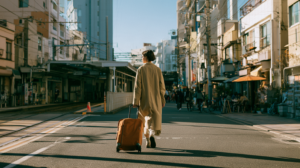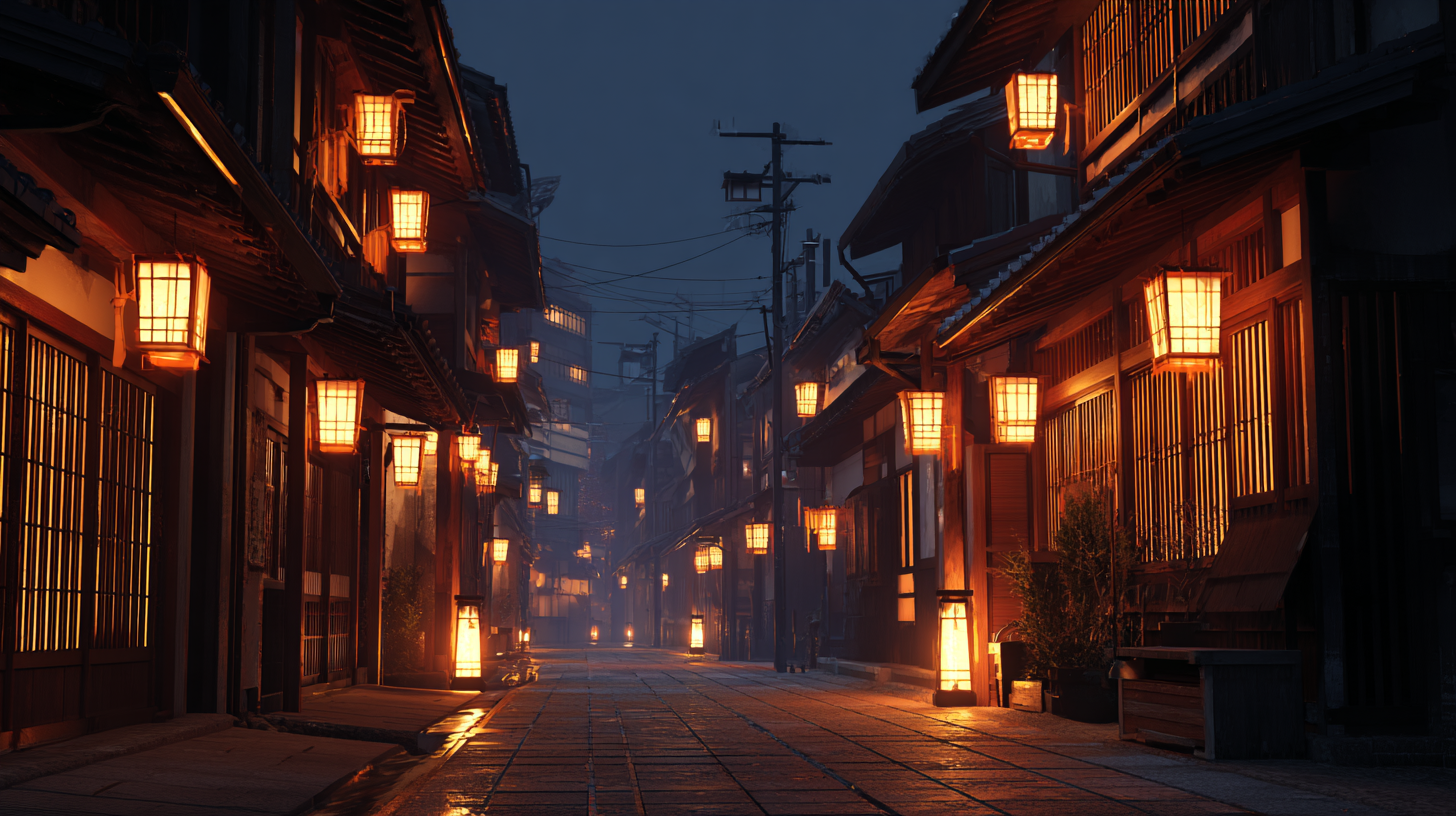
I had been to Asakusa before. I had walked Nakamise-dori, lit incense at Senso-ji, bought ningyo-yaki at the same stall everyone goes to. But the second time I walked through Asakusa’s backstreets — after finishing Demon Slayer — I stopped in front of a narrow shopfront with a low wooden eave and a paper lantern swaying in the draft from the subway grate below. I recognized it. Not a specific scene. Something more fundamental: the proportions of the street, the layered sound of wooden sandals on stone, the way the light fell through gap-toothed rooftops. This was where Tanjiro’s world was built.
Demon Slayer (Kimetsu no Yaiba) is the highest-grossing anime film of all time in Japan and one of the most watched series globally. Its setting — a fragmented, twilight version of Taisho-era Japan (1912–1926) — pulls from real places across the country. Some were direct visual references used by the studio’s animators. Others are landscapes so evocative of the show’s atmosphere that the connection feels inevitable once you’re standing in them. This guide covers both.
These are the real locations behind Demon Slayer, with practical information for visiting each one in 2026.
Asakusa, Tokyo — The City Where Tanjiro Sells Charcoal

Asakusa is the most direct real-world reference in Demon Slayer. The city Tanjiro visits to sell charcoal in the early episodes is modeled on Tokyo’s shitamachi (下町) merchant districts during the Taisho period — and Asakusa is the neighborhood that has preserved more of that atmosphere than anywhere else in the capital.
The area around Senso-ji Temple (浅草寺) is the obvious starting point. The Kaminarimon Gate (雷門) and Nakamise shopping street are busy year-round, but turn off the main corridor into Denpoin-dori (伝法院通り) or the Shin-Nakamise covered arcade and the scale shifts immediately — low shop facades, wooden beams, narrow lanes. Early morning is transformative: before 8am the incense smoke from Senso-ji drifts through streets that are effectively empty, and the sound design of the neighborhood — wooden doors, birdsong, distant temple bells — is startlingly close to what the show’s sound team created.
Hoppy Street (ホッピー通り), just west of Senso-ji, has izakayas that look largely unchanged from decades ago. The adjacent Hanayashiki amusement park (花やしき), opened in 1853, is still operating and adds a time-slip feeling that deepens the Taisho mood considerably. Access: Asakusa Station on the Ginza Line (東京メトロ銀座線), Tobu Skytree Line (東武スカイツリーライン), or Asakusa Line (都営浅草線). The area is best explored on foot for two to three hours.
Inariyama Park (Ageo, Saitama) — The Bamboo Grove of Fujikasane Mountain

The Final Selection sequence — where Tanjiro and other candidates fight in a bamboo forest on Fujikasane Mountain — is one of Demon Slayer’s most visually arresting early scenes. The combination of dense, hollow-sounding bamboo, filtered moonlight, and enclosed vertical space draws directly from Japan’s real bamboo forests, and Inariyama Park (稲荷山公園) in Ageo City, Saitama, is widely cited by Japanese fans as the closest match in feel and scale.
The park centers on a bamboo grove that covers a significant hillside, with paths winding through the culms in near-darkness even on bright days. The light in late afternoon, when the low sun catches individual bamboo stalks while the path remains in shadow, is precisely the visual grammar used in the show’s forest scenes. It’s accessible, free to enter, and consistently uncrowded — the kind of place that rewards visiting on a weekday when you’re the only one in it. Access: Inariyama Koen Station (稲荷山公園駅) on the JR Kawagoe Line — about 45 minutes from Ikebukuro Station.

Fushimi Inari Taisha, Kyoto — The Mountain of a Thousand Gates

Fushimi Inari Taisha (伏見稲荷大社) in southern Kyoto is one of the most visually distinctive shrines in Japan: a network of approximately 10,000 vermillion torii gates (鳥居) winding up Mount Inari through old-growth forest. The mountain trails stretch 4 kilometers each way and gain 230 meters in elevation, passing through dense cedar forest where the gates narrow and the light becomes strange.
The mountain setting — a spirit-inhabited peak accessible only by a marked path through tunneling gates — directly parallels the logic of Demon Slayer’s demon-hunting territories. The Yotsutsuji intersection (四つ辻) at roughly the halfway point offers a panoramic view over Kyoto that is particularly powerful at dusk, when the gates glow orange against a darkening sky. The summit (一ノ峰) takes about 90 minutes from the base at a moderate pace.
The lower section of the shrine is extremely crowded during peak hours and in peak season. The mountain above Yotsutsuji thins out dramatically — most day-trippers turn back at the viewpoint. Go up. Access: Inari Station on the JR Nara Line (JR奈良線) — a 5-minute walk from the torii. The trail is open 24 hours; nighttime walking, with lanterns lit and near-total silence above the tourist section, is an experience that belongs specifically to this mountain.
Saiko Iyashi no Sato Nenba, Yamanashi — The Taisho Village at the Foot of Fuji
Saiko Iyashi no Sato Nenba (西湖いやしの里根場) is a reconstructed Taisho-era village on the western shore of Saiko Lake, one of the Fuji Five Lakes in Yamanashi Prefecture. Twenty-one thatched-roof farmhouses (茅葺き屋根の民家) have been rebuilt on the site of a village destroyed by a typhoon in 1966, with Mount Fuji visible directly across the lake when skies are clear.
This is the most complete ground-level evocation of Demon Slayer’s visual world outside of a theme park recreation. The combination of thatched roofs, hand-cut timber frames, wood smoke, and the particular grey-green palette of old Japanese farmland — all of it compressed against a backdrop of lakewater and volcano — creates the same visual density the show uses for its mountain village sequences. Entry costs ¥500 for adults. The site opens daily from 9am to 5pm (closed Tuesdays in winter). Access: from Kawaguchiko Station (河口湖駅), take the Retro Bus to Saiko Iyashi no Sato (西湖いやしの里根場) — approximately 40 minutes, ¥150 with the two-day lake pass.

Togakushi, Nagano — The Mountain Shrine in the Mist


Togakushi (戸隠) is a mountain shrine complex in Nagano Prefecture, approximately 1,200 meters above sea level, set within one of Japan’s most atmospheric cedar forests. The approach path to the Upper Shrine (奥社) passes through a 2-kilometer avenue of 400-year-old sugi cedars so tall and closely spaced that the sky disappears entirely. In summer, mist collects in the cedar canopy. In winter, the path is snow-buried and the only sound is wind.
Togakushi is the real-world location most directly analogous to the Demon Slayer Corps’s mountain training grounds — and to Sabito and Makomo’s final grove. The forest scale is not cinematic; it is genuinely oppressive in the way the show intends. The shrines themselves — Hoko-sha (宝光社), Chuko-sha (中社), and Oku-sha (奥社) — are connected by trails and span a distance of about 8 kilometers. Allow a full day. Accommodation in the surrounding village includes traditional soba restaurants and small minshuku. Access: from Nagano Station (長野駅), take the Alpico bus to Togakushi Oku-sha Iriguchi (戸隠奥社入口) — about 60 minutes, ¥1,400 one way.
Mitake Gorge, Okutama — River, Rock, and Ancient Forest
Mitake Gorge (御岳渓谷) runs along the Tama River in Okutama, western Tokyo — technically still within the city’s administrative borders, but an hour and a half by train from Shinjuku and completely different in character. The gorge cuts through ancient granite, and the river section between Mitake Station (御嶽駅) and Kori Station (古里駅) passes through forested slopes with overhanging rock formations, old cedar groves, and stretches of river that catch light in ways that rarely happen in accessible places.
The walking path along the gorge is about 3.5 kilometers. Mount Mitake (御岳山) rises above — accessible by cable car from Mitake Station — and holds Musashi Mitake Shrine (武蔵御嶽神社), a mountain-top wolf shrine that has been active since the 7th century. The combination of water, ancient rock, and forest shrine represents the full environment that Demon Slayer uses for its outdoor combat sequences. Access: JR Ōme Line to Mitake Station (御嶽駅) — about 90 minutes from Shinjuku, ¥860. The gorge path starts immediately outside the station.
Planning Your Demon Slayer Pilgrimage in 2026
A dedicated pilgrimage combining Asakusa, the Saitama bamboo forest, Fushimi Inari, and Saiko Iyashi no Sato requires at minimum four days and is best organized around the JR Pass if traveling between Tokyo and Kyoto. The Fuji Five Lakes area (Yamanashi) sits conveniently on the route back from Kyoto to Tokyo if you add it to the end of the trip.
Togakushi and Mitake Gorge work well as day trips from Nagano City and Tokyo respectively, and can be layered into a broader Japan itinerary without requiring significant rerouting. Spring (March–May) and autumn (October–November) are the most atmospheric seasons for the outdoor locations; the bamboo forests and mountain shrines gain considerably from mist and seasonal foliage. The Saiko village and Togakushi cedar forest are also striking under winter snow — January and February visits trade warmth for an environment that is closer to the show’s colder sequences than anything possible in summer.
For Asakusa specifically: book accommodation in the neighborhood rather than just visiting for a day. Walking the backstreets at 6am — before the tourist economy starts — or after 9pm, when the izakayas are still open and the shopping streets have emptied, is when the Taisho-era resonance is strongest. The neighborhood’s atmosphere during those hours is genuinely hard to find anywhere else in Japan.