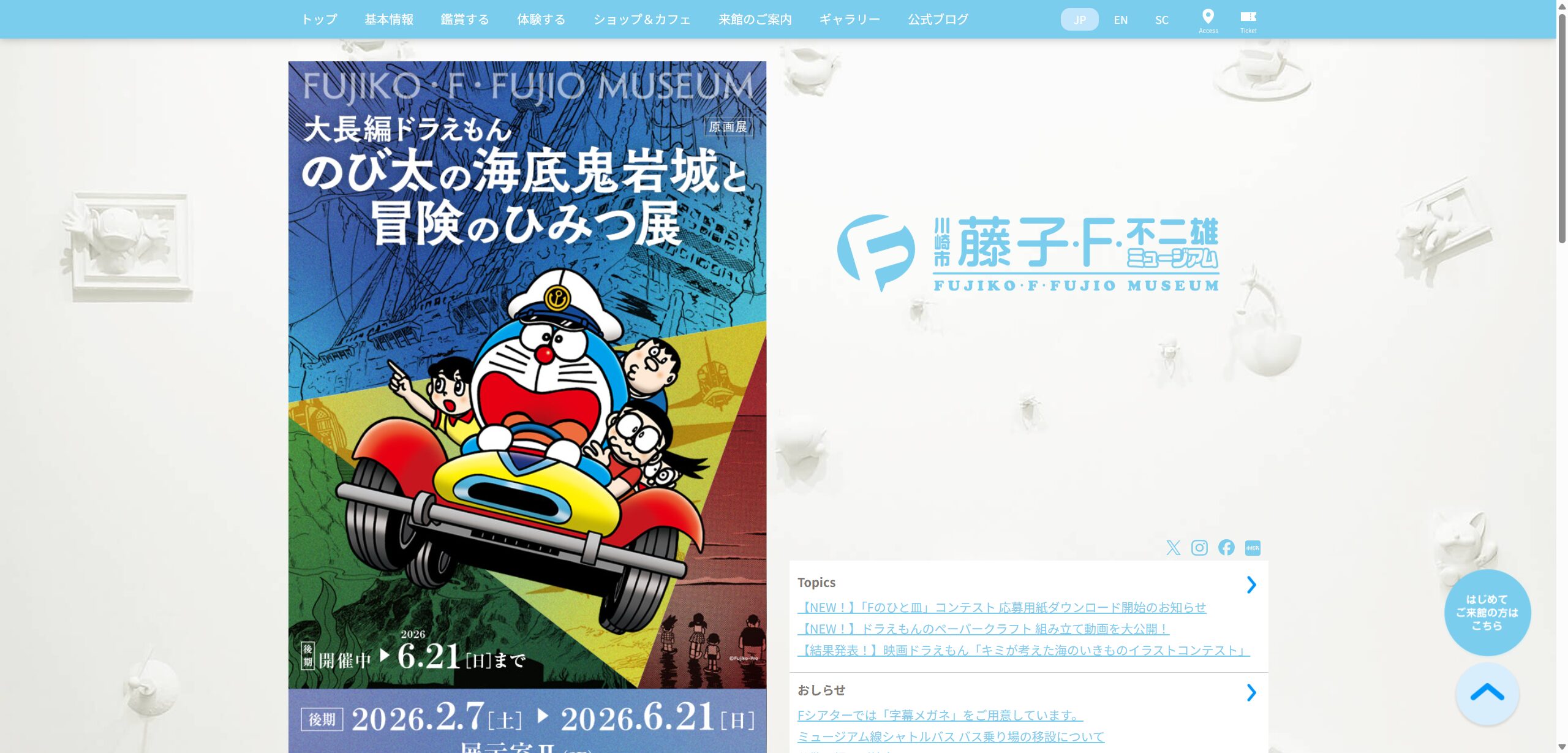
Foreign visitors often discover Doraemon late — through a clip, a meme, a Japanese friend who grew up with it, or simply by noticing a blue robotic cat on an enormous number of products across Japan. But in Japan itself, Doraemon is something different: a cultural cornerstone, as embedded in childhood as anything the country has produced. The Fujiko F. Fujio Museum (藤子・F・不二雄ミュージアム) in Kawasaki is where that legacy is curated, and visiting it is a different kind of experience than most anime-adjacent tourism offers.
This guide covers everything foreign visitors need to know for 2026: the ticket system, what’s inside, how to get there, what to buy, and how to make the most of a half-day in Kawasaki.

What Is the Fujiko F. Fujio Museum?
The museum — universally referred to as the Doraemon Museum by foreign visitors — is officially dedicated to the life and work of Hiroshi Fujimoto (pen name: Fujiko F. Fujio), co-creator of Doraemon and dozens of other beloved manga series. It opened in 2011 in the Tama Ward (多摩区) of Kawasaki, near the apartment district where Fujimoto lived and worked during the early years of Doraemon’s creation.
The building is recognizable immediately: a curved exterior with colored circular windows and a wall of Doraemon-themed imagery. Inside, the museum is divided across three floors with exhibits covering original manuscript pages, personal artifacts from Fujimoto’s studio, interactive reading rooms, and a dedicated short-film theater. Unlike many franchise museums, the focus here is genuinely on the craft of manga creation — original pen-and-ink pages, correction fluid marks and all, displayed in cases that let you see exactly how the drawings were constructed.
Tickets: How the System Works in 2026
Admission to the Fujiko F. Fujio Museum is by advance ticket only — walk-in visitors are not accepted. Tickets are sold through Lawson ticket machines (ローソンチケット) and the Loppi system inside Lawson convenience stores in Japan. For foreign visitors, online ticket purchase via l-tike.com or through overseas agent services is the more practical option. Tickets go on sale on the 10th of each month for slots three months ahead.
Entry is time-slotted: 10am, 12pm, 2pm, or 4pm. Tickets cost ¥1,000 for adults (18+), ¥700 for junior high and high school students, ¥500 for children 4–12, and free for under 4. Each ticket covers museum entry for the full session; the short film included with entry is screened at set times during each slot. Tickets are routinely sold out 2–3 months in advance for weekend dates. Weekday morning slots in January and February are the most accessible windows for same-season planning.

What You’ll See Inside
The ground floor begins with a large reading room containing complete collections of Fujiko F. Fujio’s manga works — not just Doraemon, but lesser-known titles including Kiteretsu Daihyakka, Perman, and SF Short Stories. These are displayed in Japanese, but the art tells its own story. The sheer volume of work produced over a career gives the room a weight that accumulates gradually as you flip through volumes.
The second floor is where the most distinctive exhibits live. Original manuscript pages are displayed under museum glass — handwritten paneling, revised dialogue bubbles, Fujimoto’s personal notes in the margins. For anyone who has drawn, this is remarkable to see: a page of Doraemon that looks almost identical to the printed comic, but with physical evidence of every decision the artist made. Pencil underdrawings are visible. Correction tape is visible. The work is visible in a way that printed pages erase entirely.
On the third floor, there is a rooftop garden — the Dokodemo Door Terrace (どこでもドアテラス) — where you can stand inside a life-size recreation of the iconic pink door and photograph yourself as if stepping through. The view is unremarkable, but the detail in the door itself is exact to the original design. There is also an outdoor area with bronze sculptures of Doraemon characters you can sit with, designed specifically for photographs.
The Short Film and What Makes It Special
Included with every ticket is access to the museum’s theater for an original Doraemon short film not available anywhere outside the museum. The film changes periodically — as of early 2026, a new installment from 2024 is screening. Films are in Japanese without subtitles, but the visual storytelling is clear enough that language barrier is minimal. Duration is approximately 15 minutes. The theater seats are small and the experience is intimate in a way that multiplexes aren’t.

Getting There from Tokyo
The museum provides a dedicated shuttle bus from Noborito Station (登戸駅), which is served by both the Odakyu Odawara Line (小田急小田原線) from Shinjuku and the JR Nambu Line (JR南武線) from Kawasaki Station. From Shinjuku, take the Odakyu Line Rapid Express to Noborito — approximately 25 minutes, ¥310. The shuttle bus departs every 10–15 minutes from the station’s north exit (北口), costs ¥210, and takes 10 minutes. Look for the Doraemon-printed bus — it is impossible to miss.
The museum is also accessible by walking from Mukogaoka-Yuen Station (向ヶ丘遊園駅) on the Odakyu Line — about 16 minutes on foot. This walk is pleasant through a residential neighborhood and recommended if you want a brief glimpse of the area where Fujimoto actually lived.
The Museum Café and Shop
The ground-floor café (ミュージアムショップ&カフェ) serves Doraemon-themed food: Dorayaki (どら焼き, the character’s favorite food) in multiple flavors from ¥350, character-shaped soft serve ice cream from ¥700, and a set lunch menu for ¥1,500. Items on the menu change seasonally. The café queues during weekend midday slots can reach 30–45 minutes — ordering for takeout and eating in the outdoor garden area is faster.
The museum shop carries exclusive items including: Doraemon plush toys in museum-specific colorways (¥2,200–¥3,500), original-design stationery referencing Fujimoto’s manuscripts (¥800–¥1,500), and hardcover art books documenting the museum’s collection (¥4,000). Shop items are only available onsite and periodically sell out. The shop is accessible without museum entry — guests waiting outside for a later slot can browse.
Practical Tips for 2026
The museum is smaller than most foreign visitors expect — roughly 1,000 square meters across three floors. Rushing through is possible in 60 minutes; a proper visit with the film, reading room time, and rooftop takes 2–3 hours. Bring your ticket confirmation on your phone and the QR code displayed clearly — physical tickets are not required if you booked digitally.
Photography is permitted throughout most of the museum including the manuscript exhibit (no flash). The rooftop and outdoor areas are particularly popular for photographs — arrive at your slot time rather than late to have the Dokodemo Door area less crowded. Staff are helpful, and English signage covers most of the museum, though some exhibit labels remain Japanese-only.
Combining the museum with Kawasaki’s Musashi Kosugi area (武蔵小杉) — a major dining and shopping hub 10 minutes away by train — makes for a complete day. For families, this is one of the most child-friendly museum experiences in the Tokyo area, with very few age restrictions and interactive elements spread throughout the building.