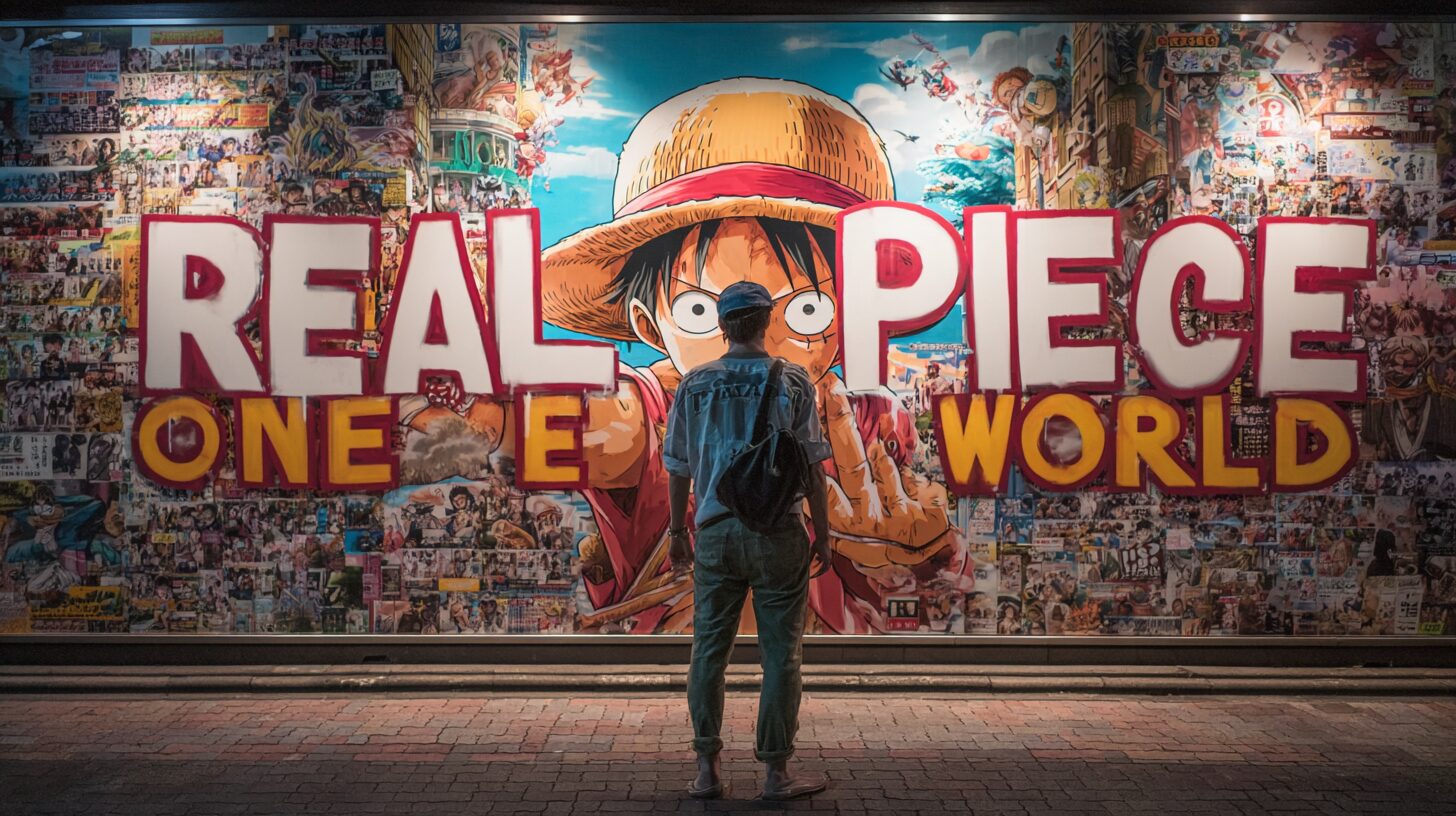

When Kumamoto was devastated by a pair of earthquakes in April 2016 — magnitude 6.5 followed by 7.3, killing 273 people and displacing tens of thousands — something unexpected happened. Eiichiro Oda, born and raised in the city, authorized the Straw Hat Pirates as official reconstruction ambassadors. Luffy’s face appeared on recovery posters across the prefecture with the words Kumamoto Rising (熊本復興). The murals followed soon after.
That decision transformed something already meaningful — one of the world’s most beloved manga creators comes from here — into something visible and permanent across the city’s streetscapes. Today Kumamoto and neighboring Nagasaki offer one of Japan’s most rewarding anime pilgrimage circuits: Kumamoto for the Straw Hat murals, recovery monuments, and the city Oda grew up in; Nagasaki for the real-world inspirations behind the series’ world-building, including Dejima’s direct influence on Sabaody Archipelago and Hashima Island’s connection to Punk Hazard.

Kumamoto: Oda’s Hometown
Eiichiro Oda was born in Kumamoto City in 1975 and grew up here before moving to Tokyo to begin his manga career. The connection between creator and hometown is well documented — Oda has spoken publicly about Kumamoto’s landscapes, its castle, and its distinct character influencing One Piece’s geographical imagination. The Wano Country arc (ワノ国編), with its feudal Japanese aesthetics and river-mountain geography, draws particularly heavily on Kyushu visual memory.
Kumamoto City is accessible from Fukuoka (博多) by Kyushu Shinkansen in 34 minutes (approximately ¥4,580 unreserved). From Osaka, the full journey takes about 2 hours 15 minutes. From Tokyo, the Shinkansen combination to Hakata and then Kyushu Shinkansen south takes approximately 5 hours and is fully covered by the national JR Pass.
The Straw Hat Murals — Kumamoto’s Living Recovery Map


The most distinctive One Piece experience in Kumamoto is the series of large-scale Straw Hat Crew murals installed across the city as part of the post-earthquake recovery project. Each mural features a different crew member — Luffy, Zoro, Nami, Usopp, Sanji, Chopper, Robin, Franky, Brook, and Jinbe — and the locations were chosen deliberately around the hardest-hit neighborhoods and the buildings that were rebuilt first.
A printed mural map is available free at the Kumamoto City Tourism Information Center (熊本市観光情報センター) inside Kumamoto Station. The full circuit covers roughly 15 kilometers and is best completed by bicycle — rental bikes are available at the station from ¥300 per hour. Dedicated fans typically complete the full mural map in one day; allowing two days means you can linger at each site and explore the surrounding neighborhoods, many of which have visibly transformed since 2016.
The Luffy mural near Kamitori shopping arcade (上通商店街) is the most photographed — a full-building installation that served as the visual anchor for the recovery campaign. The surrounding area has recovered significantly and is now one of Kumamoto’s most vibrant commercial stretches, with local restaurants and izakayas filling the rebuilt ground floors.
Kumamoto Castle — Recovery as Monument
Kumamoto Castle (熊本城) was severely damaged in the 2016 earthquakes — stone walls collapsed, turrets fell, and the main keep was structurally compromised. The decade-long restoration project became a physical embodiment of the prefecture’s recovery, and the castle in 2026 stands as something more layered than the typical historic site: you can see clearly what was destroyed and what has been rebuilt, the seams still visible in some sections of stonework.
The main keep (天守閣) completed its restoration in 2021. Entry ¥800 for adults. Open 9am to 5pm daily, last entry 4:30pm. The castle grounds are extensive — allow two to three hours for the full circuit. From Kumamoto Station, the Kumamoto City Loop Bus (しろめぐりん) runs directly to the castle for ¥150. The surrounding Sakuranobaba Josaien (桜の馬場 城彩苑) shopping complex offers Kumamoto’s regional specialties: spicy lotus root (辛子れんこん), raw horse meat (馬刺し), and Kumamoto ramen.
Greenland Amusement Park — One Piece Zone


Greenland (グリーンランド) in Arao City (荒尾市), northern Kumamoto Prefecture, hosts a dedicated One Piece Zone — one of the most comprehensive One Piece themed areas in Japan outside of Universal Studios Japan. The zone includes life-size reproductions of the Going Merry and Thousand Sunny ships, character statue installations throughout the grounds, themed rides, and limited merchandise available only at this location.
Park entry ¥1,500 for adults (rides require additional tickets). From Kumamoto Station, take the Kagoshima Main Line (鹿児島本線) to Arao Station (荒尾駅) — approximately 40 minutes, ¥860. A shuttle bus runs from the station to the park entrance. Open daily during peak season; check the official Greenland website for 2026 operating calendar as hours vary significantly by season.
Nagasaki — Where the World-Building Began

Nagasaki’s connection to One Piece is less biographical than Kumamoto’s but arguably more architecturally embedded. The city was Japan’s only open port to the outside world for over 200 years during the Edo Period, and the concentrated cosmopolitanism of that arrangement — Dutch merchants at Dejima, Chinese traders in the Chinatown district, a city that developed its own hybrid visual culture — is directly reflected in the geography and narrative architecture of One Piece’s world.
Nagasaki is reachable from Kumamoto via Hakata by Kyushu Shinkansen, then continuing to Nagasaki by limited express — total journey approximately 2 hours. The Nishi Kyushu Shinkansen (西九州新幹線), which opened in September 2022, connects Nagasaki to Takeo-Onsen (武雄温泉) in 23 minutes, reducing overall travel time from western Kyushu significantly.
Dejima — The Blueprint for Sabaody Archipelago
Dejima (出島) was a small fan-shaped artificial island in Nagasaki Bay where Dutch East India Company traders were confined during Japan’s sakoku period of national isolation. As the sole official point of contact between Japan and the Western world for two centuries, Dejima became the pressurized interface zone where foreign culture, technology, and ideas entered Japan under controlled conditions.
Oda has referenced Dejima as a direct inspiration for Sabaody Archipelago (シャボンディ諸島), the coastal gathering point at the edge of the New World in the series. The structural logic of the location — a controlled interface zone at the boundary between two worlds, where different powers negotiate access — maps precisely onto Sabaody’s narrative function in the story.
The reconstructed Dejima site (出島和蘭商館跡) in central Nagasaki has restored period buildings, Dutch-style gardens, and museum displays about the trade relationship. Entry ¥520 for adults. Open 8am to 9pm daily. From Nagasaki Station, take the Nagasaki Electric Tramway (長崎電気軌道) to Dejima-machi stop — 10 minutes, ¥130.
Hashima Island (Gunkanjima) — Punk Hazard’s Visual Source
Hashima Island (端島), universally known as Gunkanjima (軍艦島, Battleship Island) for its silhouette on the horizon, is a decommissioned coal-mining island 15 kilometers off the Nagasaki coast. Abandoned since 1974 when the coal reserves ran out, it has been left exactly as it was — crumbling concrete residential towers, rusting industrial infrastructure, vegetation forcing through former hallways — and was designated a UNESCO World Heritage Site in 2015.
The island’s visual character — industrial ruins on an isolated rock surrounded by open sea, accessible only through controlled authorization — directly informed the design of Punk Hazard (パンクハザード), the experimental island arc. The specific combination of decayed industrial architecture, absolute isolation, and the sense of a catastrophic past is reproduced faithfully in the arc’s establishing shots.
Gunkanjima cruises depart from Nagasaki Port Terminal 2. Several licensed operators run tours; Gunkanjima Concierge (軍艦島コンシェルジュ) offers detailed English commentary. Cruise and landing tours cost approximately ¥4,000 to ¥5,500 and last 2.5 to 3.5 hours. Landing is weather-dependent and is canceled approximately 40% of the time in winter months — book as early in your stay as possible to allow for weather cancellation and rebooking. Reserve online in advance during peak season as tours fill quickly.
Planning the Two-City Pilgrimage Itinerary
A five-day itinerary covers both cities without rushing. Days 1 to 3 in Kumamoto: castle and recovery area on Day 1, the full mural circuit by bicycle on Day 2, Greenland amusement park on Day 3. Days 4 to 5 in Nagasaki: Dejima and Chinatown on Day 4, Gunkanjima cruise booked for the morning of Day 5 (early booking allows rebooking if the weather cancels the first attempt).
The JR Pass covers the Kyushu Shinkansen between Kumamoto and Hakata. The Nishi Kyushu Shinkansen segment to Nagasaki is also JR Pass eligible. For a Kyushu-focused trip, the regional Kyushu Rail Pass (all-Kyushu, 5 days, approximately ¥20,000) is worth comparing against the national JR Pass — it covers more efficient routing within the island and is significantly cheaper if Kyushu is the sole destination.